



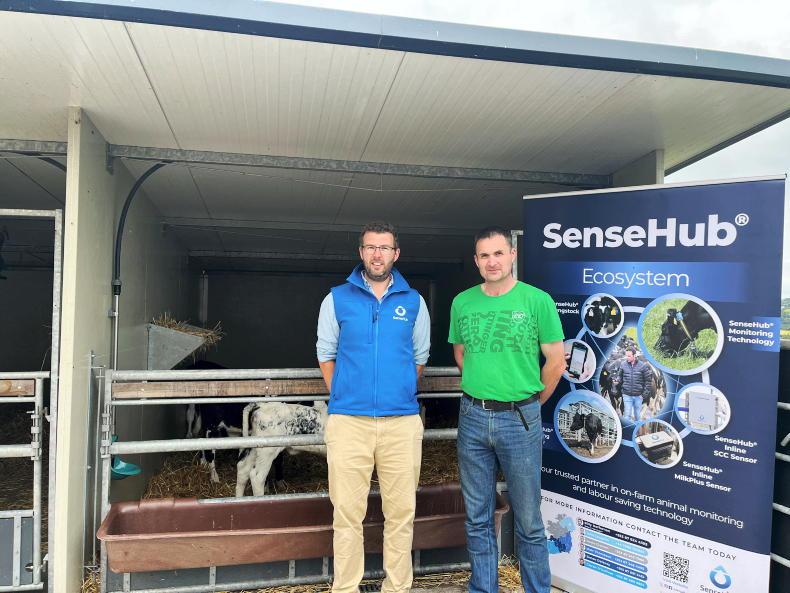
Ballygawley dairy farmer Mark Rea is improving the genetic gain in his herd, with the use of fertility monitoring technology.
The 140ac grassland unit supports 90 purebred British Friesian cows. There is a 90ac milking platform and an additional 50ac outfarm is used for young stock and silage.
Cows yield 6,600l at 4.3% butterfat and 3.4% protein. Total concentrate input per cow is two tonnes, giving a milk from forage of around 2,200l/cow.
At a farm walk last week, Mark outlined how the livestock monitoring system SenseHub plays a key role in improving cow fertility and herd health.
With grant aid from the Farm Business Improvement Scheme, Mark secured funding for the new technology in spring 2023.
Fertility
Herd fertility on the Rea farm is excellent with an average calving interval of 370 days and a current replacement rate of 18%.
Breeding within the herd had previously relied on stock bulls only, as Mark worked off farm full-time until 2019 and has been part-time since then. Heat detection was therefore an issue on the farm and the use of AI wasn’t reliable.
“The first year we used SenseHub alongside the stock bulls to give confidence in the system. It showed cows in heat but in some cases, there were cows showing no signs of heat, or little to no bull activity when they came in for milking,” Mark explained.
“When the herd was scanned everything matched up to the SenseHub dates. It gave me confidence in it, so when cows were housed in autumn 2023, we started inseminating,” he said.
Mark carries out the task of inseminating cows with over half the herd AI’d during the winter before a Holstein stock bull is introduced at turnout in the spring.
All services are based on natural heats, which are picked up through the SenseHub system. Cows wear neck collars that transmit to a receiver unit, which then sends notifications to a smart phone.
Technology
The technology works by monitoring 10 behaviour traits, such as feeding, rumination and activity levels. These traits are constantly measured with a real time update every 20 minutes. Each update is benchmarked against a 10-day average for each animal to flag up any change in behaviour.
“Heat detection with SenseHub is presented in a traffic light system via the app, whereby a green zone means cows are cycling and ready to be served,” explained John Graham from MSD.
To reach a target milk production of 7,500 litres, Mark has started to introduce Holstein genetics into the breeding policy. A team of AI bulls have been selected on +400kg for milk solids and +10kg protein.
The average cow size within the Rea herd is currently around 580kg and Mark is happy for this to increase with the introduction of Holstein genetics to around 650kg.
Calf rearing
Calves on the Rea farm are reared on six litres of a 24% protein skim-based milk replacer for up to 70 days, with ad lib access to a high protein heifer developer pellet.
Calves are group housed in open-sided calf accommodation, which was designed by Cheshire-based firm The Calf Company.
The “optimum climate calf barn” was built on the farm three years ago. The calf bays are separated by 52mm reinforced plastic walls and each pen measures 3m by 5m.
The rear height of the calf pens is 2m, running to 2.5m at the front with a 1m overhang.
“The calf housing will hold up to 10 calves per pen under quality assurance standards, but we find six is the optimum number,” Mark said.
This is the first year the SenseHub calf health monitoring tag has been use on the Rea family farm.
The idea is to monitor calves 24-7 to pick up any signs of ill health before clinical signs are visible.
Warm weather causes cell count to rise
Somatic cell count (SCC) readings in bulk milk samples have been an issue on local farms in recent weeks, according to Niall McCarron from Lakeland Dairies.
This has been put down to high nighttime temperatures providing an ideal environment for bacteria to grow and an increase in fly numbers causing cross-contamination.
McCarron said SCC average results for the dairy co-op have risen from around 200,000 to over 240,000.
“Research shows you are losing two litres per cow if SCC is over 250,000 on a bulk sample. Based on a 305-day lactation, this is a potential reduction of 610l/cow. At current milk prices, it is a loss of £250 per cow,” he said.



SHARING OPTIONS