



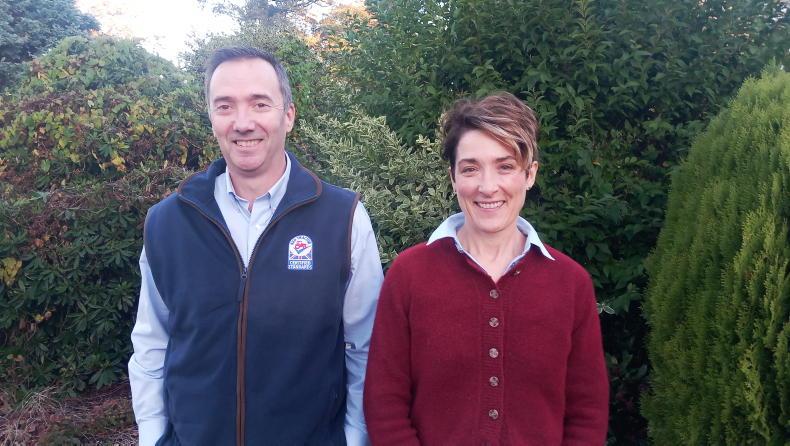
The requirements under Red Tractor quality assurance schemes have been reviewed, with the aim of making the farm audit process more streamlined.
The rules for the UK-wide dairy scheme, as well as the beef and lamb scheme in England, were initially revised by the committees that set scheme standards.
This includes the 18-member dairy technical advisory committee which is made up of representatives from UK farming unions, dairy processors, and retailers.
“We have gone through every single line of those standards over the last year. We have spent over 1,000 hours collectively going through this. It has been painstaking,” said committee chair Amy Jackson.
According to Red Tractor, the number of requirements under the UK-wide dairy scheme has reduced by a quarter, with the English beef and lamb scheme requirements down by a third.
However, Jackson points out that this has mainly been achieved by cutting out areas of overlap and repetition from the lengthy scheme standard.
I will hold my hands up and say we haven’t been able to turf out loads of stuff
“All in all, it has been made much more streamlined. I will hold my hands up and say we haven’t been able to turf out loads of stuff because a lot of it has stayed relevant.
“But we have been able to get rid of duplication and we have removed some points that have become outdated or superseded,” Jackson said.
The revised standards are currently open to a farmer consultation, where scheme participants can give feedback on the proposed changes before they take effect next year.
The chief executive of Red Tractor, Paul McLaughlin, said the review exercise has been about justifying the need for every requirement within the scheme standard.
“What farmers will be required to do from an outcome point of view hasn’t changed very much, but the audit process has changed quite a bit. It should reduce inspection times,” he said.
Technology
McLaughlin said Red Tractor also want to make better use of technology to help speed up the audit process.
In particular, he said the existing online portal for uploading documents is to be made “more intelligent” so that paperwork can be submitted at any time and any issues will be flagged before an audit.
“It means when the assessor comes up the farm lane, they are not spending two hours at the kitchen table going through paperwork.
“If you can upload records to the online portal throughout the year, there shouldn’t be a massive pile of paper-based records to sort out before each audit,” McLaughlin said.
Paul McLaughlin, who was appointed Red Tractor chief executive in May 2026, wants the organisation to improve its engagement with farmers on the ground.
Red Tractor has had a turbulent few years, stemming from a farmer backlash in late 2023 when an environmental module was planned amid limited consultation with scheme participants.
The plans were subsequently dropped and comprehensive reviews were carried out into the governance of Red Tractor and the role of farm quality assurance schemes in general.
“It is fair to say that farmers felt Red Tractor had moved a bit away from them over the last few years,” McLaughlin said in an interview with the Irish Farmers Journal.
“The farm assurance review highlighted some areas where change could happen and the organisation has been doing quite a lot of that recently. I have tried to accelerate that,” he said.
Farmer engagement is an area that McLaughlin wants to focus on and it explains why Red Tractor held a series of meetings with scheme participants in NI earlier this week.
“We want to be more visible and go to things that farmers are at. We are not here to tell you what Red Tractor is about. It is about listening and trying to understand farmers’ issues and concerns,” McLaughlin said.
He said the current consultation with farmers about revising scheme standards also stems from both the quality assurance reviews and feedback from scheme participants.
“We have been looking at the audit burden and we are trying to make things more effective and more efficient,” he said.
Whilst acknowledging that quality assurance audits can feel burdensome, Paul McLaughlin maintains that the process means farmers are actually faced with fewer inspections.
“A lot of the things that are being assessed are legal requirements that as a farmer you need to do anyway,” he said.
McLaughlin gives the example of veterinary medicine records and points out that farmers are required by law to keep an up-to-date medicine book.
He also highlights that retailers and processors are legally required to ensure their supply chains comply with food safety and traceability laws.
His point is that farmers could face even more individual inspections if all-encompassing quality assurance audits were not carried out by the likes of Red Tractor.
But ultimately a key reason for these schemes is to reassure consumers and to give UK producers a market premium above lower standard alternatives.
“We were set up 26 years ago after BSE when confidence in British food was on the floor.
“Red Tractor was brought in by the farming unions to restore confidence among consumers.
“Today, it gives us a point of difference so we can say ‘our standards are different’. It’s a great message to be able to give to consumers,” McLaughlin said.





SHARING OPTIONS