


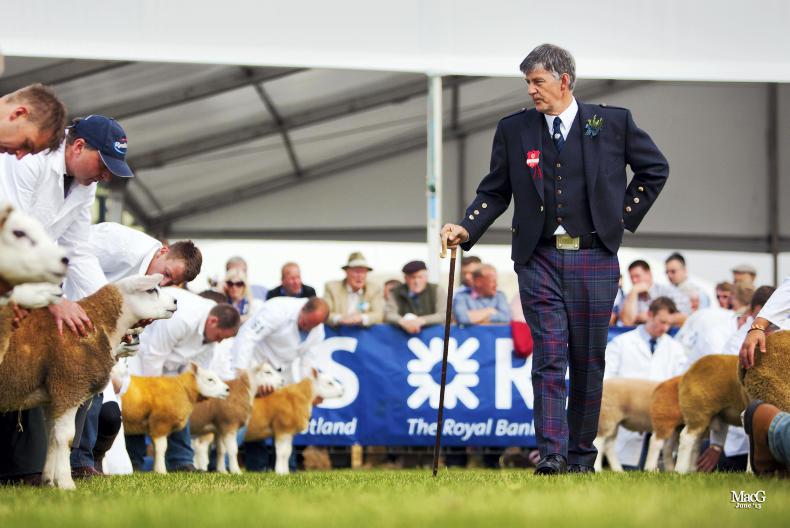
What started off as my hobby in 1980 has evolved to be the mainstay of our farm today, something I am very proud of,” according to Gordon Gray of Ettrick Texels fame. “It isn’t often in life that something that brings so much enjoyment can also be at the core of a family business.”
Gordon and Christine Gray, with their son David, run Sunnycroft Farm, an all-grass owner-occupied 165ac farm situated on the outskirts of Selkirk in the Scottish Borders, which rises from 500ft to 900ft above sea level.
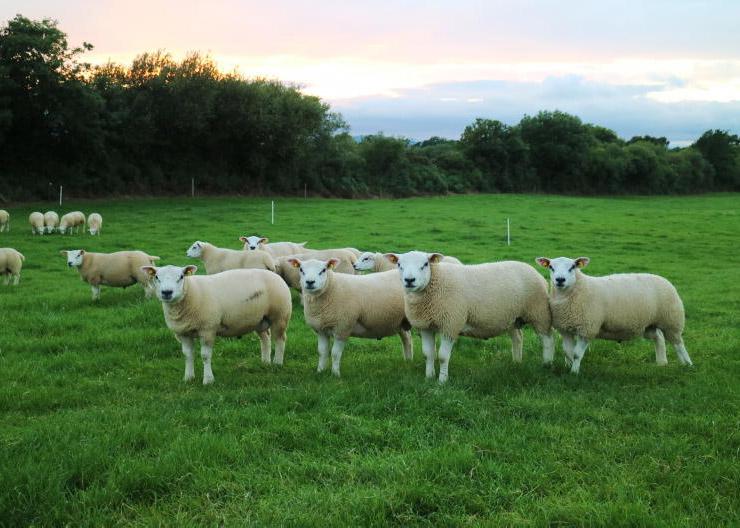
A further 250ac is rented locally to help facilitate what can only be described as an impressive enterprise. Stocking comprises of 100 pedigree Texel ewes, 100 pedigree ewe hoggets, 35 tup hoggets, 200 MV-accredited crossbred ewes (some of which are used as recipients for ET work in the pedigree flock), 450 crossbred commercial ewes and 100 dry hogget ewes for replacements.
A herd of 20 pedigree Aberdeen Angus cows plus followers is also run, along with 100 store cattle grazed annually on the rented ground.
As if this wasn’t enough, David operates a scanning service in the Borders area, scanning 100,000 ewes and 7,000 cows annually. His fiancée Claire also runs a pig, dog and cow scanning service.
Flock history
The flock has come a long way and was no overnight success, explains Gordon. He has always strived to follow breeding lines and has reaped the rewards.
“The flock was established in 1980 under the original prefix of Hillridge, which was then our family farm. However, when we relocated to the Ettrick Valley in 1990, I decided it was more appropriate to rename the flock. It seems to be on an upward curve since then.
“The flock was founded originally on my late father-in-law Andrew Barr’s Heathery Hall flock, which contained many of the original top blood lines of that era.
“Andrew was one of the six pioneers who imported the breed into the UK in 1974. The flock increased whenever the opportunity arose, buying from the top flocks at the time, often looking to see what families were breeding best, and whenever a dispersal sale occurred we would buy into that line.
“To me, female families are the most important and so it has proven over the years, when we have retained a ram for our own use.”
Ram purchases
Gordon then began to talk through the different sires purchased through the years, showing an astonishing memory of each sire, which can only be down to his passion for the breed.
This passion saw Gordon perform the roles of both president and chair of the British Texel Society, which he says “brought great personal satisfaction”.
Gordon has always put emphasis on purchasing the best rams he could for his flock, mostly in partnership with others, allowing stronger buying power.
“Price paid bears little resemblance to their performance. However, we have been fortunate in that our largest outlays have, on the whole, paid dividends,” he explained.
He began with his first major purchase in 1993, when he bought a quarter-share of the 17,000gns Tinwald Yorkie. Gordon explained how Yorkie propelled the flock into the premier league.
“His sons and daughters put us on the map, and a third share of a son, Ettrick Ace, was retained, who also contributed to the flock’s early success.”
The next notable sire Gordon added to the flock was the fairly modestly priced Knock Firefly at 4,200gns.
“His first crop of lambs peaked at 16,000gns for Glenmorangie, who then went on to sire the then-record priced Texel, the 50,000gns Craighead Hercules.
“His daughters were to become very influential in the flock and the beginning of our female sales with surplus gimmers sold to a top of 13,000gns in 2001 and 8,500gns in 2000. These ewes went on to produce sons at 26,000gns and 10,000gns for their new owners.
“A Hercules son, Crookholm Impressario, was the next sire to make a big impact in the flock, and indeed the breed itself. Impressario was purchased for 9,000gns and his first crop of lambs included the 36,000gns Ettrick Jackpot, who continued to grow our name when he sired the 110,000gns Newhill Major.
“We retained semen from Jackpot and used it very successfully to breed, among others, the 13,000gns Ettrick Mighty Mouse, who, in turn, is the maternal grandsire of last year’s 60,000gns purchase Clinerty Yuga Khan.”
The flock made a major investment in 2004 with joint purchases of Baltier King at 52,000gns and the 28,000gns Castlecairn Kung Foo Fighter.
Gordon carries high regard for these two sires: “King’s females proved tremendously milky and fleshy and he produced the first-prizewinning ram lamb at 2005 RHAS, namely Lion King.
“Kung Foo Fighter, on the other hand, has established one of our best breeding lines to date.”
Then came the first megastar Knock Papoose, who arrived at what proved to be a bargain 3,800gns. Gordon points out how Papoose proved to be a game-changer for the flock.
“His females proved standouts, with many show winners from those retained, as well as females sold to 26,000gns and 10,000gns, along with numerous other high-priced lots.
“His sons sold to a top of 10,500gns in the shape of Rainbow Warrior, of whom we retained a quarter share.
“He was also the sire of the first-prizewinning ewe lamb and reserve female champion at the RHAS in 2011, who we later sold privately for a five-figure sum, which by far superseded the breed record auction price for a ewe lamb at that time.”
Northern Irish-bred Foyleview Superstar was then purchased in 2011 by the Gray family, this time for 46,000gns.
“His daughters sold by us topped at 19,000gns and 14,000gns. Ettrick Sir Allan was also retained that year; he was a maternal brother to Rainbow Warrior.
“Sir Allan was a tremendous female breeder, with numerous top-priced sales, peaking at 11,000gns, as well as many show prizewinners.”
The exciting Sportmans Unimog was purchased in 2013 and sired the 10,000gns Ettrick Van Gough and retained son Vagabond, as well as daughters sold for 6,500gns and 6,000gns.
The Grays followed this in 2015 with the purchase of Shannagh Won-o-Won at the Irish premier sale from the Wilson family in Co Donegal.
Both Gordon and David have been very impressed with the Shannagh ram and say they will be back again to look for further sires in Ireland: “Won-o-Won sired lambs to 14,000gns for David’s Tima flock in 2016 and his daughters proved a big hit at our recent select seven sale where the top two sold for 10,000gns and 7,500gns.”
The latest purchase at Ettrick came in the form of 60,000gns Clinerty Yuga Khan, a joint purchase at Lanark 2016.
He has bred exceptionally well across all four flocks, producing a fantastic first crop of lambs, with his top 12 sons averaging over £7,000 each.
This year’s two purchases, 17,000gns Usk Vale Albatross and Hartside All Star, are both out of their respective flock’s best ewes. Gordon and David are excited as to what these two rams will breed.
Performance
While the Grays do not focus entirely on high EBVs when purchasing rams, they always take them into consideration when making their final choice and have found in the past many of the traits they look for are mainly found in the high index sheep.
David explained: “The average EBV for all our Texel ewe hoggets retained this year is in the top 5% of the breed, with 25% of them being in the top 1%.
“These EBVs are definitely of benefit when we sell our stock south of the border and have also proved to have a very positive effect on the sale of our shearling rams at Kelso.”
Last year’s 60,000gns purchase Clinterty Yuga Khan and his brother Yankee Doodle (whom they also purchased) are safely in the top 1% of the breed for EBVs.
Showing
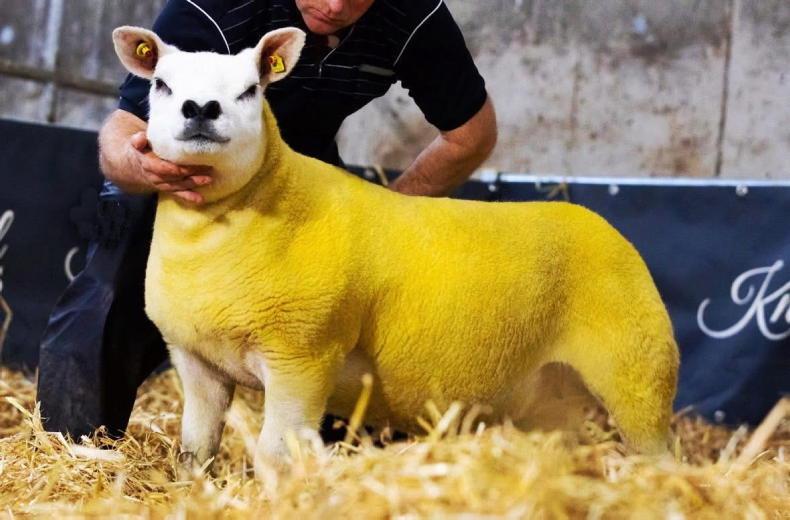
The Ettrick name is renowned throughout show rings in the Texel world, winning the Royal Show twice and reserve champion at the Great Yorkshire Show in 2014, as well as being part of the champion interbreed pairs and female champion in 2015.
Gordon and David are very proud of this fantastic achievement and Gordon has judged at all the major Texel shows and sales in the UK, as well as the French National.
“We seem to have struck a good balance between EBV attributes and phenotype, as we have enjoyed a considerable amount of success in the show ring in past years.
“We have won most of the classes at one time or another at the RHAS and GYS. On a more local note, we have won the Scottish Texel Club show points trophy in five of the eight years it has been contested.
“This year, we won the overall championship at Carlisle ram sales and best group of three, all of which were Yuga Khan sons.”
Sales
“We are part of a group of eight who annually hold the select seven sale at Lanark Mart in December, which has now been running for over 20 years,” explained Gordon about their sales.
“We sell 20 in-lamb gimmers, having along the way achieved the second- and fifth-highest female price records at 26,000gns and 19,000gns.
“Other surplus females are also sold at the breed society sales at Lanark, Welshpool, Worcester, Carlisle and Builth Wells, where the championship and top price have been achieved over the years, peaking with the 14,000gns sale at Lanark in 2012.
“I have also recently been delighted to export males and females to Germany, Holland, France and Italy, as well as many annual sales to Ireland.”
Aberdeen Angus
The Aberdeen Angus herd was founded in 2003 with the purchase of four in-calf heifers from the Wedderlie herd. Since then, through the purchase of select bloodlines and the use of AI and embryo transfer, the Ettrick herd name is now well established among Angus breeders.
The herd has enjoyed a few notable successes in recent years, winning reserve overall champion at the famous Perth bull sales, along with champion and reserve titles at Carlisle.
Future
Gordon concluded with what he thinks the future will hold and a few wise words: “Who knows what will happen post-Brexit, but, often, when one door closes, another opens, so, like everyone else, we will just have to wait and see.
“We feel that on the relatively small acreage that we own, we have to try to specialise in the pedigree market.
“We will possibly see genomics play an increasing role in sheep breeding. However, there will never be any substitute for ‘kenning a guid beast when you see it’ (knowing a good beast when you see it). And remember, ‘it’s no’ what he hae, it’s what you dae wi what hae’ (it’s not what you have, it’s what you do with what you have).”



SHARING OPTIONS