


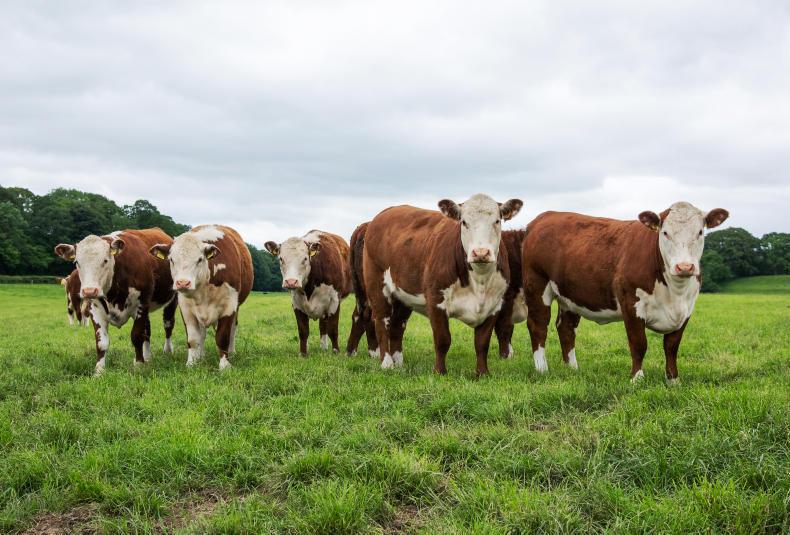
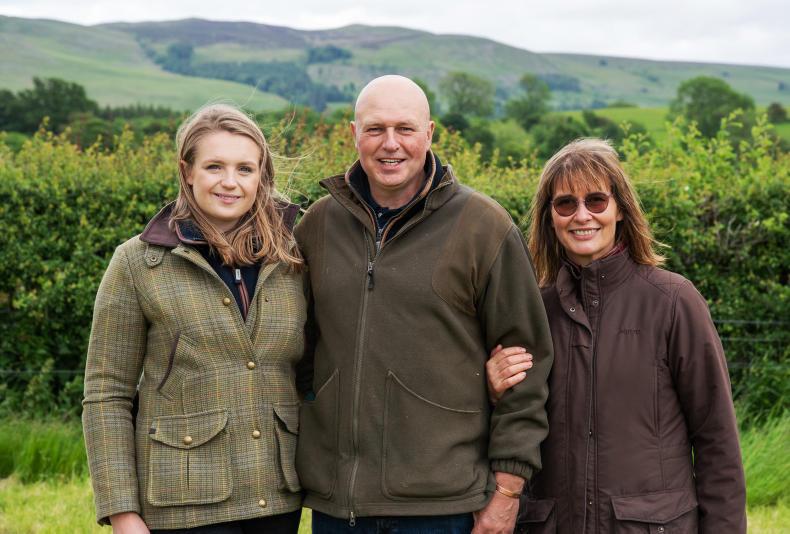
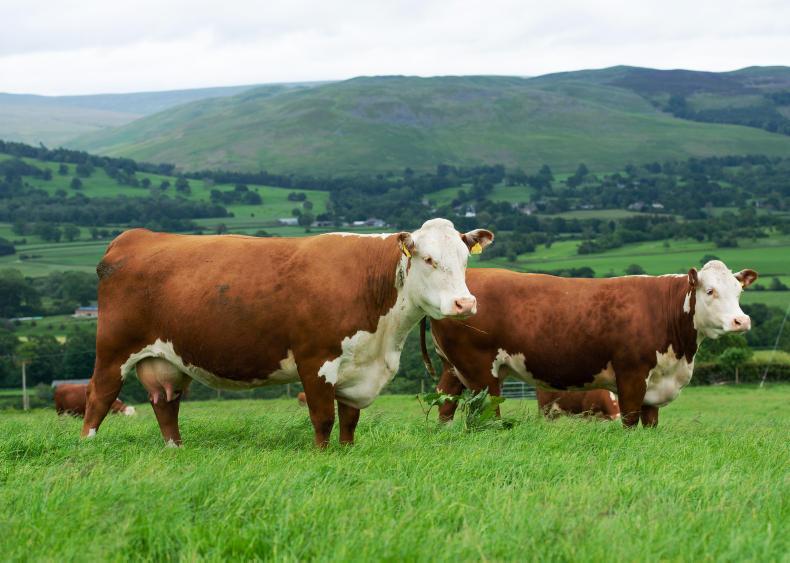
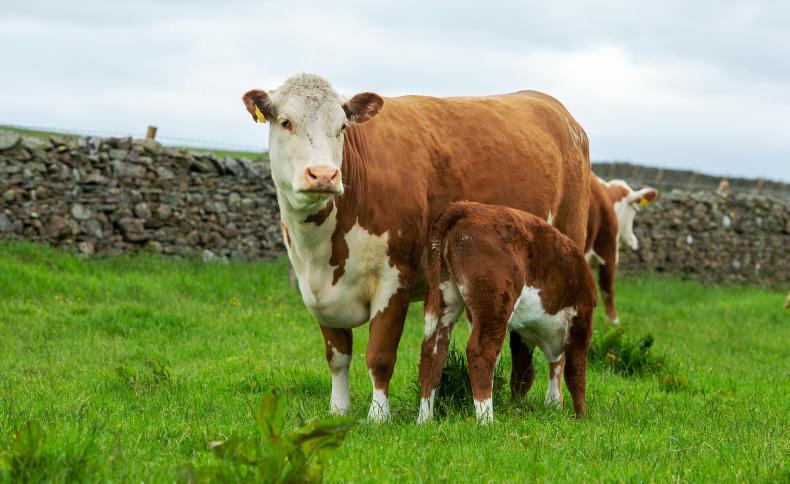
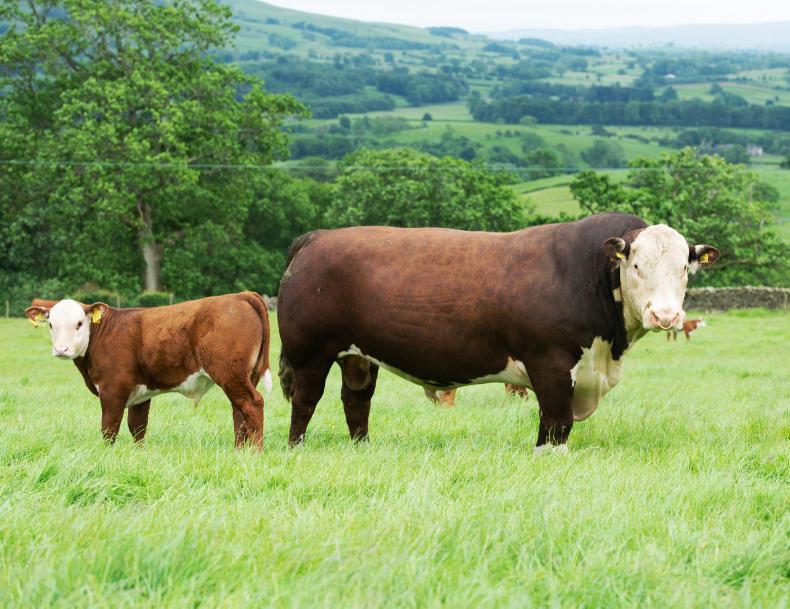
The Netherhall pedigree Hereford herd is based in southern Cumbria outside of the town Kirkby Lonsdale. Over the past five years, the Kelly family of David, Maggie and Harriet have changed from an all-continental setup to a majority traditional herd. This 900ac farm which is aiming to have 300 purebred Hereford cows in two years’ time was host to an open evening last week arranged by the UK Hereford cattle breeding society.
Originally a prominent name in Limousin and Belgian Blue circles, the Kellys changed their enterprise in search of a more simplistic system.
David said: “Ethically with the Belgian Blues and caesareans we thought public perception might change that eventually. We were then looking for another breed and we just decided we wanted a simple system and we wanted to do it off grass and try reduce costs as much as possible. The biggest cost now is we have to house them.”
Having looked at Herefords at UK shows, the family saw a lot of bigger, bonier types, which didn’t fit into their image of Herefords. However, on a holiday to New Zealand, and after visiting a few ranches they were advised that to see proper Herefords, Australia was the place to go.
After much research online, a call resulted in a fluke meeting with Australian Hereford breeder Ian Locke who was in England visiting his son in college. This prompted the purchase of a batch of 40 embryos from his Wirruna range.
“We liked what we got, but we wanted to go over and have a look properly. We’ve been over two or three times now. We go over, select a sire, Ian jumps them for us and we get semen over. When we went over first, we looked at the flushing cows, said we love that one, don’t like that one. Straight away he also learned we had a type, and he knew what type we liked. He flushes his best cows who have done well for three seasons. So to get into his flush programme, they have to have had two really good calves,” added David.
To try to reduce any chance of introducing disease into the herd, these embryos were implanted into crossbred heifers from the commercial herd then run by the Kellys. Only one main batch of animals was purchased by the family and these came from John Douglas’s Ervie herd in Scotland. The batch contained 30 heifers, 10 old cows and a stock bull which all descend from American L1 (line bred) Herefords. These genetics came primarily from Jack Holden, based in Montana, the next source the Kellys looked at. Having looked at some cows in America, another batch of embryos were imported.
Maggie said: “Also he had a sale. We were quite lucky. A heifer in the sale was from a really good family and he said he would put us in touch with somebody so we could buy a share and get some eggs. Anyway, the heifer was supposed to make 20 odd thousand. It didn’t, and the people had backed out. So we bought it at $7,000. The exchange rate at the time meant it was about £3,500, so Jack keeps the cow and we get 50% of its progeny. We sold one calf for $7,000 and we have a bull to go, so we actually made money which then covered flushing her and we ended up with 55 eggs by three different bulls.”
While that may have been a stroke of luck for the outfit, the conception achieved on-farm from these embryos is largely down to management at ground level. Over the six years, conception rates hit around the 70% mark, with the exception of last year’s crop, which only hit 50% due to the extreme heat. The Kellys now has about 120 embryo-bred calves on the farm.
“We have 140 purebreds calving and another 50 embryos on the ground this year. There are another 70 heifers to come in so next year we’ll be up to about 250 calving, with hopefully 300 to bull. We’ve gone for a moderate cow, not too big and we try stock them a lot higher. We think we can calve a lot more cows because we can stock them a lot harder because they are easier managed and calve that much easier,” David added.
Smaller stock
The herd now has cows which average between 650kg and 700kg, much smaller than the breed is used to, both in Ireland and the UK. All heifers are then bred to calve at 23 to 24 months of age with a bulling weight of 380-420kg.
David says that milk is a key selection point for all their animals. “Milk is a massive thing. There’s no substitute for it. We’re trying to wean calves at seven months at an average of 300kg, a bit more on the bulls maybe, a bit less on the heifers. We try to get them out as early as possible. Heifers were turned out on 18 March this year and they did fantastic.”
It was clear to see to all in attendance the beautiful bags of milk under each cow, and while the type might be smaller, they were consistent throughout. The other biggest difference in the type of cow bred by the Kellys compared to that of fellow UK pedigree breeders was the amount of bone they had.
“We are taking a lot of bone out of the carcase and that seems to be working,” said David.
The key drive was to keep the system as simple as possible; reduced bone benefits calving ease and the choice of the Hereford was to try keep inputs as low as possible. The only concentrates being fed on farm are during the weaning period and this is just to get them over the initial hurdle of weaning before being changed back to a silage diet. This regime is the same for both bulls and heifers and is coupled with a good paddock grazing system.
To maintain growth rates off a grass-based system, and to try to make marked improvements on carcase conformation, the new programme at Netherhall was keen to follow estimated breeding values (EBVs). In particular, three main traits were identified as key – birth weight, gestation length and rib eye.
Chasing calving traits along with carcase traits has so far seen the herd’s main markets being dairy. However, as time goes on this is changing. The herd has seen much more interest from the beef market, with a number of pedigree herds also expressing interest.
“We want growth as well, not silly growth but obviously if people are going to buy them for dairy or beef they want them to grow don’t they. We’re not chasing single traits. We’re trying to move a bit of everything.
“They’re weighed as soon as they’re born. We weigh any time they come in, and it just gives us more information on what they’re doing. Everything that can be scanned for, we do – eye muscle area, intramuscular fat, fat depth and scrotal size.
“We’re also concentrating on gestation, trying to get the length down for these dairy boys so that makes a big difference. We aim to get it into the range of 276-278 days, but we don’t want to compromise on the quality of the calf either.
“Last year we PRIDed and AI’d 73 cows and got 57 cows off that batch in the spring. Their due date was 7 April [283-day gestation] and by then they’d all calved bar three and some had calved a fortnight before but we were still getting mid-30kg to higher 30kg calves.”
A similar-type system is run with the heifers, blanket AI service following a synchronisation programme. While the herd aims to use slightly more stock bull in the future, the hope is still to maintain a high number of AI-bred calves to keep the gene pool wide enough to breed their own stock bulls.
Bull sales
The herd currently amounts to 140 purebred cows, with the aim to go to 300 in the next two years. With this number, David hopes to have in the region of 100 bulls to sell annually.
“The idea when we first started out was we’d be selling our bulls at two years, but there’s bulls you’ve seen that are 14 months and they’re sold. They’re so fertile, we cannot believe it. If you don’t feed them, they seem more fertile! We’re surprised with how well it’s gone. There are people coming picking out a bull younger, saying can we take that bull for a few heifers and it will be a good bull next year.”
Dairy beef
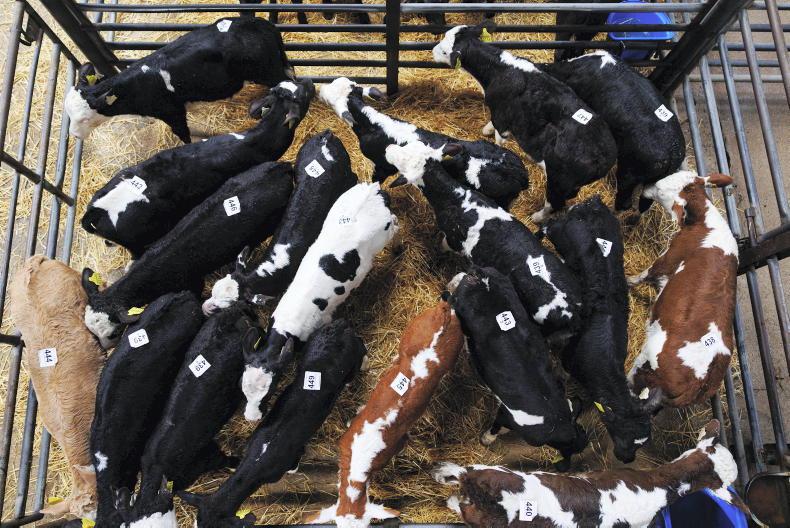
As a way of keeping in touch with what customers of Netherhall bulls are looking for, the herd this year started buying progeny from previous dairy customers. In total, the herd now runs 200 dairy beef calves on a separate holding to ensure herd health is maintained.
“Harriet is back full-time with us now from university so she’s looking after the calves. The concept of buying the calves back from people who buy your bulls is very good. We’re going to follow all our calves through to slaughter with Dunbia, see how they’re doing. Our own cattle we have killed with them to date have killed out really well, and are getting good grades so it will be interesting to see how they are doing when crossed with dairy cows. The aim is to finish at 20 months for steers, heifers might be a bit older.”
Due to the influx of outcross genetics, with figures and data collection to match, the herd has attracted much attention from AI centres both in the UK and Ireland. Cogent has purchased no fewer than four bulls for semen collection in the last two years. NCBC was also quick to purchase a bull, with Netherhall 1 Oz Daffy making his way to Irish soil a number of years ago. This bull was again used heavily in the dairy market, with nearly 3,000 calves registered to him to date.
“It’s working very well with AI centres. We’re asking them what they want and trying to breed what they want. We had sold Limousins and Belgian Blues to Cogent before, so we had a good relationship. Feedback overall has being great. Even looking back we’re seeing a lot of pedigree breeders using our bulls.”
The family are very open with invitations to see the herd as they believe only then will people appreciate what the type of cattle and the breed are all about. Looking forward, David sees a very bright future for the breed due to its adaptability across sectors.
“By inviting people we found perhaps people’s perception of Hereford was they didn’t realise what a Hereford was. But since they’ve seen them, long and milky cattle, its gone away and made people think.
“The Hereford is kind of understated as a crossing bull. I think it has a lot to offer other breeds by crossing. You can finish your stock a lot cheaper, which cuts cost of production. I think there’s a massive market for suckler-bred, grass-fed beef. I do think there’s a real premium product there. You want to be paid on quality. With Brexit and everything, and subsidies [under threat], it’s just the way forward.”



SHARING OPTIONS