


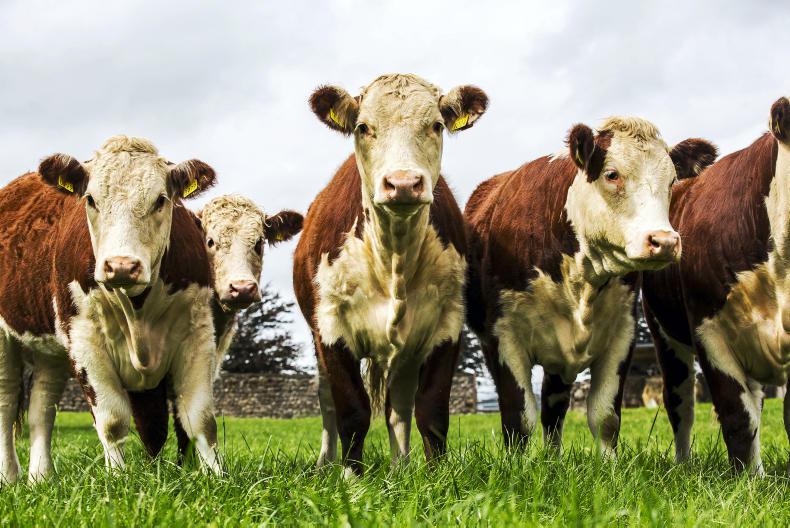
Outcross breeding
Outcrossing is the most straightforward of these breeding programmes – it is simply the mating of animals that are totally unrelated.
The primary drawback with outcrossing is that outcrossed individuals are less likely to transmit their own type to the offspring because of their more varied genetics.
Inbreeding
The term inbreeding refers to the mating of individuals that are more closely related than the breed average – such as sire to daughter, half-siblings, sire to granddaughter, etc.
Inbreeding can lock in desirable ancestry traits in a relatively fast time.
Inbreeding will also be more likely to pass on desirable traits their offspring and makes it easier to predict how an animal will turn out.
Some disadvantages of inbreeding include the risk of inheriting any undesirable characteristics the family line carries, while it also raises the chance of offspring inheriting recessive genes for an undesirable trait or genetic disorder.
Studies by Teagasc on dairy cattle have shown that even a 1% increase in inbreeding leads to a drop in most milk production and reproductive traits
Intense inbreeding may result in the loss of vigour in stock or inbreeding depression.
Inbreeding depression is the reduction in performance and viability due to reduced genetic variation.
With inbreeding depression, reproductive fitness tends to be affected more than performance traits.
Studies by Teagasc on dairy cattle have shown that even a 1% increase in inbreeding leads to a drop in most milk production and reproductive traits.
Most breeders will be familiar with the inbreeding coefficient. This is the standard measure for the level of inbreeding in an animal. It is used for determining just how close, genetically, certain animals are.
Sibling matings will have a coefficient of 25%, while half-sibling matings will carry a coefficient of 12.5%
It indicates the probability that genes are identical by descent. The technique assumes that there are two forms of a gene and that each form has an equal chance to be passed on to the next generation.
The vast majority of animals have an inbreeding coefficient of less than 10%. An animal mated to its own parent will have an coefficient of 25%.
Similarly, sibling matings will have a coefficient of 25%, while half-sibling matings will carry a coefficient of 12.5%
The higher the percentage, the greater the potential benefits and risks. Some consider the optimal coefficient across a given herd/flock to be 12.5%.
Such a level ensures consistency of type and kind, uniformity of animals, while also allowing for enough diversity to avoid inbred depression.
Line breeding
Line breeding is highly strategic inbreeding. You often hear the adage: “Line breeding is when it works – inbreeding is when it doesn’t.”
So why would you line breed?
The most common reason is to lock in desirable traits.
A certain level of inbreeding will reduce the amount of genetic diversity in the population, increasing the chances of passing on the positive traits we want to see in offspring.
It is also a way to preserve an exceptional animal’s influence through future generations.
For every generation that passes between the ancestor and the present, their influence is reduced by a half. To avoid this dilution, linebreeding takes advantage of the probability that genes from an exceptional ancestor will be kept going for an extra generation.
Line-bred animals also tend to produce more consistent offspring due to the smaller amount of genetic variation.
Linebreeding takes advantage of the probability that genes from an exceptional ancestor will be kept going for an extra generation.
Of course, linebreeding is not the answer to all questions when it comes to breeding and certainly should not be a goal.
However, if you’re fortunate enough to have top breeding stock, it can prove a very powerful and beneficial tool to maintain that standard in years to come.



SHARING OPTIONS