



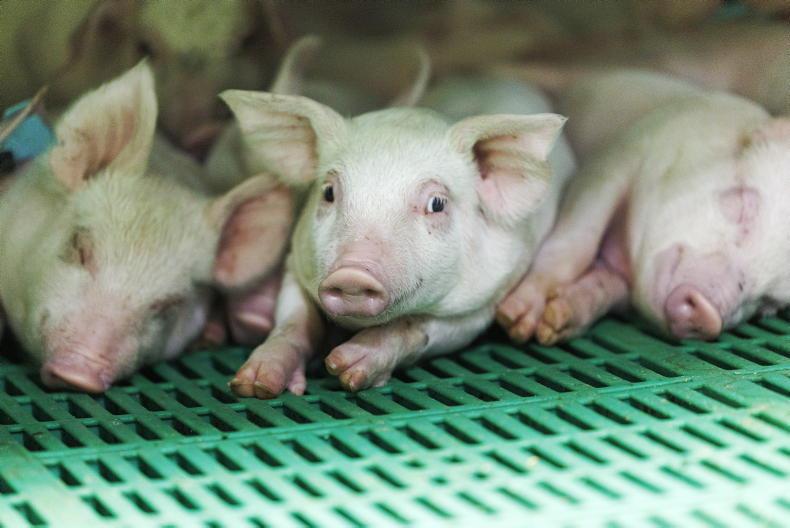
Pig farmers preparing to build over the coming years must bear updated EU-wide permitting rules in mind when setting out their plans, Teagasc pig development officer Gerard McCutcheon told Teagasc’s national pig conference in Cavan.
New requirements will await pig units carrying more than 350 livestock units across all pig categories, equivalent to an integrated farm of 118 sows taking all pigs to slaughter.
Previously, a pig farm would only have been included if it exceeded either threshold of 750 sows or 2,000 production pigs of 30kg or heavier at 0.3LU/head, meaning a unit with 700 sows and 1,800 pigs was excluded.
The rules come on the back of a review of the Industrial Emissions Directive approved at EU-level in 2024 which will see more pig farmers taken into the Environmental Protection Agency’s (EPA) permitting fold from 2032.
The rules are designed to minimise emissions to air, water and land, covering noise, water, electricity and inputs.
McCutcheon said ‘permitting’ or ‘registering’ look more like terms that will be used to describe the new system, rather than ‘licensing’ as it is expected the EPA will require a “lighter load of regulation or administration” for farmers impacted.
The pig conference heard the EPA is “not seeing these smaller farms coming in as serious threats, but by the same token, they are required by law to manage them and regulate them”.
“But even in the meantime, if you are thinking of putting in new housing, you should be looking at putting in houses that will show that they reduce the emissions of particularly ammonia and methane,” McCutcheon said.
He said the EPA’s approach to on-farm requirements of the changes appear so far “manageable” for farmers in that they will likely avoid the environmental reports costing between €20,000 and €50,000 currently.



SHARING OPTIONS