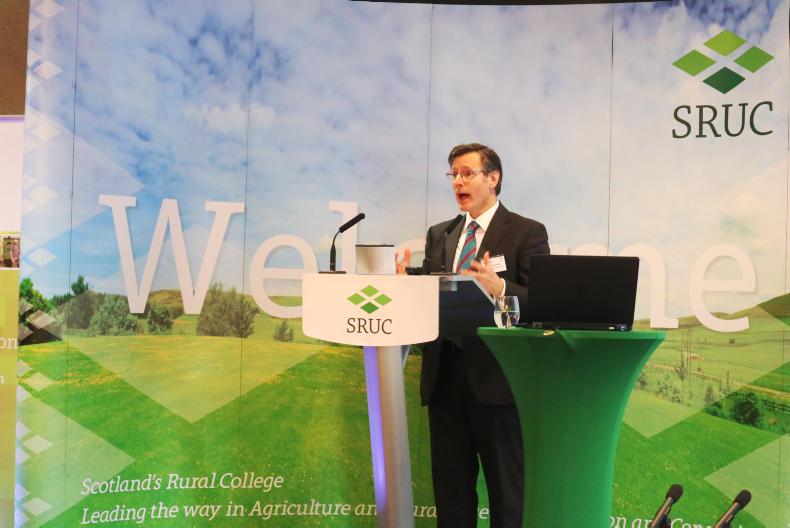
Scotland can have very different farming rules compared to the rest of the UK according to the Scottish Government’s National Advisor on Agriculture David Barnes. Speaking at this week’s SRUC and Teagasc joint conference on Brexit, Barnes used his speech to set out how Scotland could have much more autonomy than many people think. “I question the requirement for a high degree of uniformity for the UK to strike trade deals. That is not the case,” said the senior civil servant.
Barnes agreed that there would be some necessary common rules affecting farming but went onto to say that the Scottish Government believes most decisions should be devolved to Holyrood.
He described the assumption that we would have a strict common frame work as “the single-market way, we have been used to”, before going on to say we do not necessarily need a high degree of commonality in the UK. The Scottish Government will accept frameworks where they are necessary but not where they are only desirable.
The CAP has delivered on its social obligations but fell short on both economic and environmental measures according to Prof Ian Boyd, chief scientific advisor at the Department Of Environment, Food and Rural Affairs. Boyd pointed out that, on average, in farming we use 10 calories on fossil fuel for one calorie of food. He also explained that farmland bird species have fallen 54% since the 1970s whilst birds in non-farming areas have not seen a similar decline. He said that the CAP had failed the UK and if we continue to compromise on future farming rules we will end up with a similar failing plan.
“We need to reward outcomes not inputs,” was Boyd’s message to the room.
“Food production is a side issue when you read the Defra proposals,” said Steven Thomson, Agricultural Economist at SRUC during his presentation. Before going on to state that we need to avoid internal competitive advantage between different parts of the UK. He did stress. Before raising the concern that World Trade Organisation commitment could wipe out coupled payments.
Scotland can have very different farming rules compared to the rest of the UK according to the Scottish Government’s National Advisor on Agriculture David Barnes. Speaking at this week’s SRUC and Teagasc joint conference on Brexit, Barnes used his speech to set out how Scotland could have much more autonomy than many people think. “I question the requirement for a high degree of uniformity for the UK to strike trade deals. That is not the case,” said the senior civil servant.
Barnes agreed that there would be some necessary common rules affecting farming but went onto to say that the Scottish Government believes most decisions should be devolved to Holyrood.
He described the assumption that we would have a strict common frame work as “the single-market way, we have been used to”, before going on to say we do not necessarily need a high degree of commonality in the UK. The Scottish Government will accept frameworks where they are necessary but not where they are only desirable.
The CAP has delivered on its social obligations but fell short on both economic and environmental measures according to Prof Ian Boyd, chief scientific advisor at the Department Of Environment, Food and Rural Affairs. Boyd pointed out that, on average, in farming we use 10 calories on fossil fuel for one calorie of food. He also explained that farmland bird species have fallen 54% since the 1970s whilst birds in non-farming areas have not seen a similar decline. He said that the CAP had failed the UK and if we continue to compromise on future farming rules we will end up with a similar failing plan.
“We need to reward outcomes not inputs,” was Boyd’s message to the room.
“Food production is a side issue when you read the Defra proposals,” said Steven Thomson, Agricultural Economist at SRUC during his presentation. Before going on to state that we need to avoid internal competitive advantage between different parts of the UK. He did stress. Before raising the concern that World Trade Organisation commitment could wipe out coupled payments.






SHARING OPTIONS