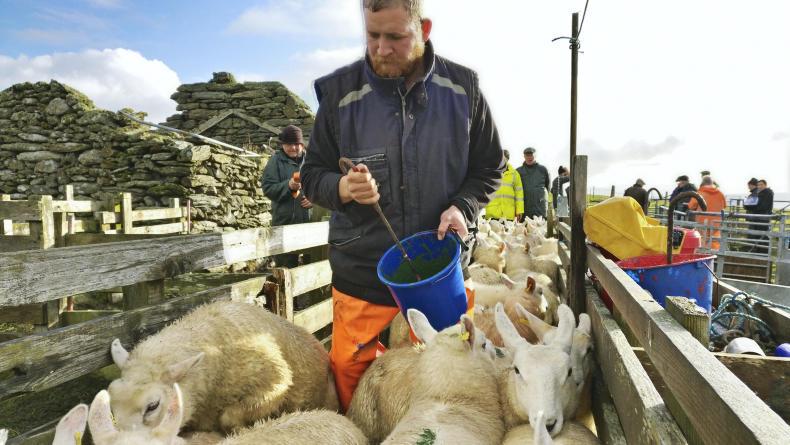
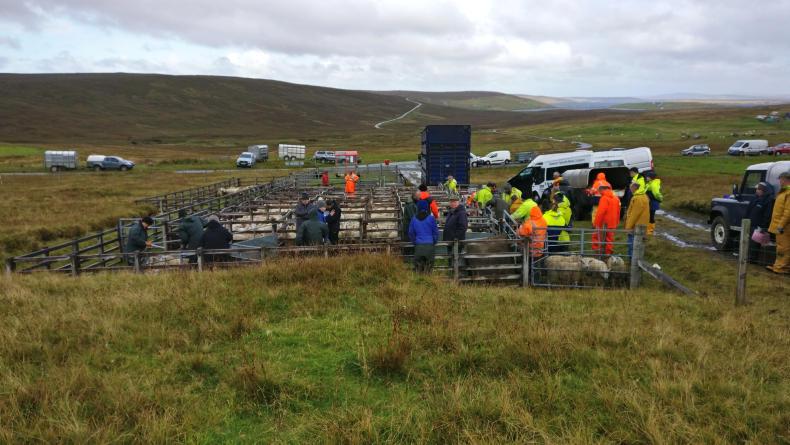
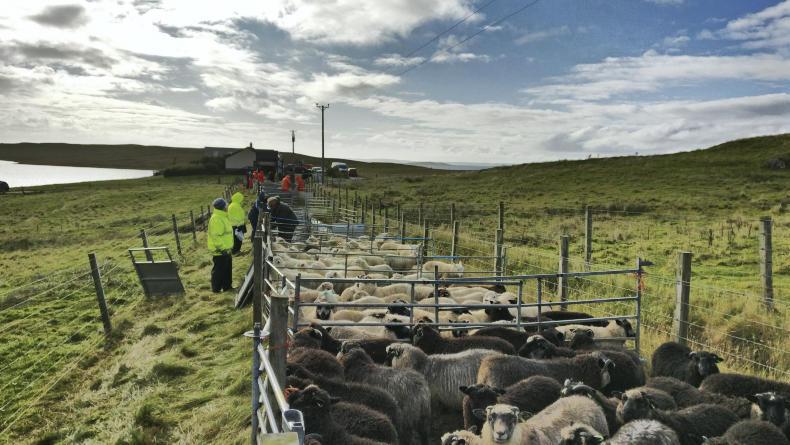
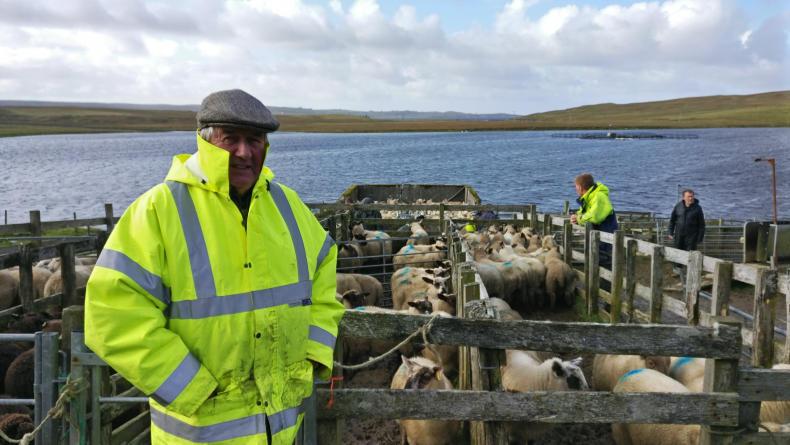
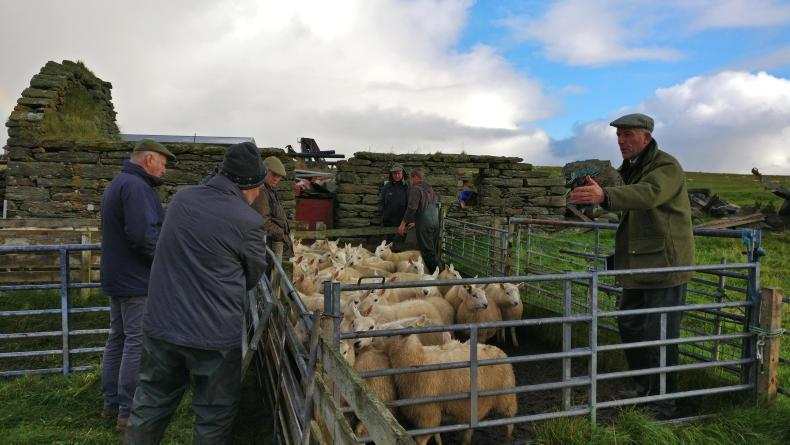
That’s a blue ‘L’ on that lot folks, a blue ‘L’. Now, fine lot of lambs here, 26 in the lot. Fine lambs, who’ll give me £45? We’ve a £40 over, £40 on bid ...” Went the rhythm of the Shetland sheep sales. Possibly the last on-farm sheep sales to be held in Britain. With a small number of mainland buyers, a growing number of Shetland sheep are being sent directly to Thainstone mart and with the looming threat of Brexit, there is no guarantee that on-farm sales will take place in 2018.

“It is a very historic way, I suppose 25 years ago that’s the way sheep were sold not only in Shetland, but in the Western Isles as well,” auctioneer Rod MacKenzie told Farmers Journal Scotland. “Largely they’ve stopped in those areas and Shetland would be one of the last places that carries on these farm-to-farm sales.”
Rod stands in the ring with the buyers and the sheep for the sales, taking bids from buyers from mainland Scotland, as well as the Shetland Livestock Marketing Group (SLMG) staff helping at the sales. The staff are usually buying either for their own crofts or to fill orders for other folk.

“The prices this year are quite steady, but I think the weather in Aberdeenshire and all over has caused them to slip a bit. Farmers are more worried about getting their harvest secured. A lot of them will take lambs later in the season.”

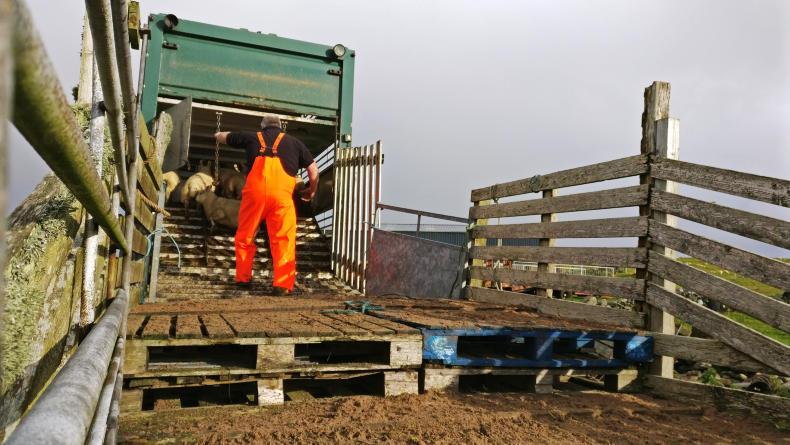
The difficulty with farming over 300 miles from mainland Scotland is that the sheep have to travel a long way to the main market. It costs £6/head to send them via ferry to Aberdeen. The chairman of SLMG estimates that 30,000 sheep or more are sold through the co-operative, despite the total number of lambs and ewes leaving Shetland being somewhere between 90,000 and 100,000.
“We would like to get more stock coming through the mart, we would encourage members and non-members to come with their lambs and cattle rather than shipping them to a mart on the mainland, or selling privately,” said Cecil Eunson, who farms on mainland Shetland, with over 1,000 sheep. He was recently elected as chair of the co-operative, which has approximately 250 members. It operates the mart and abattoir in Lerwick.
With some farmers in Shetland opting to send their sheep directly to Thainstone rather than through the mart in Lerwick, SLMG is encouraging more people to support local.
“If you send your lambs away and don’t see them sold you’ll get a ticket back and see what they’ve made,” said MacKenzie, who has his own croft near Inverness. “But I think if you can put a face to your livestock, be it sheep or cattle, it’s a great thing. You’re also doing something for the local economy.”
Some farmers believe that the lack of buyers in Shetland keeps prices down and that produce would get a better return elsewhere. But in his experience, MacKenzie says “all buyers of all livestock have decreased no matter where you are in the country. Time is one factor, there are less people on farms than there have been traditionally. A lot of people will phone the local buyer and say ‘get me a few hundred lambs’.”
 However, Brexit might be the final nail in the coffin for the on-farm sales. Lamb is the most exposed sector in the agricultural industry, with so much sheepmeat being exported to Europe.
“Brexit is meant to break in spring 2018, so a year on from now we’ll be selling lambs that will be fattened in 2019,” MacKenzie said. “It will be like walking in the dark with your eyes shut and blindfolds on, I think. There would need to be some sort of guarantee for people to buy. We don’t want prices to reach such a level that would put producers in these areas out of business. We want to keep sheep in these areas, it’s most important that people have a purpose for living here.”
He is adamant that even if this is the last year of on-farm sheep sales in Shetland, that Lerwick mart must be kept going in order to give people the option to see their stock being sold.
As far as the chairman of SLMG is convinced, the on-farm sales will go ahead next year if there is a demand for them.
“If there is demand for it and the numbers are high enough, then there’s no reason we won’t be back here next year. If we’re losing a lot of money on it we’ll have to reassess the situation,” Eunson said.

Read more
Creating a brand for Shetland lamb
That’s a blue ‘L’ on that lot folks, a blue ‘L’. Now, fine lot of lambs here, 26 in the lot. Fine lambs, who’ll give me £45? We’ve a £40 over, £40 on bid ...” Went the rhythm of the Shetland sheep sales. Possibly the last on-farm sheep sales to be held in Britain. With a small number of mainland buyers, a growing number of Shetland sheep are being sent directly to Thainstone mart and with the looming threat of Brexit, there is no guarantee that on-farm sales will take place in 2018.
“It is a very historic way, I suppose 25 years ago that’s the way sheep were sold not only in Shetland, but in the Western Isles as well,” auctioneer Rod MacKenzie told Farmers Journal Scotland. “Largely they’ve stopped in those areas and Shetland would be one of the last places that carries on these farm-to-farm sales.”
Rod stands in the ring with the buyers and the sheep for the sales, taking bids from buyers from mainland Scotland, as well as the Shetland Livestock Marketing Group (SLMG) staff helping at the sales. The staff are usually buying either for their own crofts or to fill orders for other folk.
“The prices this year are quite steady, but I think the weather in Aberdeenshire and all over has caused them to slip a bit. Farmers are more worried about getting their harvest secured. A lot of them will take lambs later in the season.”
The difficulty with farming over 300 miles from mainland Scotland is that the sheep have to travel a long way to the main market. It costs £6/head to send them via ferry to Aberdeen. The chairman of SLMG estimates that 30,000 sheep or more are sold through the co-operative, despite the total number of lambs and ewes leaving Shetland being somewhere between 90,000 and 100,000.
“We would like to get more stock coming through the mart, we would encourage members and non-members to come with their lambs and cattle rather than shipping them to a mart on the mainland, or selling privately,” said Cecil Eunson, who farms on mainland Shetland, with over 1,000 sheep. He was recently elected as chair of the co-operative, which has approximately 250 members. It operates the mart and abattoir in Lerwick.
With some farmers in Shetland opting to send their sheep directly to Thainstone rather than through the mart in Lerwick, SLMG is encouraging more people to support local.
“If you send your lambs away and don’t see them sold you’ll get a ticket back and see what they’ve made,” said MacKenzie, who has his own croft near Inverness. “But I think if you can put a face to your livestock, be it sheep or cattle, it’s a great thing. You’re also doing something for the local economy.”
Some farmers believe that the lack of buyers in Shetland keeps prices down and that produce would get a better return elsewhere. But in his experience, MacKenzie says “all buyers of all livestock have decreased no matter where you are in the country. Time is one factor, there are less people on farms than there have been traditionally. A lot of people will phone the local buyer and say ‘get me a few hundred lambs’.”
However, Brexit might be the final nail in the coffin for the on-farm sales. Lamb is the most exposed sector in the agricultural industry, with so much sheepmeat being exported to Europe.
“Brexit is meant to break in spring 2018, so a year on from now we’ll be selling lambs that will be fattened in 2019,” MacKenzie said. “It will be like walking in the dark with your eyes shut and blindfolds on, I think. There would need to be some sort of guarantee for people to buy. We don’t want prices to reach such a level that would put producers in these areas out of business. We want to keep sheep in these areas, it’s most important that people have a purpose for living here.”
He is adamant that even if this is the last year of on-farm sheep sales in Shetland, that Lerwick mart must be kept going in order to give people the option to see their stock being sold.
As far as the chairman of SLMG is convinced, the on-farm sales will go ahead next year if there is a demand for them.
“If there is demand for it and the numbers are high enough, then there’s no reason we won’t be back here next year. If we’re losing a lot of money on it we’ll have to reassess the situation,” Eunson said.
Read more
Creating a brand for Shetland lamb






SHARING OPTIONS