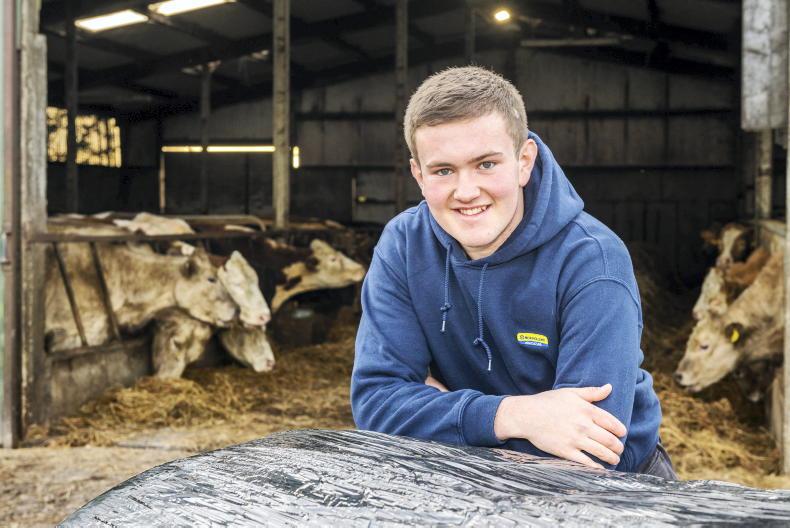
Sixteen-year-old Stephen Hurley on his farm in Schull. \ Andy Gibson.
ADVERTISEMENT
I farm: “With my grandad Mackie and uncle Alan Hurley. I try get to the farm after school and I work there most Saturdays. The farm has 92 spring-calving suckler cows and we rear all calves to sell as stores in Kenmare.”
Cattle: “There’s Limousin, Charolais, Hereford, Simmental and a few Polly cows and they’re put to Limousin and Charolais stock bulls. My favourites are the Charolais as they’re the quietest and the nicest to work with. There’s one calved and the rest aren’t far off. It’ll get very busy then.”
Work: “I do a bit of everything on the farm. I enjoy being out and around with the animals and doing something useful. It could be dosing or de-horning. On Saturday, I moved a trailer load of bales, broke up a load of timber and fed cattle. The cows are on just silage but the weanlings are getting a bit of meal and sugar beet as well. I like the work, the mixture of animals and the mechanics. It’s nice talking to the lads and having a bit of craic as well.”
ADVERTISEMENT
Off farm: “I play rugby with Skibbereen RFC and GAA with Gabriel Rangers.”
School: “My project to test the old wives’ tale of letting silage bales air to prevent pink eye in cattle went the whole way to the RDS for the BT Young Scientist this year. We were always opening the silage wrap 10-12 hours before feeding on the farm and I wanted to see if it makes a difference. With the help of my teachers at Schull Community School, I tested bales from different areas of the farm by swabbing them for bacteria once opened and then again, the following morning. I found that there was a reduction in the number and types of bacteria colonies present. Leaving it out in the air made all the anaerobic bacteria die off and I reckon it would reduce the winter pink eye incidence in cattle.”
Register for free to read this story and our free stories.
This content is available to digital subscribers and loyalty code users only. Sign in to your account, use the code or subscribe to get unlimited access.
The reader loyalty code gives you full access to the site from when you enter it until the following Wednesday at 9pm. Find your unique code on the back page of Irish Country Living every week.
CODE ACCEPTED
You have full access to the site until next Wednesday at 9pm.
CODE NOT VALID
Please try again or contact support.
I farm: “With my grandad Mackie and uncle Alan Hurley. I try get to the farm after school and I work there most Saturdays. The farm has 92 spring-calving suckler cows and we rear all calves to sell as stores in Kenmare.”
Cattle: “There’s Limousin, Charolais, Hereford, Simmental and a few Polly cows and they’re put to Limousin and Charolais stock bulls. My favourites are the Charolais as they’re the quietest and the nicest to work with. There’s one calved and the rest aren’t far off. It’ll get very busy then.”
Work: “I do a bit of everything on the farm. I enjoy being out and around with the animals and doing something useful. It could be dosing or de-horning. On Saturday, I moved a trailer load of bales, broke up a load of timber and fed cattle. The cows are on just silage but the weanlings are getting a bit of meal and sugar beet as well. I like the work, the mixture of animals and the mechanics. It’s nice talking to the lads and having a bit of craic as well.”
Off farm: “I play rugby with Skibbereen RFC and GAA with Gabriel Rangers.”
School: “My project to test the old wives’ tale of letting silage bales air to prevent pink eye in cattle went the whole way to the RDS for the BT Young Scientist this year. We were always opening the silage wrap 10-12 hours before feeding on the farm and I wanted to see if it makes a difference. With the help of my teachers at Schull Community School, I tested bales from different areas of the farm by swabbing them for bacteria once opened and then again, the following morning. I found that there was a reduction in the number and types of bacteria colonies present. Leaving it out in the air made all the anaerobic bacteria die off and I reckon it would reduce the winter pink eye incidence in cattle.”
If you would like to speak to a member of our team, please call us on 01-4199525.
Link sent to your email address
We have sent an email to your address. Please click on the link in this email to reset your password. If you can't find it in your inbox, please check your spam folder. If you can't find the email, please call us on 01-4199525.
ENTER YOUR LOYALTY CODE:
The reader loyalty code gives you full access to the site from when you enter it until the following Wednesday at 9pm. Find your unique code on the back page of Irish Country Living every week.
SHARING OPTIONS