


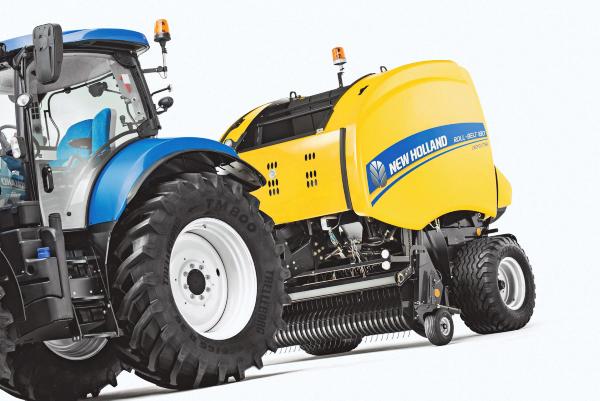
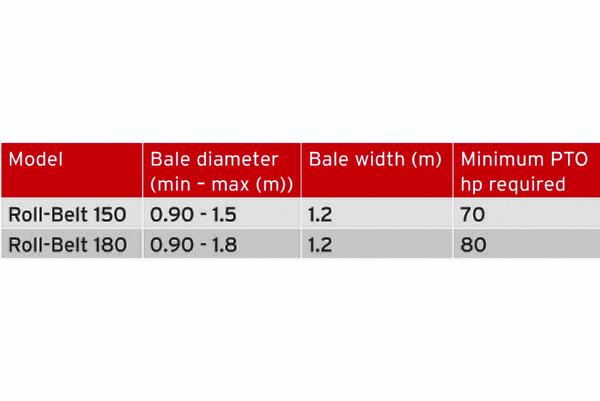
The machines are available in 1.5 and 1.8 metre bale diameters. New Holland claims that the pick-up has been completely redesigned to boost capacity by up to 20% in silage.
There is a choice between a 1.8 and 2 metre wide pick-up configuration. The machine has a four tine bar pick-up.
New Holland believes that the heavy-duty, five solid tine bar pick-up will be more suited to silage making conditions. The tines come with reinforced rubber and they are claimed to be 10% stiffer laterally and last five times longer. The pick-up section can be fitted with an optional feed assist roller.
The folding castor type gauge wheels make changing from transport to field configuration simple. The wheels swing up and round, and are locked in the transport position without having to be removed.
Operators can choose between the SuperFeed standard rotor with New Holland’s ‘W’ pattern fingers. The 455mm diameter rotor claims to maintain high throughput of all crops. New Holland claims that the CropCutter version delivers denser bale as it comes with 15 integrated knives.
New Holland has introduced ‘DropFloor’ system for the baler to clear crop blockages. This is operated from the tractor cab. When large wedges of crop block the rotor, the floor is lowered to provide additional space in the feeding space and baling can continue.
As it is a belt baler four 273mm wide belts form the bale. New Holland claims that these belts are much stronger than in the past as there are no joints. This is claimed to eliminate stretching. The belts’ texture has been engineered to assist cleaning and to prevent clogging.
Dual hydraulic density system
New Holland is now fitting a second hydraulic density cylinder to increase the bale density by up to 5% when compared to the BR7000. The system has a density cylinder on either side of the chamber for improved density control.
There is the choice of using twine only, net only or net and twine combination system on the new balers. New Holland claims that the twine placement system has been redesigned. It now has a centre pivot dual twine tube to maintain a consistent wrap pattern.
The duckbill net wrapping system is now mounted closer to the actual bale. New Holland claims that it takes even less time to provide full wrap coverage. Up to two rolls of additional net can be stored on net-only models, with a storage area to the rear of the baler while a second roll can be stored above the active roll.
ISOBUS compatible
These new Roll-Belt balers are fully ISOBUS compatible for single monitor control. Users can select the wide colour touchscreen IntelliView IV or use the existing monitor in their tractor. The Bale Command Plus II monitor is standard, and enables operators to control up to four wrap patterns and can memorise up to 20 individual bale counts records.
Operator safety
The balers are fitted with single-piece, self-supporting side covers. These can only be opened using a specific tool to prevent accidental opening during working.
The electric power safety cut-off switch, located on the baler drawbar, enables operators to cut the power to the baler, to ensure it is fully deactivated. This provides greater safety when changing the net or when checking for blockages.
For Irish conditions the new Roll-Belt balers can be specified with wide 500/55/R20 low profile tyres to reduce compaction when baling silage. New Holland claims that during high speed road transport, these tyres absorb bumps to deliver a smoother, more comfortable ride and prevent potentially dangerous bouncing.
These machines will not be available until the 2014 season and prices will be announced closer to their arrival on the market.


SHARING OPTIONS