


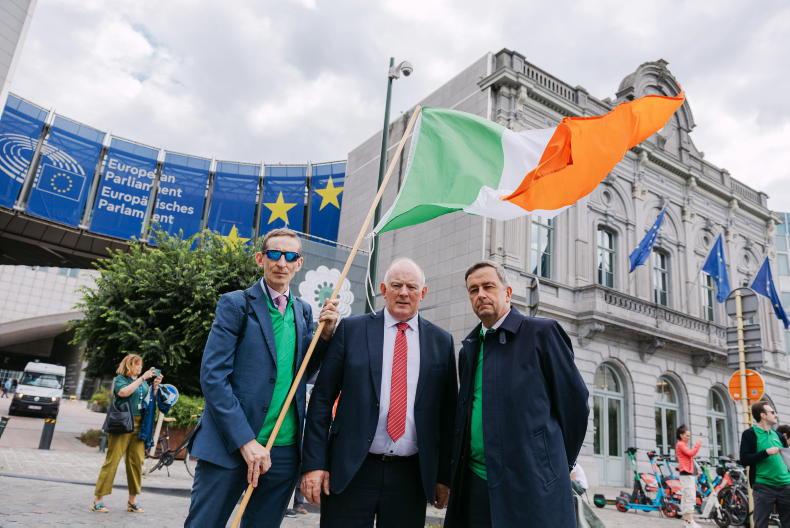
The announcement of the European Commission’s Multi-Annual Financial Framework budget proposals only happens once every seven years, so you’d think it would be a slick, well-choreographed presentation. The same applies to the policy proposals for the next CAP cycle. Holding them both on the same day seemed to be a show of strength and authority from Commission President Ursula von der Leyen, budget commissioner Piotr Serafin, and agriculture commissioner Christophe Hansen.
Instead, it had all the gravitas of a GAA club’s COVID-19 era online bingo night using a dodgy broadband signal.
Serafin’s unveiling of the EU’s proposed budget for 2028-2034 was postponed no fewer than three times last Wednesday.
The talk in Brussels was that the hold-up was related to CAP. Until the last moment, there had been no ring-fenced CAP budget at all – it was just going to be announced as part of an €865bn “single budget” for CAP, cohesion, and much more.
To Hansen’s credit, the word is that he dug in and insisted on CAP having its own fund. One can only hope that the Irish commissioner Michael McGrath was right by his side as this was taking place.
In the end, Serafin’s announcement was upstaged by Ursula von der Leyen’s simultaneous press conference, with tweets and shares from her office and attending journalists providing the first sight of the new proposals.
The budget proposals were quickly followed by Christophe Hansen revealing his CAP policy proposals to a distinctly underwhelmed European Parliament Agriculture Committee. It seems like no-one likes the package as presented. Well, almost no-one. It’s hard to know whether to depict Minister Martin Heydon calling it “a good beginning” (see page 7) as brave and supportive or naive and foolhardy.
The big question is whether the ministerial council Heydon will chair this time next year can build a coalition that will present a credible and coherent alternative proposal. If everyone is opposed to Hansen’s proposals, but for different reasons, it will simply be a coalition of chaos. The same applies to the European Parliament’s Agriculture Committee. There will be a vast range of counter-proposals from the many shades of the political rainbow currently in the parliament.
That doesn’t mean the ministerial council or the parliament won’t have any success in editing Hansen’s proposals, perhaps significantly.
But it does mean the counter-proposals might be even worse for the typical Irish family farm.
Perhaps Martin Heydon is right, and like the Tipperary hurlers, a relatively slow start to the next CAP will evolve into a swashbuckling second-half. We can only hope.





SHARING OPTIONS