
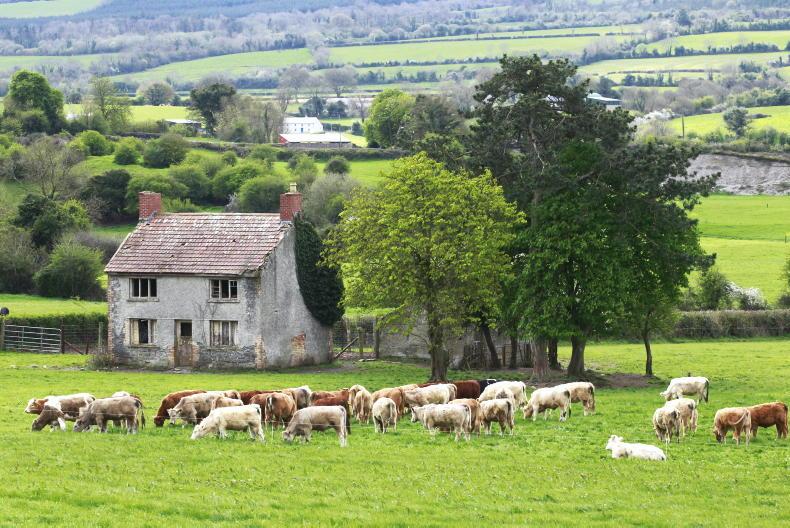
There’s a touch of a transition period about the farm at the moment as the relatively good weather means paddocks can get their final grazing without being wrecked.
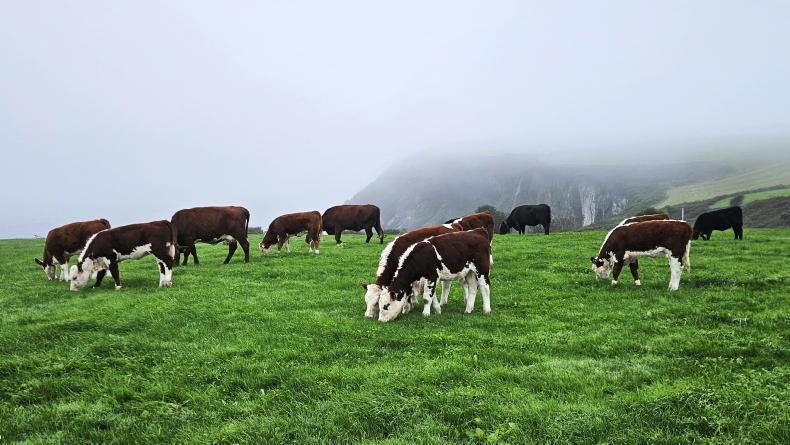
The weanling heifers have settled nicely into the redstart too. I’m bringing them in by night and they have their routine at this stage. Plans to house some of them full-time will now be deferred. Aside from one who keeps going under the fence, the rest are waiting at the gap to be let back in once they have had their fill.
Along with the weanling bulls, they are getting silage that was cut in mid-September. Test results from it show that it had 18.7% protein so ration can be cut back a fraction while they are on that.
It came from that mad burst of growth after the drought and yielded six bales to the acre.
Depending on how they do on it, a similar cut could be an option worth considering in future and put those bales to one side for the weanlings. It would be one way to try and keep a home-grown, high-protein feed in front of them.
All those little tricks could be needed judging by the signals coming on the CAP front. A delayed payment a number of years ago led to a bit of a shake-up of on-farm thinking in order to reduce dependence on them.
If CAP cuts come to fruition, it will mean a second major challenge facing the beef sector with increased competition in the British beef market also looming on the eastern horizon.
By the end of this year, Australia and New Zealand will have had access for almost 81,000t of tariff-free beef into the UK market.
When the post-Brexit trade deals with those two big southern hemisphere neighbours began in 2023, they started with a figure just short of 33,000t.
When 2032 rolls around that figure will be closer to 149,000t after which they will have unlimited access to the UK market.
That has the potential to be serious competition to contend with.
For context, in 2025 approximately 194,000t of Irish beef was sold to the UK.
Inside the farm gate, cost reduction and efficiency gains, where they can be made, will be the name of the game by the looks of things.
There’s scope for that everywhere and the recent beef calving statistics released by the ICBF show where some can be made.
Broken down on a per county basis, the stats tell their own story and land type and legacy are all at play.
It’s a combination of three of my favourite topics: cows, history and geography, and figuring out why certain types of farming practices are located where they are.
While it’s not a map per se, the figures tell so much and there’s a clear northwest/southeast divide.
Farmers in the south and southeast are more likely to calve heifers for the first time at a younger age and they have a larger herd size.
The national average suckler herd size is 16 cows, with the range going from 25 cows in Kilkenny to 10 in Leitrim. My home county of Cork sits right in the middle at an average of 16 cows and has 2,685 suckler herds.
That puts it at 42,960 cows. You’d probably find the same number of cows on, depending where you look at scale-wise, 20 to 50 cattle stations in Queensland. Maybe it’s more reassuring for us to look inwards than at the competition. It’s more comforting.