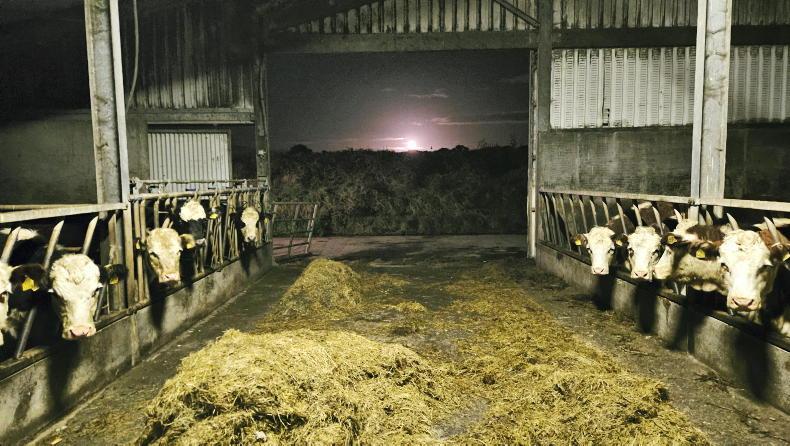
With a few heifers moving on last week, there was another rearranging in the shed. The cows due towards the end of the calving season were grouped together and can have a different diet to the rest. There are still a few vaccines to be caught up on, but other than that the yard routine is comfortably in autopilot mode.
If ground gets a chance to dry out a bit, I’ll take a chance and get some slurry out, but the paddocks it can go on will be pretty limited for now at least. At least the wind, rain and constantly changing weather forecasts are coming now. Given how unpredictable weather has been in recent years, it’s hard to complain about January weather in January. Hopefully we’ll get a run of good weather to balance it out.
Replacement heifer selection will move into the spotlight here shortly. Usually, most of those decisions would be made ahead of housing and most of the probables would already be in a group of their own.
Given grazing went later on the out-farm and space was required in the main shed that year, early grouping wasn’t possible.
The priority is to give them their initial BVD shot. That run through the crush is a good tester and most years there’s less heifers to get the booster shot than the first one as their behaviour rules them out.
I’ll have a few more opportunities than I thought to see what their crush manners are like as I got notice to do a TB test next month.
It’s a few days before calving is due to start and at least with stock housed, there won’t be the inconvenience of rounding them all up, but it’s always an unwelcome event.
An article in these pages caught my eye last week with Noel Bardon reporting on the 2035 agricultural outlook report from the European Commission.
It expects that EU countries will be producing 9.2% or 615,000t less beef in a decade’s time. Included in the forecast was a prediction of 2m fewer dairy cows and 860,000 fewer suckler cows with beef production expected to fall across Europe by 615,000t. In effect, that’s similar to taking the current Irish herd out of the system.
Things change fast, however, a year ago the same report predicted beef production to stand at 6.3m tonnes in 2035. This estimate has been revised downwards to 6.1m tonnes. That’s despite last year’s record high prices.
A positive from the report was that the decreased supply is likely to result in beef prices steadying at around the €7/kg mark for the next decade.
That allows for a bit of financial planning, but the focus needs to remain on keeping costs under control.
Another point of note was the fact that favourable market prices and coupled beef income supports could only slow down the downward trend and not stop it.
Such a prediction will come as no surprise to those on the ground, but it points to an opportunity for those willing to remain involved.
In an Irish context does that mean a renewed focus needs to come on how to make things more efficient at farm level?
Efficient is seen as a dirty word by some in beef but with less labour available it’s something that is worth focusing on, especially in a sector that has shown it can function with a good proportion of part-time operations.