



It’s over 30 years since sexed semen was first offered to livestock farmers but high cost, poor conception rates and limited availability have kept it a niche product. Is that all about to change? Recent trial results from across the world suggest that it might be closer to widescale industry adoption due to more reasonable prices and better fertility rates.
Juan Moreno, the effervescent boss of Sexing Technologies (ST), suggests it takes 25 years for a technology to mature. He suggests phase 1 of the sexed semen technology was from 1976 to 1993. In 1976 Californian researchers made the breakthrough which allowed them separate the X and Y chromosomes (the male and female).
He suggested phase 2 was from 1994 to 2012 where product price wasn’t as expensive as phase 1 and the amount of sexed semen used increased.
In 2003, the commercialisation of sexed semen in the United States started. Moreno is confident that we are starting phase 3, which ultimately would see greater than 80% of farmers using sexed semen rather than conventional semen. The product would be reasonably priced or not hugely different to conventional semen and users would create value from using it.
He said: “Think about changes that are happening. It’s not that long ago when we had phones that were connected to a line where you had to stick your finger in and twist around the dial on the front of the phone.
‘‘Now on some mobile phones you can call out a name and the phone will dial that person automatically without having to touch the phone.”
The same process of change is happening in sexed semen technology. He said: “Think about this – from 1984 to 2000 sexed semen was less than 5% of the total semen market.’’
US researcher Johnson was able to process semen at 200 to 400 cells/second, get 83% purity (male/female) and achieve a pregnancy rate of 70% of conventional semen. The process was very inefficient. The next step improved and researchers were able to sex 5,000 cells/second, achieve 85% purity and achieve 80% of the pregnancy rate of normal semen. We are now able to process 18,000 to 20,000 cells/second, achieve greater than 93% purity and achieve 92% of the fertility that you can get with normal semen. He sees the next phase as where researchers will be able to process 60,000 to 140,000 cells/second. This change in technology means sexed semen can now compete with normal semen in the marketplace and AI companies can offer the product to their customers.
Moreno suggested new technology to be released on the market from his ST company in 2014. Called ‘Sexed Ultra’, it will take sexed semen to the next level.
Sexed semen
Who are Sexing
Technologies (ST)?
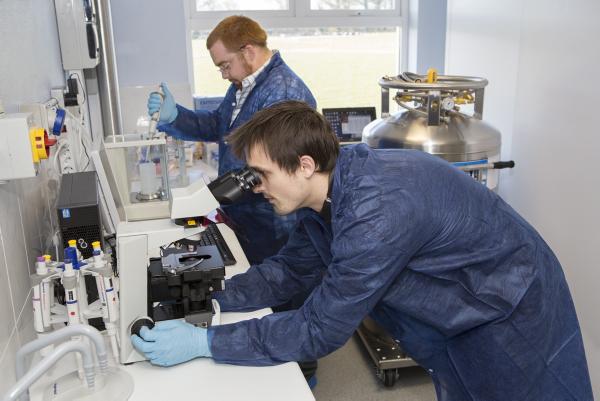
ST are a company that are headquartered in Navasota, Texas, in the United States. They have a team of 40 plus researchers who are all working to separate male and female chromosomes in almost 20 laboratories across the world. In April this year, a team of 15 ST researchers came to Ireland to set up and work sorting machines from a laboratory in Moorepark. They brought in new semen sorting machines and kept them going 24 hours a day sorting semen for use in a large scale research trial.
What is the science behind sexing semen?
Purified sperm is sex-sorted into X-bearing chromosome (female) and Y-bearing chromosomes (male). Sperm is sorted by identifying differences between the X and Y bearing sperm. The X chromosome (female) contains about 3.8% more DNA than the Y chromosome in cattle. A ray of light is passed through the sperm and a sorting machine can divert the X chromosomes one way and the Y chromosomes the other. ST minimum acceptable purity range is greater than 87% (nine out of 10 will be female if that’s what you want – or vice versa).
Juan Mureno
Why sex semen at all?
“Obviously varies across the world for different reasons. In US many will use sexed female semen for calving ease reasons – much easier pull-out heifer calves. In Europe sexed female semen is used by dairy farmers who want replacement dairy animals only and beef calves for sale. Remember, in most countries, with the exception of a few select males sold to AI organisations, most dairy bull calves are only good for beer money.”
Is the purity level really over 90% – can you guarantee nine out of 10 successful conceptions will be sorted?
“Yes, our machines can easily achieve over 90%. The faster the speed of sorting, the lower the purity so if farmers/industry were willing to accept 80% purity (eight out 10 females), then we can turn up the speed on the machines and lower the cost of the product. Our Genesis Three machine is fully automated and can sort 18,000 cells/second.”
Can you sex semen from other animals?
“Yes no problem. In fact semen from sheep could be the exception to the rule because often sexed sheep semen has better conception rates than conventional sheep semen.”
Could a sorting machine in Britain sort semen for Ireland?
“In theory yes it could. Sort the semen in a special medium for transport, freeze it and send it to Ireland.”
How could the cost of sexed semen be reduced?
“You could drop the purity (90% down to 75%) so the machine runs faster. You can drop the number of cells per straw (2m down to 1.5m or 1m cells/straw) or you can aim to increase the usage so your fixed costs are diluted across more semen. After that it’s about moving profit margins.”
Biggest new on farm technology at moment in US?
“It must be the use of genomic testing of female calves on dairy farms. Farmers are taking a hair sample from heifer calves the minute they are born and getting a genomic value on the calf for $18 per test. In some large dairy units there are hundreds of heifers going for fattening because the farmer is deciding based on the genomic value of the heifer that he has better heifers for replacements so the rest are fattened.”
Your next big trial?
“We are starting research on a semen concentrate trial in sexed semen to see if we can bring down the number of cells from 2m per straw to 1.5m per straw and still get good pregnancy rates. However, now that we have achieved pregnancy rates that are 92% of normal semen, I don’t ever want to go back to a product that has low pregnancy rates.”





SHARING OPTIONS