



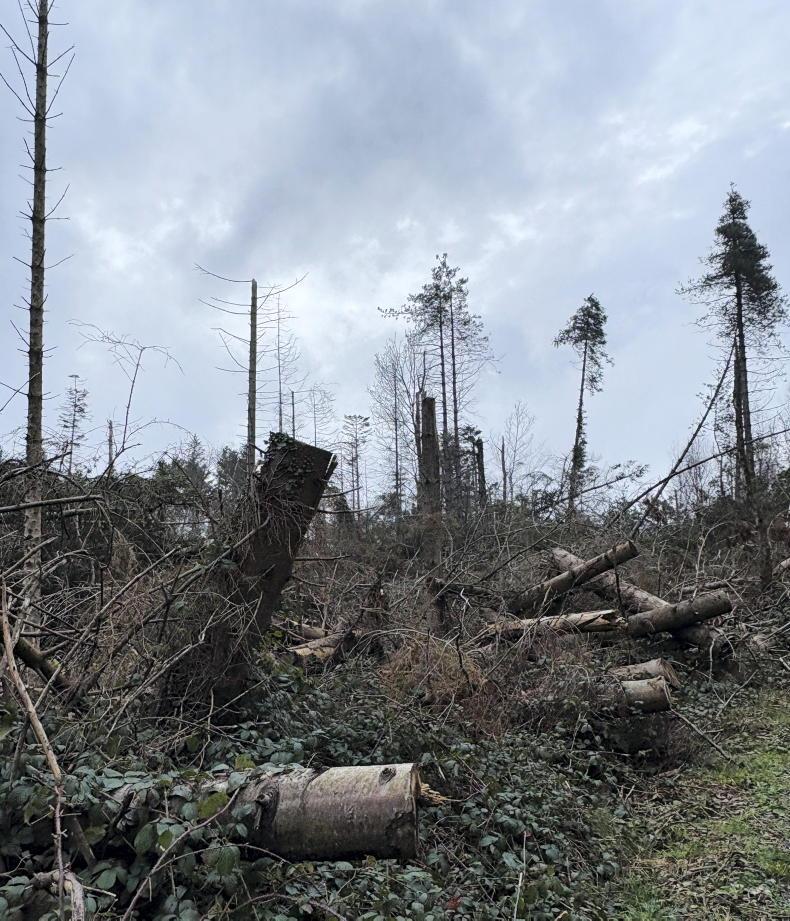
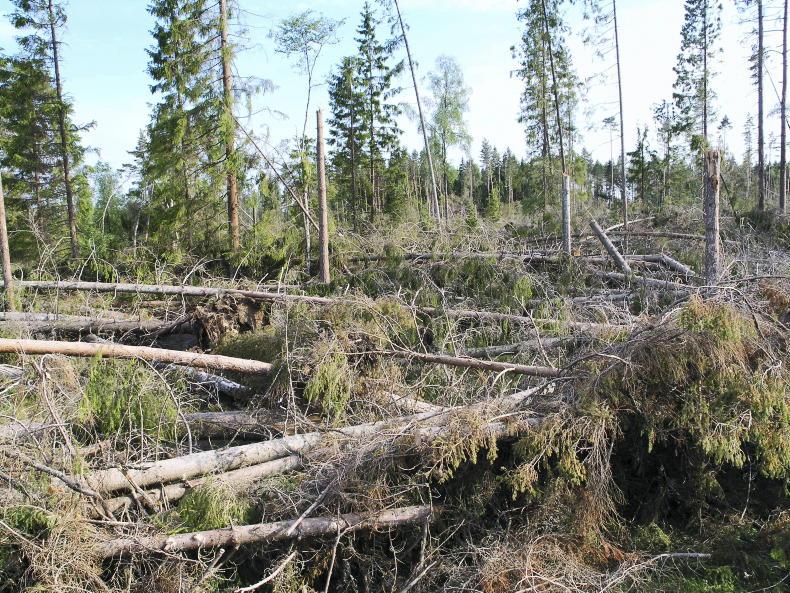
Forestry companies, timber processors and other stakeholders have been revising their schedules for removing windblown timber. Those who predicted that most windblown forests would be cleared by early 2027, now believe that harvesting will continue into 2028.
It’s often forgotten that Sweden only removed the last of its 75 million m³ of windblown timber in 2009, four years after storm Gudrun. Unlike Ireland, while the Swedes removed most of the windblown timber in one year, they wet-stored over 10 million m³ of logs – to avoid degrade – which they released onto the market from 2006 to 2009.
The Swedes also suspended all standing sales until the windblown timber was harvested by providing state assistance, especially for haulage. In the absence of similar initiatives in Ireland, some harvesting of standing sales has continued, although Bord na Móna has stockpiled pulpwood and Coillte is storing timber in depots and making it available to sawmills in the south.
The concentration of windblown timber in Mayo, north Roscommon and most of Leitrim and Cavan is a major logistic problem. Add an estimated one million m³ blown down in Northern Ireland, and the picture becomes more acute. Unlike the early days of dealing with ash dieback, no cross-border initiative took place to address storm Éowyn.
Yet, major progress has been made as export timber markets have been sourced for surplus logs. Last year’s CSO data showed that record harvesting was achieved in privately owned forests amounting to 2.95m m³. It is likely that most of this was windblown as forest owners with standing crops are unlikely to sell during the current log saturated marketplace.
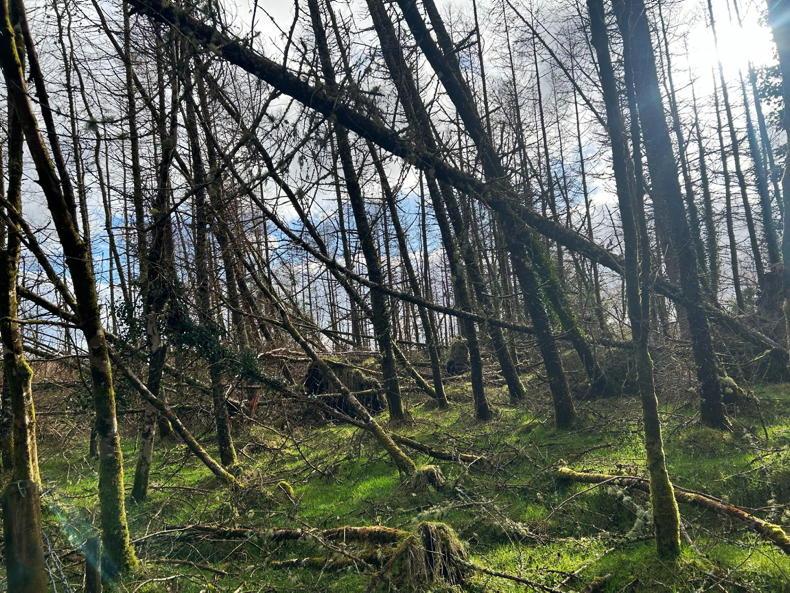
Similar progress this year would help to clear a significant area of wind-damaged forests. However, since work by the Windblow Taskforce has been discontinued, there is no national data base for windblow harvested to date. Forestry company spokespersons are reluctant to provide figures, but there is consistency in their views that they will be harvesting until at least the end of next year.
They also agree that windblown forests in the 25-30 age category, that have been previously thinned, are still attractive. While sawlog prices have fallen to €40/m3, this is still a good price as the Reconstitution Scheme for Windblow (RSW) will cover most of the reforestation costs.
Younger plantations are proving difficult to sell because of oversupply and a stagnant market. Pulpwood prices, which had fallen to €14/m³ are now as low as €7/m³ according to some foresters contacted.
The take-up of the RSW is still low, simply because most foresters and forestry companies are concentrating on harvesting. Where harvesting is completed or planned, forest owners should engage a registered forester to apply for this grant scheme, which provides between €3,858/ha and €6,744/ha (Table 1).
The scheme is available for forests that suffered from significant damage, ie 20% or more of the forest area. The RSW is sufficiently flexible to apply to “islands of standing trees where there has been windblow on all sides or windblow on 70% or greater of the sides”. However, it makes sense not to harvest adjoining blocks of forests that have survived the storm. Search online for Reconstitution Scheme for Windblow 2026 for full details.


SHARING OPTIONS