The terms and conditions of the 2016 Areas of Natural Constraint (ANC) scheme included two stocking rate limits applicants had to meet to be eligible for payment.
The first was maintaining a minimum stocking rate of 0.15LU/ha over a seven-month continuous retention period within the calendar year.
Some farmers who did not reach the required stocking rate early in the year did not receive payments when released in September and had to wait until they hit the required limit. Others on marginal lands, particularly in the west and northern half of the country, faced challenges in keeping heavy livestock out on wetter lands.
It is therefore not surprising that mart managers report much more activity in the last two weeks from farmers looking to purchase animals for summer grazing systems. Many of these farmers are not purchasing their full summer requirement, rather they are buying enough numbers to get them registered as hitting the minimum stocking rate requirement now, with good grass supplies an added incentive.
Activity for heavier cattle from a portion of these farmers with no housing could be temporarily reduced given the heavy rainfall in recent days, but demand for light cattle, ewes and lambs and dry hoggets is likely to persist.
There is no sign that the retention period rule will change when the terms and conditions for 2017 are released in the coming weeks. There is also no sign that the other stocking rate rule to maintain an average stocking rate limit of at least 0.15LU/ha over the 12-month calendar year will change.
Eligible animals
The other element of the terms and conditions that has attracted close attention by a small cohort of farmers in recent years is the classes of animals that are eligible for contributing to the stocking rate calculations.
Donkeys and horses have been under the spotlight, but there are no signs as yet of any changes afoot, with equine breeding enterprises eligible in recent years provided mares were bred with relevant stud books and had a foal in the required scheme years.
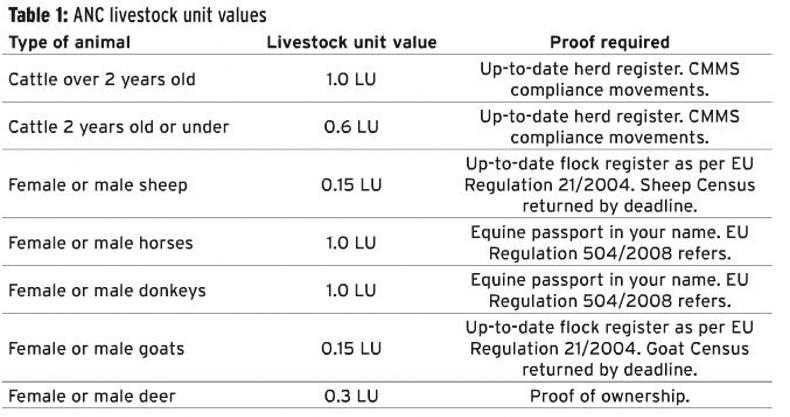
Table 1 details the classes of animals and livestock unit values as per the 2016 terms and conditions.
Payment rates
The other query that has cropped up recently, and does so each year, relates to payment rates and the area of ground payment can be claimed for.
There is increased discussion this spring with some applicants listening to calls for higher payment rates from farm organisations and trying to assess if payments could be higher in 2017. This, along with awaiting confirmation on clawback on the sale of Basic Payment Scheme entitlements, has been raised in conversations with a number of auctioneers.
At present, payment rates remain unchanged, with calls for higher payments related to a review of the ANC which is taking place this year. Table 2 details payment rates for the three main different land-type classifications.
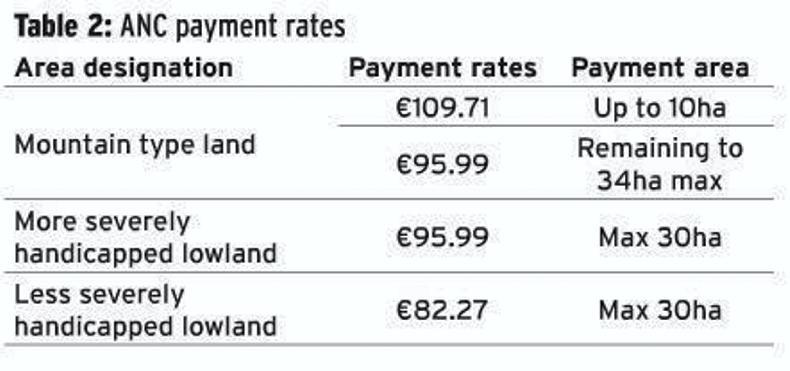
The top-up of €13.72 for the first 10ha of mountain-type land is only payable where applicants have sheep, cattle or goat enterprises or a combination of these. For the 2016 scheme year, applicants with a combination of mountain-type land, more severely handicapped lowland and/or less severely handicapped lowland will be paid up to a maximum of 30ha except where the area of mountain type land declared is between 30ha and 34ha.
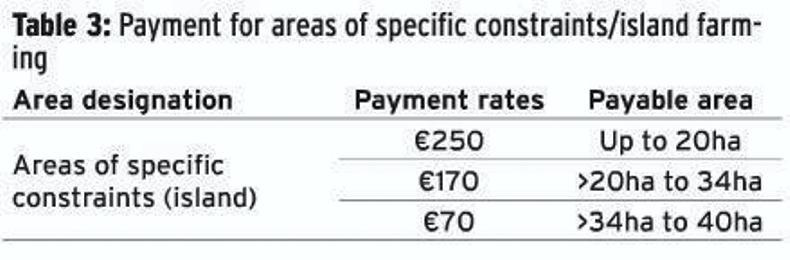
Table 3 details rates for islands which are designated as areas of specific constraints and is essentially the payment structure the Irish Natura Hill Farmers association is campaigning for hill farmers.
Read more
ANC funding battle continues
Full coverage: ANC
The terms and conditions of the 2016 Areas of Natural Constraint (ANC) scheme included two stocking rate limits applicants had to meet to be eligible for payment.
The first was maintaining a minimum stocking rate of 0.15LU/ha over a seven-month continuous retention period within the calendar year.
Some farmers who did not reach the required stocking rate early in the year did not receive payments when released in September and had to wait until they hit the required limit. Others on marginal lands, particularly in the west and northern half of the country, faced challenges in keeping heavy livestock out on wetter lands.
It is therefore not surprising that mart managers report much more activity in the last two weeks from farmers looking to purchase animals for summer grazing systems. Many of these farmers are not purchasing their full summer requirement, rather they are buying enough numbers to get them registered as hitting the minimum stocking rate requirement now, with good grass supplies an added incentive.
Activity for heavier cattle from a portion of these farmers with no housing could be temporarily reduced given the heavy rainfall in recent days, but demand for light cattle, ewes and lambs and dry hoggets is likely to persist.
There is no sign that the retention period rule will change when the terms and conditions for 2017 are released in the coming weeks. There is also no sign that the other stocking rate rule to maintain an average stocking rate limit of at least 0.15LU/ha over the 12-month calendar year will change.
Eligible animals
The other element of the terms and conditions that has attracted close attention by a small cohort of farmers in recent years is the classes of animals that are eligible for contributing to the stocking rate calculations.
Donkeys and horses have been under the spotlight, but there are no signs as yet of any changes afoot, with equine breeding enterprises eligible in recent years provided mares were bred with relevant stud books and had a foal in the required scheme years.
Table 1 details the classes of animals and livestock unit values as per the 2016 terms and conditions.
Payment rates
The other query that has cropped up recently, and does so each year, relates to payment rates and the area of ground payment can be claimed for.
There is increased discussion this spring with some applicants listening to calls for higher payment rates from farm organisations and trying to assess if payments could be higher in 2017. This, along with awaiting confirmation on clawback on the sale of Basic Payment Scheme entitlements, has been raised in conversations with a number of auctioneers.
At present, payment rates remain unchanged, with calls for higher payments related to a review of the ANC which is taking place this year. Table 2 details payment rates for the three main different land-type classifications.
The top-up of €13.72 for the first 10ha of mountain-type land is only payable where applicants have sheep, cattle or goat enterprises or a combination of these. For the 2016 scheme year, applicants with a combination of mountain-type land, more severely handicapped lowland and/or less severely handicapped lowland will be paid up to a maximum of 30ha except where the area of mountain type land declared is between 30ha and 34ha.
Table 3 details rates for islands which are designated as areas of specific constraints and is essentially the payment structure the Irish Natura Hill Farmers association is campaigning for hill farmers.
Read more
ANC funding battle continues
Full coverage: ANC







SHARING OPTIONS