Agents for Purcell Brothers continue to buy young weanling bulls for the firm’s 20,000 head export contract to Turkey. The firm has a tight specification on the cattle it wants: born after 1 May 2016 and weighing from 200kg to 320kg. Mart managers report that these agents are interested in cattle born in the period May to August 2016, possibly September.
This means they are buying from the smallest cohort of cattle in age terms.
Each year calving peaks in February and March and declines sharply after May, not picking up again until the following January.
ADVERTISEMENT
Nonetheless, figures for calf births from the Department of Agriculture’s Animal Identification and Movement system suggest that sufficient cattle are there.
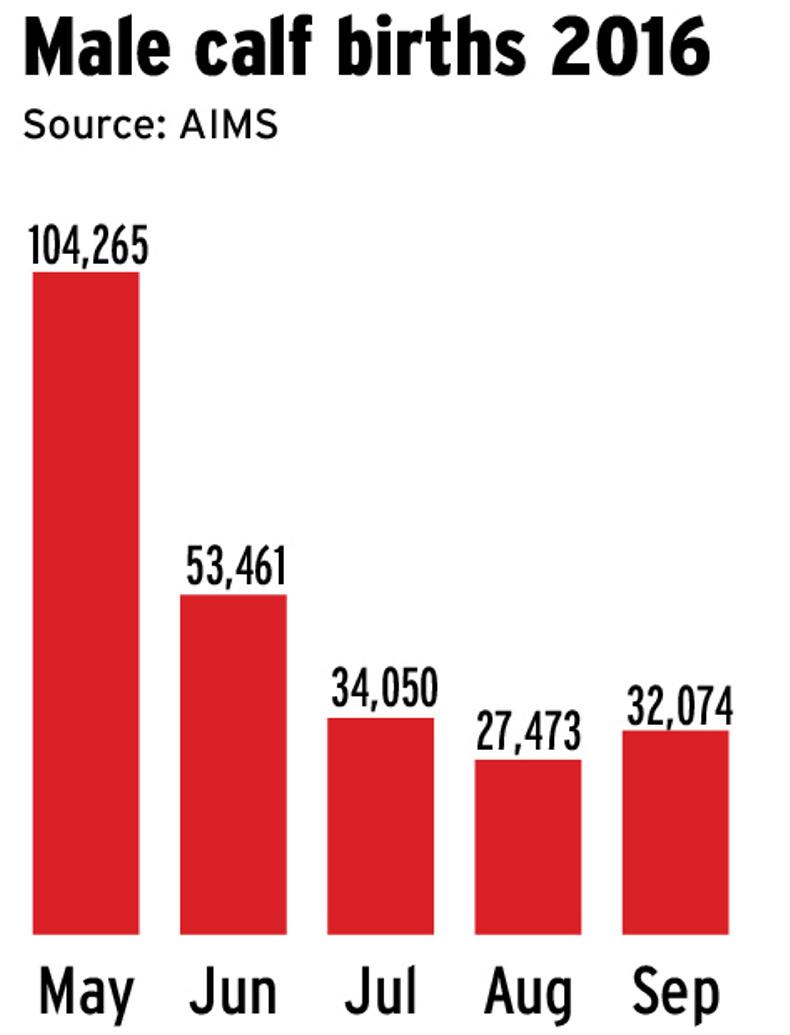
The graph shows the average number of male calves born in the relevant months for the three years from 2013 to 2015.
Just over 250,000 calves were born in these five months, over half in May and June. Well over half of these animals would be suitable for this export contract to Turkey, being either from suckler herds or being beef crosses on dairy cows.
Register for free to read this story and our free stories.
This content is available to digital subscribers and loyalty code users only. Sign in to your account, use the code or subscribe to get unlimited access.
The reader loyalty code gives you full access to the site from when you enter it until the following Wednesday at 9pm. Find your unique code on the back page of Irish Country Living every week.
CODE ACCEPTED
You have full access to the site until next Wednesday at 9pm.
CODE NOT VALID
Please try again or contact support.
Agents for Purcell Brothers continue to buy young weanling bulls for the firm’s 20,000 head export contract to Turkey. The firm has a tight specification on the cattle it wants: born after 1 May 2016 and weighing from 200kg to 320kg. Mart managers report that these agents are interested in cattle born in the period May to August 2016, possibly September.
This means they are buying from the smallest cohort of cattle in age terms.
Each year calving peaks in February and March and declines sharply after May, not picking up again until the following January.
Nonetheless, figures for calf births from the Department of Agriculture’s Animal Identification and Movement system suggest that sufficient cattle are there.
The graph shows the average number of male calves born in the relevant months for the three years from 2013 to 2015.
Just over 250,000 calves were born in these five months, over half in May and June. Well over half of these animals would be suitable for this export contract to Turkey, being either from suckler herds or being beef crosses on dairy cows.
If you would like to speak to a member of our team, please call us on 01-4199525.
Link sent to your email address
We have sent an email to your address. Please click on the link in this email to reset your password. If you can't find it in your inbox, please check your spam folder. If you can't find the email, please call us on 01-4199525.
ENTER YOUR LOYALTY CODE:
The reader loyalty code gives you full access to the site from when you enter it until the following Wednesday at 9pm. Find your unique code on the back page of Irish Country Living every week.





SHARING OPTIONS