Under the Nitrates Regulations, farmers are obliged to ensure that the total amount of nitrogen from organic manure applied to their own land does not exceed 170kg N/ha/year, ie the equivalent of two dairy cows per hectare. The nitrates derogation allows farmers to exceed the limit of 170kg/ha up to a maximum of 250kg/ha, subject to certain conditions being met, including the following:
Farming a holding that is at least 80% grass, a derogation is only available in respect of grazing livestock.Have a fertilisation plan in place on the holding by March 1.Farmers in derogation cannot import livestock manure.A breach of this regulation will affect your Basic Payment Scheme (BPS), and a reduction will be applied to your annual payments under the Direct Payments Scheme and Rural Development Programme measures. A percentage reduction will be applied to your annual payments of 1%, 3%, or 5% depending on the gravity of the breach. The penalty may be trebled in the case of the same infringement occurring more than once within 36 months of each other.
If you are dissatisfied with the penalty decision, you may appeal it. It’s a requirement that every farmer prepares a nutrient estimate, to abide with cross compliance. Cross compliance examinations are chosen on a risk and random basis, and you are given ten days to get a plan in place.
Niall Ryan of Teagasc cautions: “Farmers that don’t have a nutrient management plan risk applying over the maximum level of phosphorus (P). This is because if you don’t have soil samples you take the P index to be 3 which only allows you to spread 16 kg/ha. P levels would be suffering consequently.”
The department provides annual N and P statements online as a service to all farmers registered on agfood.ie. This is a record of the annual production of N and P on the holding produced by cattle only, so if you have other livestock you will have to calculate and add on their N and P production. The department has released its June statement which contains figures for the first six months of the year. This is a great help to farmers as it will help determine whether you will be exceeding your livestock manure limit.
Table 1 shows a simple explanation of how to calculate kilogrammes of organic nitrogen and phosphorus produced by farm animals on your own farm per year.
Two options exist for farmers when exporting slurry:
The first way is when a farmer moves slurry to a tank on to another farmer’s holding. The slurry is to remain on the importer’s holding and will be spread on his land. In this case, the exporter must complete a record 3 form. This form must be filled up and sent to Johnstown Castle, Co Wexford. Failure to return this form results in a penalty. The second way slurry is exported, is if a farmer is exporting slurry to an empty tank on a farm which is not being used by the owner and the farmer intends to bring back the slurry to his own farm for spreading. In this case, the exporting farmer has exclusive access to the tank in question and there is no need for records to be submitted.Export forms or rental agreements must be submitted by 31 December.
Tony Reid from the nitrates section at Johnstown Castle recommends farmers to engage with advisors: “Many farmers are receiving penalty letters and they don’t fully understand why. Advisers are there to help farmers protect their payments against any unnecessary cuts. Some farmers are threatening their BPS by simply not sending back exporting slurry forms. The majority of farmers are compliant, it’s only a small minority now that are not.”
The farmer view
Michael Fagan, dairy farmer with no derogation
My Teagasc adviser wrote up a plan for me based on my soil test results last January. He asked me where I intended spreading slurry for silage for the coming year and drew up a guideline for the quantities each field should get. P is a major worry from an environmental point of view but as well it’s a lot easier to exceed P levels than N levels.
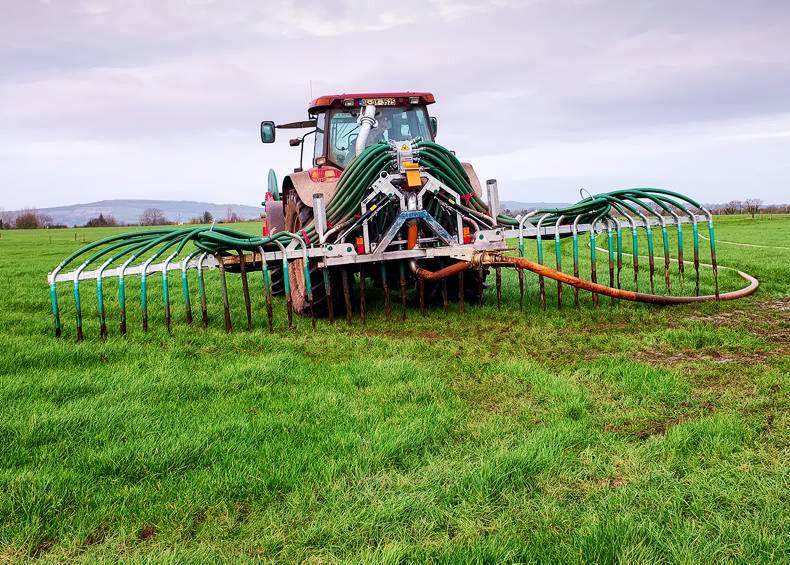
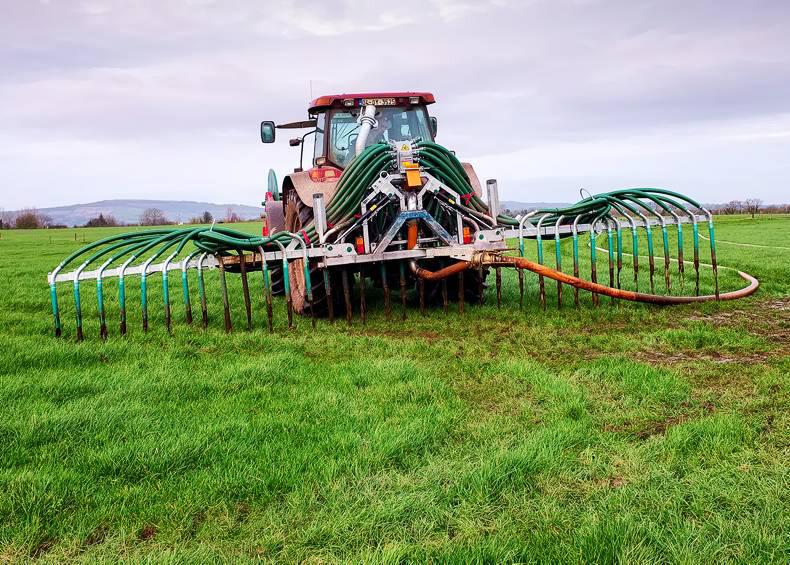
Soil samples are very handy. They let you know what you can spread in each field and help you to get the best out of the land. I use an umbilical system and trailing shoe for spreading slurry. I am registered on agfood.ie and I have got my N and P statement for the first six months of the year. This lets me know where I currently stand. It is looking like I will be exceeding the 170kg so I have decided that I am going to have to export slurry. It’s the best option for me. There can be an issue for some farmers importing slurry. There is the possibility that they can also go over their allowance so it is crucial that this is looked into.
Farmers who have no stock and just make silage are also another great option for higher-stocked farms as they have a much higher allowance for slurry than livestock farms. I have a deal with a local drystock farmer who has agreed to take slurry from me. I’ll soon be filling out my form for exporting slurry as you are subject to a penalty if you fail to submit this form.
Eamon Fagan, dairy farmer
in derogation
As it stands I’m just falling above the 170kg allowance so the most practical option for me was applying for derogation. I have been doing so for the last few years. Some years I exceed the 170kg and others I just fall slightly short. Stocking rates are crucial for farmers to keep an eye on. The lower your stocking rate the easier it is to stay under the 170kg allowance.
I have a nutrient management plan prepared for my business when we need a nitrate derogation. This is beneficial because I know exactly the amounts of slurry and chemical fertilisers to spread in each field. I suppose one of the main reasons I went for derogation is because I have sufficient slurry storage. Many farmers can’t apply for derogation because of insufficient slurry storage. Intensive farmers need the nitrate derogation up to the 250kg limit. Without derogation, more progressive farmers would be pulling back or afraid of expansion. The derogation is a vital part of the dairy industry going forward.
1. First of all you multiply (number of cows on farm) X (kg of N produced by average cow per year) = full year of N kg.
2. Then divide (full year of N kg) / (ha on farm) = nitrogen per hectare.
Example. A farmer has 30 dairy cows on 20ha.
1. (30) X (85kg) = 2,550kg
2. (2550kg) / (20ha) = 127.5kg/N/ha
This farm is well below the allowance of 170kg/N/ha.
Figures for cattle numbers are calculated on a daily basis using data from (AIMS) Animal Identification and Movement Scheme.
Maximum amount of organic fertiliser you’re allowed to apply on land.
Example: (20ha) x 170kg/ha =3,400kg nitrogen.
Example (20ha) x 250kg/ha = 5,000kg nitrogen.
To avoid further payment losses as a result of exceeding the 170kg/250kg N/ha/year livestock manure limit, you can do any of the following.
Reduce livestock numbers.Export enough farmyard manure/slurry.Apply for nitrates derogation to operate above the 170kg N/ha/year threshold and not exceed 250kg N/ha/year. An application must be applied for online prior to 31 March of the year in question.
Under the Nitrates Regulations, farmers are obliged to ensure that the total amount of nitrogen from organic manure applied to their own land does not exceed 170kg N/ha/year, ie the equivalent of two dairy cows per hectare. The nitrates derogation allows farmers to exceed the limit of 170kg/ha up to a maximum of 250kg/ha, subject to certain conditions being met, including the following:
Farming a holding that is at least 80% grass, a derogation is only available in respect of grazing livestock.Have a fertilisation plan in place on the holding by March 1.Farmers in derogation cannot import livestock manure.A breach of this regulation will affect your Basic Payment Scheme (BPS), and a reduction will be applied to your annual payments under the Direct Payments Scheme and Rural Development Programme measures. A percentage reduction will be applied to your annual payments of 1%, 3%, or 5% depending on the gravity of the breach. The penalty may be trebled in the case of the same infringement occurring more than once within 36 months of each other.
If you are dissatisfied with the penalty decision, you may appeal it. It’s a requirement that every farmer prepares a nutrient estimate, to abide with cross compliance. Cross compliance examinations are chosen on a risk and random basis, and you are given ten days to get a plan in place.
Niall Ryan of Teagasc cautions: “Farmers that don’t have a nutrient management plan risk applying over the maximum level of phosphorus (P). This is because if you don’t have soil samples you take the P index to be 3 which only allows you to spread 16 kg/ha. P levels would be suffering consequently.”
The department provides annual N and P statements online as a service to all farmers registered on agfood.ie. This is a record of the annual production of N and P on the holding produced by cattle only, so if you have other livestock you will have to calculate and add on their N and P production. The department has released its June statement which contains figures for the first six months of the year. This is a great help to farmers as it will help determine whether you will be exceeding your livestock manure limit.
Table 1 shows a simple explanation of how to calculate kilogrammes of organic nitrogen and phosphorus produced by farm animals on your own farm per year.
Two options exist for farmers when exporting slurry:
The first way is when a farmer moves slurry to a tank on to another farmer’s holding. The slurry is to remain on the importer’s holding and will be spread on his land. In this case, the exporter must complete a record 3 form. This form must be filled up and sent to Johnstown Castle, Co Wexford. Failure to return this form results in a penalty. The second way slurry is exported, is if a farmer is exporting slurry to an empty tank on a farm which is not being used by the owner and the farmer intends to bring back the slurry to his own farm for spreading. In this case, the exporting farmer has exclusive access to the tank in question and there is no need for records to be submitted.Export forms or rental agreements must be submitted by 31 December.
Tony Reid from the nitrates section at Johnstown Castle recommends farmers to engage with advisors: “Many farmers are receiving penalty letters and they don’t fully understand why. Advisers are there to help farmers protect their payments against any unnecessary cuts. Some farmers are threatening their BPS by simply not sending back exporting slurry forms. The majority of farmers are compliant, it’s only a small minority now that are not.”
The farmer view
Michael Fagan, dairy farmer with no derogation
My Teagasc adviser wrote up a plan for me based on my soil test results last January. He asked me where I intended spreading slurry for silage for the coming year and drew up a guideline for the quantities each field should get. P is a major worry from an environmental point of view but as well it’s a lot easier to exceed P levels than N levels.
Soil samples are very handy. They let you know what you can spread in each field and help you to get the best out of the land. I use an umbilical system and trailing shoe for spreading slurry. I am registered on agfood.ie and I have got my N and P statement for the first six months of the year. This lets me know where I currently stand. It is looking like I will be exceeding the 170kg so I have decided that I am going to have to export slurry. It’s the best option for me. There can be an issue for some farmers importing slurry. There is the possibility that they can also go over their allowance so it is crucial that this is looked into.
Farmers who have no stock and just make silage are also another great option for higher-stocked farms as they have a much higher allowance for slurry than livestock farms. I have a deal with a local drystock farmer who has agreed to take slurry from me. I’ll soon be filling out my form for exporting slurry as you are subject to a penalty if you fail to submit this form.
Eamon Fagan, dairy farmer
in derogation
As it stands I’m just falling above the 170kg allowance so the most practical option for me was applying for derogation. I have been doing so for the last few years. Some years I exceed the 170kg and others I just fall slightly short. Stocking rates are crucial for farmers to keep an eye on. The lower your stocking rate the easier it is to stay under the 170kg allowance.
I have a nutrient management plan prepared for my business when we need a nitrate derogation. This is beneficial because I know exactly the amounts of slurry and chemical fertilisers to spread in each field. I suppose one of the main reasons I went for derogation is because I have sufficient slurry storage. Many farmers can’t apply for derogation because of insufficient slurry storage. Intensive farmers need the nitrate derogation up to the 250kg limit. Without derogation, more progressive farmers would be pulling back or afraid of expansion. The derogation is a vital part of the dairy industry going forward.
1. First of all you multiply (number of cows on farm) X (kg of N produced by average cow per year) = full year of N kg.
2. Then divide (full year of N kg) / (ha on farm) = nitrogen per hectare.
Example. A farmer has 30 dairy cows on 20ha.
1. (30) X (85kg) = 2,550kg
2. (2550kg) / (20ha) = 127.5kg/N/ha
This farm is well below the allowance of 170kg/N/ha.
Figures for cattle numbers are calculated on a daily basis using data from (AIMS) Animal Identification and Movement Scheme.
Maximum amount of organic fertiliser you’re allowed to apply on land.
Example: (20ha) x 170kg/ha =3,400kg nitrogen.
Example (20ha) x 250kg/ha = 5,000kg nitrogen.
To avoid further payment losses as a result of exceeding the 170kg/250kg N/ha/year livestock manure limit, you can do any of the following.
Reduce livestock numbers.Export enough farmyard manure/slurry.Apply for nitrates derogation to operate above the 170kg N/ha/year threshold and not exceed 250kg N/ha/year. An application must be applied for online prior to 31 March of the year in question. 





SHARING OPTIONS