


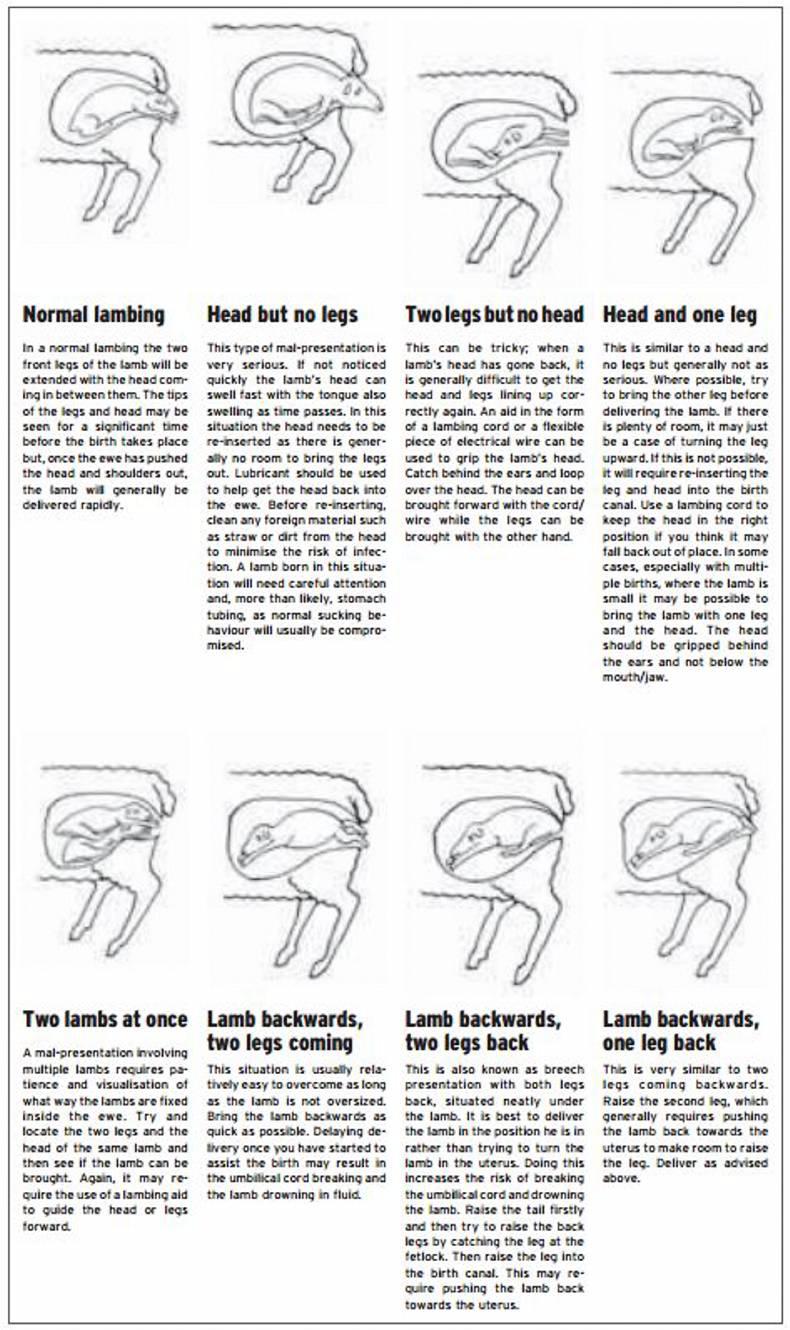
Dealing with lambing difficulties is detailed in our infographic below, but first, it is important to know when it is time to intervene in potential problems.
Signs of lambing
In the hours before lambing, a ewe will become uneasy or show signs of sickness. The signs can vary, depending on whether ewes remain outdoors or are housed. When lambing outdoors, ewes will tend to separate from the flock. This is especially true of hill and mountain breeds, whose natural instinct is to find a safe sheltered place to lamb. Ewes lambing indoors often tend to take a similar approach of separating from the flock, but this is harder to detect.
Another indication is ewes failing to come to eat or continually standing and lying or bleating looking for lambs. Where lambs are present in the same pen, ewes may think other lambs are her own and try to mismother these. For this reason, it is an advantage to remove ewes and lambs to individual lambing pens for a period to develop a strong bond, after which they can be returned to group pens where required.
Contractions may have started during this period. A lamb is surrounded by two fluid-filled sacs, normally known, in practical terms, as the first and second waterbag. Frequent contractions will push the first waterbag into the cervix, causing its dilation (to make room for the lamb to pass through). If a ewe is handled too early, this may not have taken place or the lamb may not yet have progressed into the birth canal. In these circumstances, there is a danger of causing harm to the ewe and the lamb by trying to bring lamb(s) too soon. This process may take two to three hours.
If the length of time a ewe is lambing is not known, and you think there may be problems, it is advisable to handle the ewe to see if everything is OK. If the birth is progressing normally, the ewe can be left for longer to lamb herself or the lambs can be brought, if it is possible to do so. A sure sign that a lambing is progressing successfully is the hooves of the two legs and a lamb’s nose appearing in the second waterbag.
Lambing from expulsion of the first waterbag should generally take less than an hour or slightly more than that for multiple births. Hopefully, the diagrams will help to visualise the different problems that can occur and how they can be rectified.
Oversized lamb
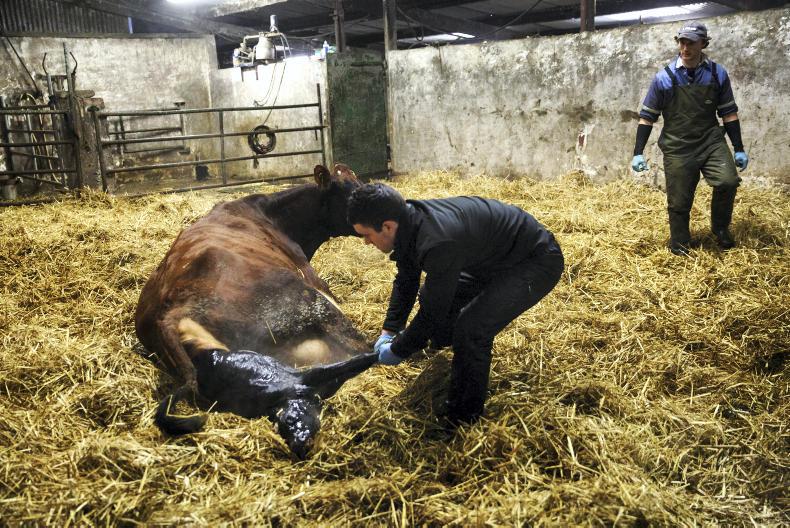
Even though the lamb may be presented in the correct manner, a difficult birth may take place due to oversized lambs or a small ewe/ewe lamb. Using plenty of lubricant will help. The legs of the lamb should be pulled gently, one at a time, to carefully ease the lamb further out.
Care should be taken when bringing the lamb not to rupture or cause any tears to the vulva of the ewe. When the lamb is coming, the skin of the vulva may need to be pulled gently back over the head, which should make it easier to bring the lamb. The force applied should be steady and not jerked. The force should be applied above the hocks (bend in leg) and behind the lamb’s ears. Pull the lamb towards the ewe’s hocks.
If the lamb gets stuck, turning the ewe on her back may help. If the lamb is stuck at the hips, releasing pressure and then pulling the lamb between the ewe’s legs and over the udder frequently helps. Continuous pressure in the one direction where a lamb is stuck at the hips generally does not work. If the lamb is too large, veterinary assistance should be sought as a Caesarean section may be necessary.
Newborn lamb
Once a lamb has been delivered, deal with it to ensure it is OK. If a lamb is showing little sign of life, holding it upside down by the legs and swinging it gently in a 180° arc may help to clear the lungs of any fluids. Only do this for a short period of a few swings. Rubbing the lamb’s ribs may also help.
Wipe any mucus from around the mouth and ears. Where a lamb appears to be having problems breathing, a piece of straw can be inserted gently into its nose to help it breathe. Check for other lambs before presenting the lamb to the ewe.
With a difficult birth it is advisable to give the ewe an antibiotic injection to help protect against infection. Also check that no tears have occurred that may need a stitch. With a difficult birth there is an increased risk of prolapsed vagina and the ewe pushing some of the birth canal out. A stitch or harness may be needed to rectify this situation.
Hygiene
Hygiene is critical. Wash your hands in soap and water before attending to the ewe. Rubber disposable gloves should be worn. Clean the lamb’s head of any foreign material before it suckles. Likewise, if a prolapse has occurred, it is vital to practice good hygiene.
This article was first published on 19 February 2011




SHARING OPTIONS