



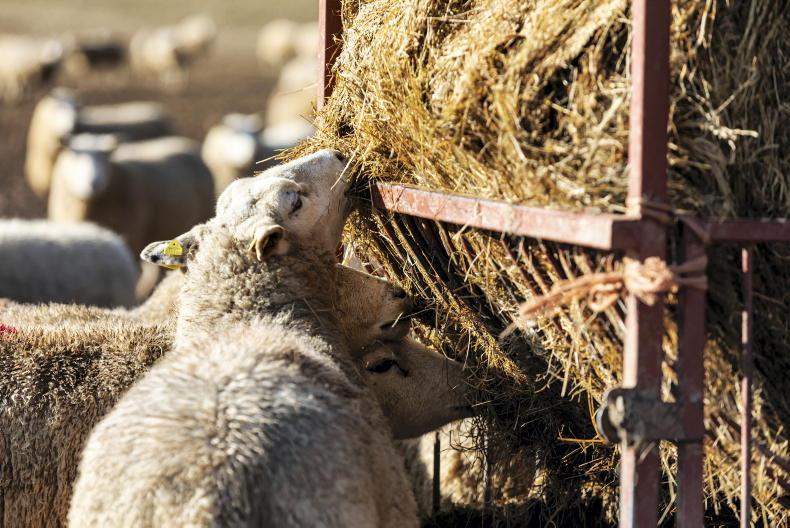
Last week’s announcement that November 2025 was the fifth wettest in 85 years of Irish records will come as little surprise to farmers dealing with the inclement weather. The torrential rainfall has followed through to December, with many areas receiving between 25mm and 50mm at the start of this week.
Grass supplies are diminishing rapidly, or are already depleted, on many farms, while there is massive pressure on utilisation.
At a Teagasc sheep seminar in Fermoy Mart last week, Michael Gottstein, Teagasc head of the sheep programme, cautioned farmers that there is a high risk in current conditions of ewes losing invaluable body reserves that will be almost impossible to replenish in late pregnancy.
Explaining the main cause of ewes losing condition, he said that “lack of feed is the main one, it’s leaving the ewes out, running out of grass, saying I don’t want to house them until after Christmas – we leave them there [outdoors] for another couple of days and during that period the body condition is absolutely melting off them.
“When you run out of feed you either need to supplement sheep at grass or you need to house them. There is no point waiting for a week or two for them to melt condition off them, as you are not going to be able to put it back on”.
Level of feeding
Michael said that in general there is not much more feeding required in mid-pregnancy compared to feeding dry ewes or those during the mating season.
“The problem with most sheep is that mid-pregnancy falls into the period of time when your grass is running out, it is generally lower in energy and it is very wet. Feeding very wet grass reduces intake by about 20% and grazing short grass reduces intake by about 20%, so if ewes are grazing short, wet grass, it really reduces intake and ewes start to burn up body condition fast.”
Table 1 details the energy requirement of ewes from mating through to six weeks post-lambing.
An energy requirement of 0.8UFL is about the amount of energy in 0.8kg of standard barley. Access to an ample supply of winter grass will be sufficient to satisfy this energy requirement. The UFL requirement increases by about 0.1UFL for each 10kg variance in ewe mature weight.
The quality of forages saved on sheep farms varies hugely. Table 2 details the energy feeding value of a range of forages.
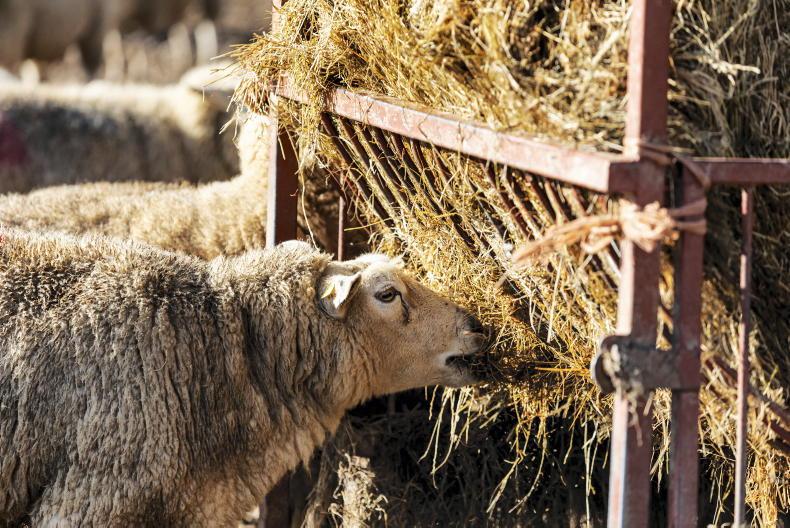
Access to average to moderate silage with a DMD of 64% to 68% will generally be sufficient to meet energy demands in mid-pregnancy, as ewe intake potential will be in the region of 1.3kg to 1.4kg DM for lowland ewes.
Good-quality hay is also typically sufficient, as ewes can consume a higher intake due to its high dry matter.
A challenge arises where ewes are being offered wet silage of poor feeding value, as in such cases ewes will not physically be able to consume enough forage to meet their nutritional needs.
This becomes very apparent as ewes enter late pregnancy, with the dry matter intake potential of a twin-bearing ewe reducing from approximately 1.4kg eight weeks pre-lambing, to 1.3kg in week six, 1.2kg in week four and down to 1.1kg. This is where feeding bulky forage with a higher intake is possible, with top-quality feeds and concentrates.
As such, forage quality becomes even more important in late-pregnancy. Table 3 details the concentrate supplementation recommended with forage of varying quality.
Thin ewes
Michael highlighted that there is often a spotlight placed on fat ewes and dealing with them. However, fat ewes are rarely a problem, given that there is such a low percentage of them present on most farms. Instead, upwards of 90% of issues are linked to thin ewes.
“The reason that thin ewes are a problem is that thin ewes have smaller lambs, they spend less time mothering their lambs – that is licking and bonding with their lambs – they have less colostrum to get their lambs going and they have a much lower milk yield post-turnout, as they cannot milk off their back.
“Every ewe after lambing needs to milk off her back to be able to mobilise body reserves and maximise her milk yield. No matter what you feed, she can’t take in enough to milk to her maximum.”
Michael says that this leads to higher lamb mortality, often through black loss. He explains that this is where lambs are released to the field with their ewe, but they are lost thereafter. He said that in 2023 and 2024 there were horrendous levels of black loss in flocks where there was a higher number of thin ewes on farms. In the worst-affected flocks, he said there was upwards of 40% losses from scanning to weaning.
“Whatever your ewes are at mating is generally going to be the best condition they are in. Some people say a little bit of weight loss is no harm and they will put it back on, but it is virtually impossible to gain condition once ewes enter late-pregnancy.”

Practical tips
Michael says that there is great potential to influence performance through concise and practical feeding management and outlined a number of tips to enhance forage intake and ewe performance:



SHARING OPTIONS