



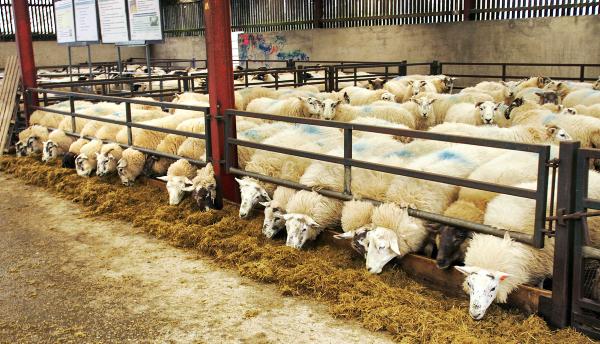
Offering ewes the correct plane of nutrition during mid and late pregnancy ensures adequate supply of colostrum post-lambing and lambs close to optimum birth weight, consequently reducing mortality and increasing performance and flock profitability.
In last week’s article, the impact of plane of nutrition in late pregnancy on lamb birth weight and mortality was discussed. The impact of silage type and grass silage feed value on ewe and lamb performance was also examined.
This article aims to summarise results from recent studies at Athenry on the effects of concentrate feeding management during late pregnancy on ewe and lamb performance.
Concentrate feed level
Silage feed value (as determined by digestibility [DMD], chop length and intake characteristics) and litter size are the major factors affecting the level of concentrate supplementation required by ewes in late pregnancy.
The effects of silage feed value on concentrate requirements of twin-bearing ewes in late pregnancy are presented in Table 1.
The rate of increase in the level of concentrate supplementation required increases as silage DMD decreases. Furthermore, as silage chop length increases, the quantity of additional concentrate required increases because intake declines.
For example, for silages at 79% and 64 % DMD, an additional 4kg and 10kg concentrate are required for long chop length silages, relative to precision chop silages, respectively.
Concentrate supplementation per ewe can be reduced by 5kg for ewes carrying singles, while ewes carrying triplets should receive an extra 8kg of concentrate.
The effects of level of concentrate supplementation on the birth weight of lambs from ewes that were offered either medium (70% DMD) or high (75% DMD) feed value silage was evaluated at Athenry and the results are presented in Table 2.
Increasing concentrate feed level above 15kg and 25kg to ewes offered the high and medium feed value silages, respectively, did not increase lamb birth weight.
However, feeding the higher levels of concentrate resulted in higher ewe condition post-lambing.
The results of the studies presented in Table 2 (and Table 3 of last week’s article) clearly show there is no benefit from feeding excess concentrate to ewes in late pregnancy.
Unlike mature ewes, ewe lambs require a plane of nutrition during early and mid-pregnancy that sustains a liveweight gain (excluding foetal weight) of approximately 80g/day. This is required to enable ewe lambs reach their normal mature body size.
As a general rule, a pregnant ewe lamb requires an extra 2.5 megajoules of metabolizable energy (ME) relative to adult ewes of similar liveweight at the same stage of pregnancy and carrying the same litter size.
The additional energy allowance is to facilitate body weight gain – if it is not provided, the pregnant ewe lamb will divert energy from the foetus, and colostrum production, to meet some of this demand.
In mid-January, the pregnant ewe lambs received 200g of concentrate daily. Concentrate allowance will be increased to 250g/day in late January.
Following pregnancy scanning (late January), the ewe lambs will be penned according to expected litter size and lambing date. Ewe lambs carrying triplets will have their concentrate allowance increased to 300g/day in mid-February.
During the last six weeks of pregnancy (mean lambing date late March), ewes carrying singles, twins and triplets will receive a total of 18kg, 26kg and 33kg concentrate/head.
If the quality of the silage available is poorer than that at Athenry, then increased concentrate supplementation would be required from housing to lambing.
Concentrate protein
For prolific flocks, the concentrate should be formulated to contain 190g of crude protein per kilogramme (i.e., 19% crude protein) as the grass silage on many sheep farms has a low protein concentration.
Some commentators within the industry suggest formulating low and high protein concentrates for feeding to ewes during the second last and last three-week periods of pregnancy, respectively.
However, considering the size of most sheep flocks in Ireland, and the fact that ewes are offered low levels of concentrate during the first two to three weeks of supplementation, together with the low protein concentration of grass silage on most sheep farms, the benefit of using two different concentrates is at best marginal.
For example, while relative to a 19% crude protein concentrate (containing 200kg soyabean meal per tonne), the reduction in the cost of formulating a 14% crude protein concentrate is approximately €50/t, this equates to only 1c to 2c per ewe daily during the first few weeks of supplementation, when ewes are offered between 0.2kg and 0.4 kg/ewe daily.
For every 100 ewes in a flock, one tonne of concentrate will last for 50 and 25 days, respectively, when ewes receive a daily concentrate allowance of 0.2kg and 0.4kg/head. Therefore, for most farms, there is no benefit from animal production, logistically or financially to offering a low-protein concentrate during the first weeks of concentrate supplementation.
Where maize silage is offered as the forage, then crude protein concentration should be increased to 23%.
Also, as maize silage normally has lower concentrations of minerals and vitamins, mineral and vitamin supplementation should be increased by approximately 50% during late pregnancy.
Concentrate protein ingredient source impacts on animal performance. In a recent study at Athenry, the effect of concentrate protein source offered during late pregnancy on the performance of ewes and their progeny was examined. The results are presented in Table 3.
Two concentrates were formulated to have the same metabolizable energy (12.4 MJ/kg DM) and protein concentrations (18% as fed). The protein sources in the concentrates were either soyabean meal or a mixture of by-products (rapeseed, maize distillers and maize gluten).
Lambs born to ewes that had been offered the soyabean-based concentrate were 0.3kg and 0.9kg heavier at birth and weaning, respectively, than lambs born to ewes offered concentrate that contained by-products as the protein source.
In the Athenry study, the soyabean-based concentrate cost ~€0.60 extra per ewe. The increase in the weaning weight of lambs from ewes offered the soyabean-based concentrate in late pregnancy (cost ~€0.60/ewe) is similar to the response obtained from offering each lamb 6kg of creep concentrate until weaning (cost ~€3.60/ewe per set of twins).
This clearly shows the benefit of having high quality protein sources in the concentrate offered to ewes during late pregnancy.
Concentrate ingredients
As the quantity of concentrate offered to ewes in late pregnancy is modest (depending on silage quality), it should contain high-quality digestible fibre, energy and protein sources.
Concentrate feedstuffs are generally evaluated in terms of their chemical composition (book values). However, when offered in diets based on grass silage, individual feedstuffs have different effects on digestion of the silage component of the diet.
As most ewes that are housed are offered grass silage-based diets, it is necessary to use data from studies in which grass silage was offered to evaluate the value of the feed stuffs.
The current cost, and the relative values of straights, relative to rolled barley at €220/t and soybean at €490/t are presented in Table 4.
The current costs used in this paper are based on prices (delivered to farm) prevailing currently. Straights that are value for money at present include rapeseed meal, maize distillers, corn gluten, soya hulls, maize meal and barley.
However, as soybean meal is probably the best source of protein available, it should be included so as to provide a large proportion of the protein in rations to be offered to ewes in late pregnancy.
Examples of simple, high-quality rations are presented in Table 5. When purchasing a ration, it is important to purchase on known ingredients as well as price.
Concentrate feeding management
To optimise the use of concentrate, ewes should be penned according to predicted litter size (based on ultrasonic scanning) and expected lambing date (mating date – raddle colour).
As the demand for nutrients increases in late pregnancy, supplementation should be stepped up weekly over the weeks immediately prior to lambing.
When supplementing ewes, the objective is to produce heavy lambs (which will be delivered unassisted) and ewes with adequate supplies of colostrum.
The feed schedules required to deliver different concentrate feed levels, varying from 10kg to 45kg per ewe in late pregnancy, are shown in Table 6.
During the week prior to lambing, ewes receive up to 1kg daily, clearly illustrating the benefits of penning ewes according to expected lambing date as well as expected litter size.
For example, for each extra week ewes are on the high level of concentrate supplementation, they would consume ~7 kg concentrate – thus dramatically increasing concentrate usage.
Dr Tim Keady is based at the Animal and Grassland Research and Innovation Centre, Teagasc, Athenry, Co Galway
Conclusions
Click here for Part I: Feeding ewes during late pregnancy- forage quality.





SHARING OPTIONS