


Liam Fahy, Department of Agriculture, told farmers that where they are currently taking part in an agri-environment scheme, such as AEOS, their stocking rate is governed by what was put in the plan.
For farmers who find themselves outside an agri-environment scheme, they must adhere to the new minimum/maximum stocking rates or the stocking rates in the CFP (commonage framework plan). In relation to controlled burning, Fahy told farmers that burning dates will have to be revisited.
Fahy added that the recent review of commonage framework plans was undertaken due to the increasing threat of land abandonment.
He said that the last review of commonages was undertaken in 2002 and, since then, many commonages are heading towards being undergrazed. He said that in the light of Single Farm Payments terms and conditions, areas that are under-grazed will not be eligible for payment. He told the crowd that all land must be maintained in GAEC (good agricultural and environmental condition). He highlighted that a number of issues need to be addressed:
Stocking rate: He said that a new minimum/maximum stocking rate review of commonages was undertaken. Several farmers raised concerns of the accuracy of these minimum/maximum numbers saying that in some cases they are much too low and, in other cases, too high. Fahy said that these new stocking rates are ‘not bedded in stone’, and told farmers that they will have the opportunity to ‘review and reassess’ the figures. Voices from the floor suggested that these reviews should be straightforward and not through an appeals process. He added that the minimum/maximum is based on the SPS and, if there is a surplus or deficit, it would be up to all shareholders to come together and see who wants to take up the slack.
Burning: In relation to the designated period for burning, Fahy said that this should be extended but only controlled burning allowed.
Collective arrangements: He said that there are three categories of farmers who farm commonages. The first are active sheep farmers, the second apply on SPS for these areas but have no sheep and the third do not apply and may or may not have sheep.
biggest issue
John Bryan told the crowd that the single biggest issue facing them is the co-financing of Pillar II funds from the government. He said: ‘‘We fought long and hard to maintain Pillar I and II.’’
Bryan explained that the IFA is giving a clear signal that they are not in favour of regionalisation or a co-efficient. He encouraged the crowd that where they need to apply pressure today is to get proper Pillar II funding.
He said that the Disadvantaged Areas payment needs to be brought back to 45ha and that coupling needs to be introduced at a rate of €100 on the suckler cow and €15, or more, per hill ewe.
NPWS funding drawing to an end
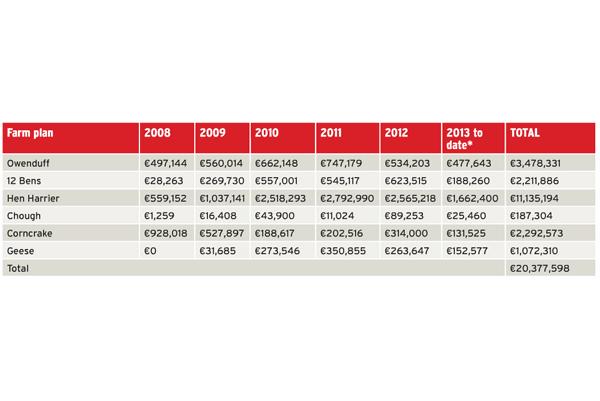
Barry O’Donoghue, National Parks and Wildlife Service, showed the figures in Table 1 of the spend on specialised targeted projects from 2008 to 2013.
In total, over €20m will have been spent over the six projects.
Barry said that due to the budgetary situation, the spend has dropped from over €4.5m in 2010 and 2011 to just €2.6m so far in 2013. With many schemes ending this year, farmers were extremely vocal about direct cuts to hill farmers in the affected areas.
Light lamb market difficult this year
IFA livestock chairman, Kevin Kinsella told farmers that, so far this year, approximately 160,000 extra lambs and hoggets were slaughtered. In addition to this, light lamb exports to the main market, Portugal, have collapsed from over 1,400t down to just 140t. He acknowledged that the light lamb market is difficult as a result. However, he mentioned the benefit of initiatives, such as Connemara hill lamb, which is available in 15 Dunnes Stores supermarkets.
He acknowledged the work done by Teagasc in terms of research, costings and advice for best practice. He said that a census needs to be carried out of hill sheep with buy in from processors, the Department and other bodies to assess current and future light lamb production and establish markets for these. He told the crowd that last year’s sheep grassland payment was rolled over for just one year. It ends this year but the scheme must be rolled over for another year. A strong lobby will be required to do this.
IFA action plan for hill farms
CAP
In the implementation of CAP in 2015, IFA is opposed to the use of regionalisation and land reduction co-efficients on eligible land for Single Farm Payment. IFA is supporting the approximation model, including the 60% minimum payment.
Targeted support through the Sheep Grassland (€15/ewe) and Suckler Cow (€100/cow) schemes must be put in place in the new CAP.
Commonages
Sustainable stocking levels to replace Commonage Framework Plans must be immediately established for each commonage area to allow hill farmers reach their full potential in a flexible manner.
Rollover of REPS4
REPS4 farmers whose contracts finish in December should be allowed a year’s extension up to the end of 2014. Furthermore, any hill farmer locked out of AEOS3 must be allowed join from 1 January.
SACs
Where restrictions are imposed across farming and other developments in SAC areas, compensation must be paid by either the Department of Agriculture or the National Parks and Wildlife Service.
Disadvantaged Areas
In the review of Disadvantaged Areas, following the CAP agreement, higher payments should apply in mountain areas under new Area of Natural Constraint criteria.
Eligible Land
Flexibility must be allowed in determining eligible land in hill areas for payments under Single Farm Payment, DAS and agri-environment measures in the new CAP.
Walks Scheme
The number of walks covered by the Walks Scheme must be increased to 80 and the allocation increased from €2m to €4m.
Lamb Market Measures
Bord Bia, in conjunction with Teagasc, the Department of Agriculture and lamb processors should undertake a comprehensive census/assessment of light lamb production and market potential and undertake a strong marketing drive for hill lamb in the most attractive markets.
Through the advisory and STAP network, Teagasc should highlight the potential economic benefit to lowland farmers of purchasing store lambs from the hill areas and link up potential hill farmer sellers and lowland buyers to meet and maximise market returns.
TAMS in Hill Areas
A broader TAMS scheme for sheep farmers including fencing and handling equipment as well as support for sheep structures.
Changing Burning Date
The closing date for burning should be changed by the Minister for Arts, Heritage and the Gaeltacht, Jimmy Deenihan, from 1 March to 15 April under the Wildlife Amendment Act.
Farm Assist
As many hill farmers are on Farm Assist, it is vital that the income and child disregards in the means income assessment, be restored to their pre-budget 2012 level.
Upland Environmental Management Scheme
To coincide with the new stocking regime, IFA is calling for the introduction of a meaningful Upland Agri-Environment Scheme in the next Rural Development Plan 2014-2020.
Payment to farmers under the agri-environment scheme must reflect the restrictions imposed by SAC designation and other restrictions with strong incentives for farmers to participate. Payment should apply across the whole farm with higher payments in SAC and Commonage areas.




SHARING OPTIONS