Mid December update from Padraig Shevlin, who farms cattle and sheep at Carrickmacross in Co Monaghan. His system involves buying and finishing store bullocks.
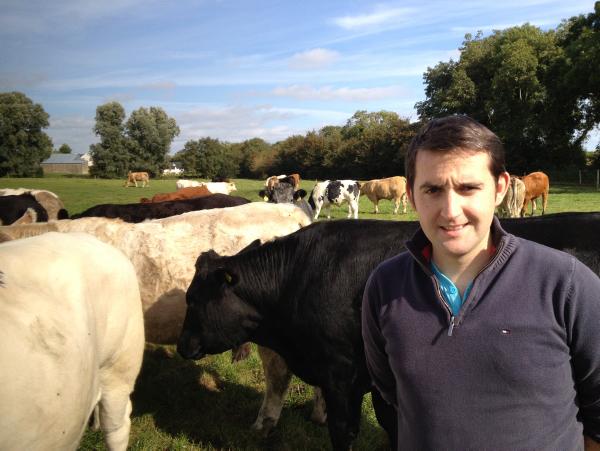
Padraig Shevlin, who farms at Carrickmacross, Co Monaghan.
ADVERTISEMENT
December is a month of reflection. It’s the quietest month of the year in terms of workload but an hour in front of a laptop, phone or going through accounts can be time well spent. This week has been a case of evaluation and planning.
For this farm it’s been silage results, soil sampling and grass seed.
Silage results came back and to say I’m puzzled would be understatement. This first year red clover ley was cut at 2,000kg/dm ha and was all leaf. When the first of the bales were opened it came as no surprise it looked excellent quality. When I received the silage sample results this week the red clover silage tested 67dmd and 18% protein. The protein figure was pleasing as this silage is been fed to store animals so it should allow good growth rates but the dmd was extremely disappointing. Some initial investigating suggests this is a common feature this year. Some samples are coming back with high ammonia levels and low pH levels suggesting high levels of nitrogen still present. The ammonia level was mid range at 12% so that wasn’t an issue but the pH was slightly high suggesting poor fermentation or lack of sugars which can be issue with red clover. A preservative would be desirable in that case but can be difficult to administer because we use all bales. The other sample I sent away was from old permanent pasture and came back with result of 69dmd and 13% protein which were acceptable for old pasture. Over the course of next 3 years all silage ground will be reseeded.
ADVERTISEMENT
Soil samples have been taken on a number of fields. I carry out a number of soil samples every year to keep on top of soil fertility. Soil fertility across the whole farm was poor with many fields in index 1 and 2. We set about improving this by the information the soil samples provide. We are very fortunate with one block of land we own, it has a naturally high pH with a range of 6.4-6.8 so this leaves us without the expense of extra lime. We have used farm yard manure with great effect to lift soil fertility and improve overall soil structure and stay within REPS constraints. Improving soil structure and having a reseeding plan in place should allow us to grow substantial more grass in future.
We have 15 acres ear marked in the spring time for reseeding. So my thoughts have turned to grass seed varieties. I hope to try the new variety AberGain as it looks as it has great potential in terms of overall tonnage of dry matter, spring and autumn growth. I hope to also try Astonenegry on some silage ground because of its figures in terms of tonnage and with our heavily stocked farm maximise grass grown is vital. I would like to try Bealey as it has performed excellently in Moorepark but I need to research it further before using it. I usually go with a 3-way mix. So for silage ground I’m considering Astonenegry, AberGain and Tyrella to allow adequate ground cover. For grazing paddocks Tyrella, AberGain and possibily Bealey.
Register for free to read this story and our free stories.
This content is available to digital subscribers and loyalty code users only. Sign in to your account, use the code or subscribe to get unlimited access.
However, if you would like to share the information in this article, you may use the headline, summary and link below:
Title: Silage, soil-sampling and grass seed
Mid December update from Padraig Shevlin, who farms cattle and sheep at Carrickmacross in Co Monaghan. His system involves buying and finishing store bullocks.
The reader loyalty code gives you full access to the site from when you enter it until the following Wednesday at 9pm. Find your unique code on the back page of Irish Country Living every week.
CODE ACCEPTED
You have full access to the site until next Wednesday at 9pm.
CODE NOT VALID
Please try again or contact support.
December is a month of reflection. It’s the quietest month of the year in terms of workload but an hour in front of a laptop, phone or going through accounts can be time well spent. This week has been a case of evaluation and planning.
For this farm it’s been silage results, soil sampling and grass seed.
Silage results came back and to say I’m puzzled would be understatement. This first year red clover ley was cut at 2,000kg/dm ha and was all leaf. When the first of the bales were opened it came as no surprise it looked excellent quality. When I received the silage sample results this week the red clover silage tested 67dmd and 18% protein. The protein figure was pleasing as this silage is been fed to store animals so it should allow good growth rates but the dmd was extremely disappointing. Some initial investigating suggests this is a common feature this year. Some samples are coming back with high ammonia levels and low pH levels suggesting high levels of nitrogen still present. The ammonia level was mid range at 12% so that wasn’t an issue but the pH was slightly high suggesting poor fermentation or lack of sugars which can be issue with red clover. A preservative would be desirable in that case but can be difficult to administer because we use all bales. The other sample I sent away was from old permanent pasture and came back with result of 69dmd and 13% protein which were acceptable for old pasture. Over the course of next 3 years all silage ground will be reseeded.
Soil samples have been taken on a number of fields. I carry out a number of soil samples every year to keep on top of soil fertility. Soil fertility across the whole farm was poor with many fields in index 1 and 2. We set about improving this by the information the soil samples provide. We are very fortunate with one block of land we own, it has a naturally high pH with a range of 6.4-6.8 so this leaves us without the expense of extra lime. We have used farm yard manure with great effect to lift soil fertility and improve overall soil structure and stay within REPS constraints. Improving soil structure and having a reseeding plan in place should allow us to grow substantial more grass in future.
We have 15 acres ear marked in the spring time for reseeding. So my thoughts have turned to grass seed varieties. I hope to try the new variety AberGain as it looks as it has great potential in terms of overall tonnage of dry matter, spring and autumn growth. I hope to also try Astonenegry on some silage ground because of its figures in terms of tonnage and with our heavily stocked farm maximise grass grown is vital. I would like to try Bealey as it has performed excellently in Moorepark but I need to research it further before using it. I usually go with a 3-way mix. So for silage ground I’m considering Astonenegry, AberGain and Tyrella to allow adequate ground cover. For grazing paddocks Tyrella, AberGain and possibily Bealey.
If you would like to speak to a member of our team, please call us on 01-4199525.
Link sent to your email address
We have sent an email to your address. Please click on the link in this email to reset your password. If you can't find it in your inbox, please check your spam folder. If you can't find the email, please call us on 01-4199525.
ENTER YOUR LOYALTY CODE:
The reader loyalty code gives you full access to the site from when you enter it until the following Wednesday at 9pm. Find your unique code on the back page of Irish Country Living every week.





SHARING OPTIONS