


It’s a moment that should have gone viral – the players and supporters of Killeagh singing Killeagh.
The line, “’95 came promotion,” in the Kingfishr song could easily have been repurposed to the current year, but unfortunately for the east Cork outfit, it was not to be. Defeat to Carrigtwohill last Sunday in the Co-op SuperStores Cork Senior A Hurling Championship (SAHC). meant that their hopes of progressing to the knockout stages of the competition came to an end.
It’s rare that things align so neatly in life, and the GAA song of the summer fitting so perfectly with success for the club after which it is named was a big ask. However, I can say with almost zero fear of contradiction that the tune will be belted out lustily at grounds and clubhouses across the country as the autumn carousel of county finals takes place.
Even though the song is very specific to Killeagh, with its mention of the club’s ground, Páirc Uí Chinnéide, and colours – leading to the strange situation of the Cork team singing about the “green and white I adore” at TUS Gaelic Grounds after beating Limerick in the Munster final – it very quickly struck a communal chord.
The writer of the song, Killeagh native Eoin Fitzgibbon, felt that it tapped in to the community aspect and the line about being buried with one’s hurley by the River Dissour almost gives a ‘warrior heading to Valhalla’ feel.
And, ultimately, the emotions of those listening are what decide how much a work of art will adhere, more so than the mere words or the melody.
While Munster rugby’s run to the 2000 Heineken Cup final ended in defeat to Northampton Saints, the journey to that point has lived with anybody who was part of it, one characterised by how The Fields of Athenry became an anthem for the province.
The fact that Munster fans were singing about a town in Connacht was of course a source of query and sometimes sneering, and when the song usurped Molly Malone as the hymn of choice at Lansdowne Road, there was some lamentation at the passing of a tradition.
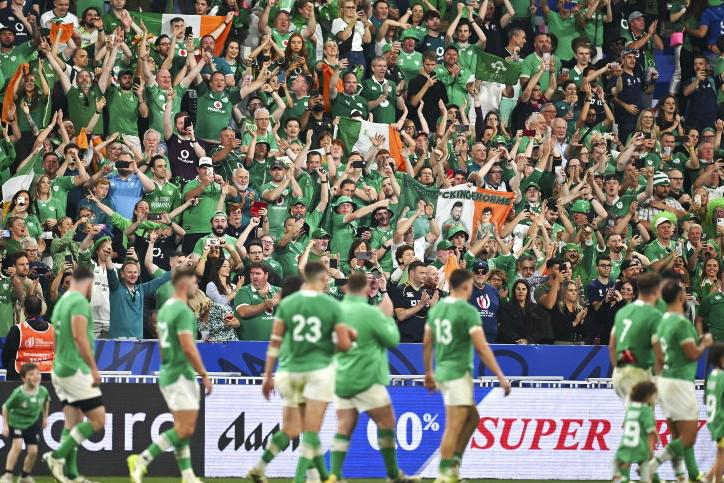
The over-examination of the meaning of the lyrics being sung by rugby fans was to the fore at the 2023 World Cup, too, when the Cranberries’ Zombie – an anti-war song written in response to the 1993 Warrington bombing – was quickly adopted by the large travelling fanbase.
We understand that there is airtime and column inches to fill – and I’m aware of the levels of irony involved on my own part, don’t worry – but it is interesting to look at the connection fans have with these songs. In those emotional moments in a packed stadium, the anthems connect the crowd and at the same time, mean something different to each person.
The first album I ever owned was (What’s The Story) Morning Glory? by Oasis. Essentially, it was an impressionable 12-year-old deciding he liked something everyone else said was cool before actually consuming it but, on the occasions when I do play it nowadays, I know every single note and lyric and am transported back 30 years.
That album ends with Champagne Supernova, an epic lasting seven minutes and 27 seconds. It features lyrics that may not stand up to scrutiny, like, “Slowly walking down the hall / Faster than a cannonball,” and Noel Gallagher was once asked by an interviewer to explain it. “I don’t know,” he said, “but are you telling me, when you’ve got 60,000 people singing it, they don’t know what it means? It means something different to every one of them.”
Unlikely anthems
So it is with sports anthems – they are special because they are organic rather than prescribed.
When Kenneth Wolstenholme introduced the very first edition of Match of The Day in August 1964, in the background you could hear the crowd singing The Beatles’ She Loves You and those fans would regularly sing the chart-toppers of the day.
For a myriad of reasons, they especially latched on to the cover of You’ll Never Walk Alone by Gerry And The Pacemakers – we doubt that Rodgers and Hammerstein could have foreseen such an eventuality when they wrote Carousel in 1945.
In recent years, Arsenal tried to ingrain the Elvis Presley version of The Wonder of You by playing it before games but fans didn’t integrate with it. What happened instead was that Louis Dunford wrote and released The Angel (North London Forever) in 2022 and that resonated with the support-base almost instantaneously – to the club’s credit, they then ensured it was given matchday prominence.
English football is of course too tribal for a song to become public property in the way that Killeagh has.
Whether it endures as a serenade of success by GAA teams, we shall see – but it has definitely been the song of 2025 and that’s no mean feat.


SHARING OPTIONS