Know what you are buying
Steve Dennis, BASF UK’s head of business and technical development says that post-patent generic products may suggest that what’s in the can is identical to the R&D brand, but this is not feasible, because the original developer of the active ingredient will never publish the full formulation of the product that reaches the market.
He adds that, while active ingredients remain the cornerstone of crop protection performance, it is the formulation that unlocks their full potential – optimising pathogen control, enhancing coverage and uptake, and improving stability.

Steve Dennis, BASF UK’s head of business and technical development.
He cites the risks based on his own and growers’ experience – blocked sprayer nozzles, settling out in the tank, and sometimes errors on packaging that affect record-keeping, and at worst, product useability.
“Crucially though, it’s also field performance that matters, and our own, and independent trials, have shown how both disease control efficacy and resulting yield impact are significantly poorer.”
BASF v generic pyraclostrobin formulations
Pyraclostrobin remains an important active ingredient for cereal, pulse and vegetable growers, sold as the brand Comet® 200 and contained within Signum® and other BASF brands.
In BASF labs, field tests and independent field trials, generic alternatives frequently fall short of stringent quality standards, important for product performance, crop safety and ensuring the active ingredient remains on the market.
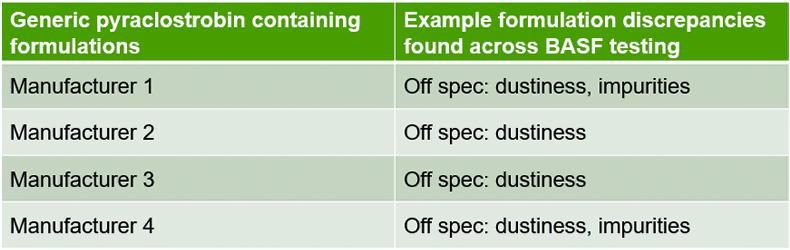
“Four generic versions of pyraclostrobin containing formulations sourced within the European market have been found to contain impurities and dustiness within the formulation, which can reduce the effectiveness and usability of the product,” Steve Dennis says.
Generic pyraclostrobin specification laboratory failures [source BASF]
Generic pyraclostrobin.
While a generic solo pyraclostrobin formulation trialled by ADAS in the UK, yielded an average of half a tonne less than Comet 200, when tested against brown rust across two trials in 2025.
Steve notes: “Since its introduction in 1997, BASF’s pyraclostrobin formulations have been reviewed and refined repeatedly to ensure regulatory compliance and field performance.
“This continuous development is carried out in line with the current state of the art approaches. In the case of Comet, the 1997 cereal formulation was fundamentally revised in 2003 and 2020. Investigations have shown that the generic formulation in the ADAS trial has similarities with the BASF formulation from 2003 – but does not reflect the latest BASF formulation technology.
Comet® 200 vs. generic pyraclostrobin, ADAS [source BASF]
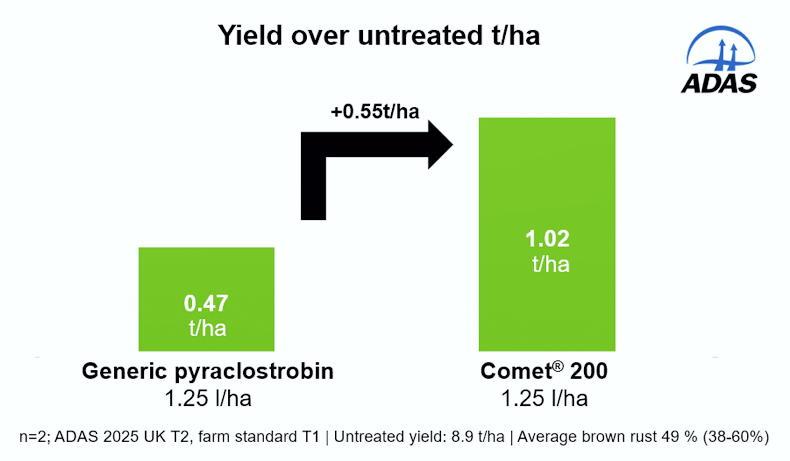
Yield over untreated t/ha.
A defining feature of BASF formulations is the use of proprietary, in-house raw materials, such as adjuvants. These innovative adjuvants have been critical for achieving a key objective of the Comet® 200 formulation – improving the uptake of pyraclostrobin into the plant.
Efficient uptake is a crucial feature when it comes to managing early season diseases like Yellow Rust in wheat or Net Blotch in barley.
Natural wax layers on leaves act as a barrier designed to exclude external substances, therefore specific uptake-enhancing adjuvants are incorporated into BASF pyraclostrobin formulations to help overcome this barrier and improve the proportion of active ingredient entering the plant over time.
Why formulation matters
When it comes to formulation, BASF products are much more than the active ingredients. For example, in the case of Comet® 200, the active ingredient, pyraclostrobin, only makes up around 20% of the finished product. The rest comprises of additional ingredients to optimise the performance of the active ingredient.
Inside every product there is a suite of unique emulsifiers, wetting agents, surfactants and other components, developed by BASF to specifically enhance its active ingredients. Together, they are a complete solution, that ensures optimal performance.
Improved targeting with minimal drift – each product has a unique combination that optimises droplet size, coverage and retention.
Optimised uptake – the adjuvants ensure active ingredients effect their target quickly, whatever the mode of action.
Enhanced durability – BASF products are fine tuned for longevity with components delivering rainfastness and the ability to resist UV degradation.
Stable solutions – emulsifiers maintain active ingredients in solution from the can to the leaf.
Each year BASF Agricultural Solutions invests just under €1 billion into research and development, which includes formulation development for both new and existing active ingredients. There are over 100 formulation experts dedicated to improving every aspect of our products performance.
The expertise that goes into every single drop of BASF chemistry turns active ingredients into farm level solutions that protect crops, protect you, and protect your bottom line.
FIND A CROP PROTECTION SOLUTION YOU CAN TRUST
Disclaimer
Use plant protection products safely. Always read the label and product information before use. For further product information including warning phrases and symbols, refer to www.agricentre.basf.ie.
Comet® 200 contains pyraclostrobin. Comet® 200 is a registered trademark of BASF.

Know what you are buying
Steve Dennis, BASF UK’s head of business and technical development says that post-patent generic products may suggest that what’s in the can is identical to the R&D brand, but this is not feasible, because the original developer of the active ingredient will never publish the full formulation of the product that reaches the market.
He adds that, while active ingredients remain the cornerstone of crop protection performance, it is the formulation that unlocks their full potential – optimising pathogen control, enhancing coverage and uptake, and improving stability.

Steve Dennis, BASF UK’s head of business and technical development.
He cites the risks based on his own and growers’ experience – blocked sprayer nozzles, settling out in the tank, and sometimes errors on packaging that affect record-keeping, and at worst, product useability.
“Crucially though, it’s also field performance that matters, and our own, and independent trials, have shown how both disease control efficacy and resulting yield impact are significantly poorer.”
BASF v generic pyraclostrobin formulations
Pyraclostrobin remains an important active ingredient for cereal, pulse and vegetable growers, sold as the brand Comet® 200 and contained within Signum® and other BASF brands.
In BASF labs, field tests and independent field trials, generic alternatives frequently fall short of stringent quality standards, important for product performance, crop safety and ensuring the active ingredient remains on the market.
“Four generic versions of pyraclostrobin containing formulations sourced within the European market have been found to contain impurities and dustiness within the formulation, which can reduce the effectiveness and usability of the product,” Steve Dennis says.
Generic pyraclostrobin specification laboratory failures [source BASF]

Generic pyraclostrobin.
While a generic solo pyraclostrobin formulation trialled by ADAS in the UK, yielded an average of half a tonne less than Comet 200, when tested against brown rust across two trials in 2025.
Steve notes: “Since its introduction in 1997, BASF’s pyraclostrobin formulations have been reviewed and refined repeatedly to ensure regulatory compliance and field performance.
“This continuous development is carried out in line with the current state of the art approaches. In the case of Comet, the 1997 cereal formulation was fundamentally revised in 2003 and 2020. Investigations have shown that the generic formulation in the ADAS trial has similarities with the BASF formulation from 2003 – but does not reflect the latest BASF formulation technology.
Comet® 200 vs. generic pyraclostrobin, ADAS [source BASF]

Yield over untreated t/ha.
A defining feature of BASF formulations is the use of proprietary, in-house raw materials, such as adjuvants. These innovative adjuvants have been critical for achieving a key objective of the Comet® 200 formulation – improving the uptake of pyraclostrobin into the plant.
Efficient uptake is a crucial feature when it comes to managing early season diseases like Yellow Rust in wheat or Net Blotch in barley.
Natural wax layers on leaves act as a barrier designed to exclude external substances, therefore specific uptake-enhancing adjuvants are incorporated into BASF pyraclostrobin formulations to help overcome this barrier and improve the proportion of active ingredient entering the plant over time.
Why formulation matters
When it comes to formulation, BASF products are much more than the active ingredients. For example, in the case of Comet® 200, the active ingredient, pyraclostrobin, only makes up around 20% of the finished product. The rest comprises of additional ingredients to optimise the performance of the active ingredient.
Inside every product there is a suite of unique emulsifiers, wetting agents, surfactants and other components, developed by BASF to specifically enhance its active ingredients. Together, they are a complete solution, that ensures optimal performance.
Improved targeting with minimal drift – each product has a unique combination that optimises droplet size, coverage and retention.
Optimised uptake – the adjuvants ensure active ingredients effect their target quickly, whatever the mode of action.
Enhanced durability – BASF products are fine tuned for longevity with components delivering rainfastness and the ability to resist UV degradation.
Stable solutions – emulsifiers maintain active ingredients in solution from the can to the leaf.
Each year BASF Agricultural Solutions invests just under €1 billion into research and development, which includes formulation development for both new and existing active ingredients. There are over 100 formulation experts dedicated to improving every aspect of our products performance.
The expertise that goes into every single drop of BASF chemistry turns active ingredients into farm level solutions that protect crops, protect you, and protect your bottom line.
FIND A CROP PROTECTION SOLUTION YOU CAN TRUST
Disclaimer
Use plant protection products safely. Always read the label and product information before use. For further product information including warning phrases and symbols, refer to www.agricentre.basf.ie.
Comet® 200 contains pyraclostrobin. Comet® 200 is a registered trademark of BASF.
SHARING OPTIONS