Spring is already a demanding time on dairy farms. With calving, breeding and turnout competing for attention, moving suitable vaccinations into winter could ease the workload - and may help cows mount a better response.
That was the message from Zoetis Area Veterinary Manager Kieran O’Mahony during a recent farmer webinar. He noted that cows around calving and early lactation can be under considerable pressure: feed intake may lag behind milk production, while stress and health challenges can affect the immune response. Winter, when cows are housed and generally in better body condition, may offer a more practical window for some vaccines.
Dennis Howard from Munster Bovine highlighted how their herd health programme can provide valuable insights for farmers to discuss further with their vets, including the potential for vaccination programmes.
Both Leptospirosis vaccination with Spirovac and the Yearly Rispoval IBR booster could be moved from spring to winter.
O’Mahony said Spirovac for leptospirosis can be given at any stage of pregnancy and lactation. Moving these vaccinations forward from spring to winter also avoids crowding vaccination around breeding. For example, a farmer who traditionally vaccinated heifers for lepto in February or March could start the process a little earlier in November/December.
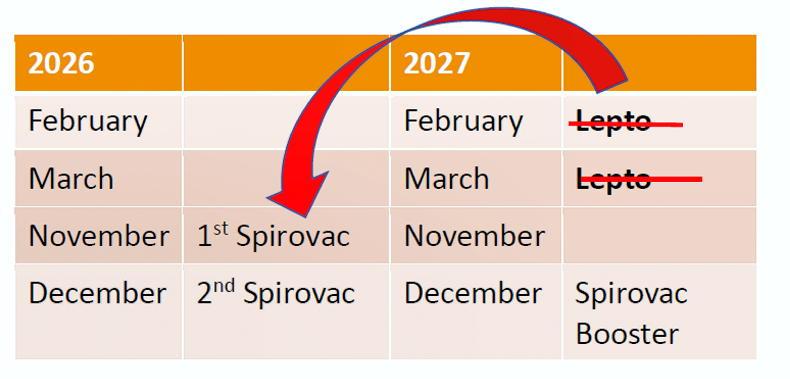
The primary course consists of two 2 mL subcutaneous injections, given four to six weeks apart, followed by a single 2 mL annual booster.
The booster can therefore be given the following December, when both cows and farmers are under much less pressure.
December is a quieter time on the farm. Although cows still need to be fed, milking has stopped, and there are no newborn calves or freshly calved cows to worry about. For farmers, the practical gain is that a job is moved out of the busiest period, when all the cattle are housed and close at hand. At this time, cows are also healthy and metabolically stable, and their body condition is often improving, so an optimal vaccination response can be expected.
Timing still matters. O’Mahony advised against combining vaccination with dry-off day, when cows are already facing a management change. Vaccines also need to be stored and administered according to their label: maintain the cold chain, use the correct dose and route, and allow enough time for immunity to develop before likely disease exposure.
Kieran encouraged farmers to discuss options to implement winter vaccinations with their vet. A little planning now could mean fewer jobs—and less pressure—when spring arrives.
Rispoval® IBR-Marker inactivated and Rispoval® IBR-Marker live contain Bovine Herpes Virus type 1 (BoHV-1), strain Difivac (gE-negative). POM(E). Spirovac® contains Inactivated Leptospira borgpetersenii serovar Hardjo. LR
For further information please see SPC or contact Zoetis(www.zoetis.ie). Prescription decisions are for the person issuing the prescription alone. Use medicine responsibly (www.apha.ie ) (www.noah.co.uk).