Anyone who has worked in a sports-adjacent role will know the old one-two. During a conversation about their job, the other person will inevitably ask, with a mix of wonderment and envy: “And so do you get in to all the matches for free?”
Confirmation of same will then elicit something along the lines of, “In fairness, you’ve some life.”
There’s no denying that there are pros to such posts but, equally, the line, “If it was so easy, then everyone would do it,” also holds true.
For much of his professional life, Marcus Ó Buachalla has been in the sporting sphere, first with Pembroke Communications, then Teneo, and now Leinster Rugby, for whom he is senior communications and media manager.
Such a role can make for busy matchdays – and an element of necessary detachment – but the passion still remains, which is the most important thing.
“On the one hand, there is still a bit of that grá still there – on a match day, and you’re getting that access or you’re seeing things that you know your mates or your pals would love to see,” he says.
“The flipside of it is that it is a job, and you do have to deal with very serious issues; a lot of the stuff lands in on your desk.
“Is it enjoyable? Absolutely. My office is the RDS or the Aviva or even Croke Park, so there’s worse places to be working for sure but, at the end of the day, it is a job and you have to make sure that you have the professional side front and centre all the time.
“When you’re in Croke Park in front of 50,000 people and the URC is being presented, ultimately to your friends and your colleagues – people see them as players, but ultimately, these are lads that I’ve got to know over the years – it’s a pretty special feeling and not many other jobs give you that buzz than working in sport and seeing those special days.
“They’re dark days too, don’t get me wrong, but as far as I’m aware, I can’t put a ball over the try-line or I can’t kick the ball through the post, so I can only focus on what I can focus on.
“That’s trying to enjoy as best I can the fact that we work in a sporting environment, and I don’t take that for granted.”
Going from a varied role with Pembroke, where Ó Buachalla would have had a number of different clients, to a focused one with Leinster in 2014 was obviously a major change. Then, over the period since, there has been a transformation in the media landscape.
“When I started, it was just me and Conor Sharkey, who was just off an internship and in his first full-time job,” he says.
“We would have used a supplier videographer that we would have brought in on a contract basis when I started out, whereas now we have an in-house team of two videographers and another who’s excellent at editing and producing.
“We’re now content creators and producers, whereas when I started out, we were very much reliant on traditional media to get our messaging out there for us.”
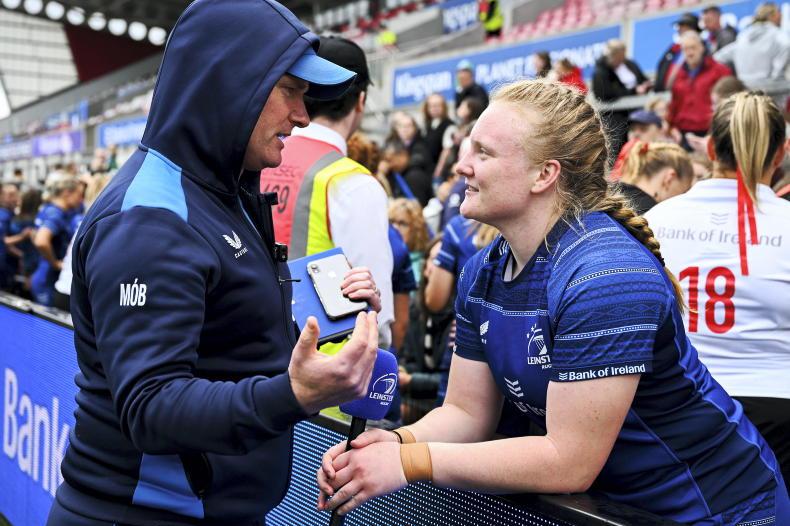
Marcus Ó Buachalla with Aoife Wafer after the Vodafone Women’s Interprovincial Championship match between Ulster and Leinster last year. \Shauna Clinton/Sportsfile
That messaging is of course two-pronged.
“There’s the professional team that people would see on a Friday and Saturday playing in the URC or in the Champions’ Cup,” Ó Buachalla says.
“But the other side of what we do in Leinster Rugby is we’re trying to put a ball into the hands of the young boys and girls in the communities of the 12 counties of Leinster.”
He has worked with Leo Cullen in various guises over the years prior to him becoming head coach and was keen to get a sense of how he wanted to do things.
“What he said to me was, ‘If it impacts the 80 minutes, you don’t have to ask me the second question.’ I was like, ‘OK, well, what’s the second question?’
“And he says, ‘Well, does it benefit Leinster Rugby?’ So he says that if it doesn’t impact the 80 minutes and it benefits Leinster Rugby, we’re on to something here and we can make it work.
“So I had a really good, clear understanding then from my first meeting with Leo about how he wanted to go about the communication piece. And ever since then – look, I’ve been working with him for nine, 10 years now as a head coach and me as head of comms and it’s been brilliant to have that clarity with Leo at that time.”
All-inclusive approach
That then allows Ó Buachalla and Paul Cahill, the digital campaign and content manager, to aim for an all-inclusive approach.
“There was that perception – and you can argue there still is a perception – of Leinster Rugby being South County Dublin and private schools,” says Ó Buachalla.
“Don’t get me wrong, there’s a massive element to that, to the school game and the role that that played in our player pathway, but we’re also very, very mindful of the 70-plus clubs that are out there.
“I think Leo, as the figurehead for the professional game and a Wicklow man, understands the important link that ties the professional game to the grassroots.
“Already this season, we’ve had an open training session in Old Belvedere – which is in South County Dublin – but also open sessions at Greystones and Wicklow Rugby Clubs and it was the same last year.
“If we’re not communicating with the grassroots and not getting out there and promoting the game among the boys and girls, then you’re not going to have players coming right the way through to the very top.”
Anyone who has worked in a sports-adjacent role will know the old one-two. During a conversation about their job, the other person will inevitably ask, with a mix of wonderment and envy: “And so do you get in to all the matches for free?”
Confirmation of same will then elicit something along the lines of, “In fairness, you’ve some life.”
There’s no denying that there are pros to such posts but, equally, the line, “If it was so easy, then everyone would do it,” also holds true.
For much of his professional life, Marcus Ó Buachalla has been in the sporting sphere, first with Pembroke Communications, then Teneo, and now Leinster Rugby, for whom he is senior communications and media manager.
Such a role can make for busy matchdays – and an element of necessary detachment – but the passion still remains, which is the most important thing.
“On the one hand, there is still a bit of that grá still there – on a match day, and you’re getting that access or you’re seeing things that you know your mates or your pals would love to see,” he says.
“The flipside of it is that it is a job, and you do have to deal with very serious issues; a lot of the stuff lands in on your desk.
“Is it enjoyable? Absolutely. My office is the RDS or the Aviva or even Croke Park, so there’s worse places to be working for sure but, at the end of the day, it is a job and you have to make sure that you have the professional side front and centre all the time.
“When you’re in Croke Park in front of 50,000 people and the URC is being presented, ultimately to your friends and your colleagues – people see them as players, but ultimately, these are lads that I’ve got to know over the years – it’s a pretty special feeling and not many other jobs give you that buzz than working in sport and seeing those special days.
“They’re dark days too, don’t get me wrong, but as far as I’m aware, I can’t put a ball over the try-line or I can’t kick the ball through the post, so I can only focus on what I can focus on.
“That’s trying to enjoy as best I can the fact that we work in a sporting environment, and I don’t take that for granted.”
Going from a varied role with Pembroke, where Ó Buachalla would have had a number of different clients, to a focused one with Leinster in 2014 was obviously a major change. Then, over the period since, there has been a transformation in the media landscape.
“When I started, it was just me and Conor Sharkey, who was just off an internship and in his first full-time job,” he says.
“We would have used a supplier videographer that we would have brought in on a contract basis when I started out, whereas now we have an in-house team of two videographers and another who’s excellent at editing and producing.
“We’re now content creators and producers, whereas when I started out, we were very much reliant on traditional media to get our messaging out there for us.”
Marcus Ó Buachalla with Aoife Wafer after the Vodafone Women’s Interprovincial Championship match between Ulster and Leinster last year. \Shauna Clinton/Sportsfile
That messaging is of course two-pronged.
“There’s the professional team that people would see on a Friday and Saturday playing in the URC or in the Champions’ Cup,” Ó Buachalla says.
“But the other side of what we do in Leinster Rugby is we’re trying to put a ball into the hands of the young boys and girls in the communities of the 12 counties of Leinster.”
He has worked with Leo Cullen in various guises over the years prior to him becoming head coach and was keen to get a sense of how he wanted to do things.
“What he said to me was, ‘If it impacts the 80 minutes, you don’t have to ask me the second question.’ I was like, ‘OK, well, what’s the second question?’
“And he says, ‘Well, does it benefit Leinster Rugby?’ So he says that if it doesn’t impact the 80 minutes and it benefits Leinster Rugby, we’re on to something here and we can make it work.
“So I had a really good, clear understanding then from my first meeting with Leo about how he wanted to go about the communication piece. And ever since then – look, I’ve been working with him for nine, 10 years now as a head coach and me as head of comms and it’s been brilliant to have that clarity with Leo at that time.”
All-inclusive approach
That then allows Ó Buachalla and Paul Cahill, the digital campaign and content manager, to aim for an all-inclusive approach.
“There was that perception – and you can argue there still is a perception – of Leinster Rugby being South County Dublin and private schools,” says Ó Buachalla.
“Don’t get me wrong, there’s a massive element to that, to the school game and the role that that played in our player pathway, but we’re also very, very mindful of the 70-plus clubs that are out there.
“I think Leo, as the figurehead for the professional game and a Wicklow man, understands the important link that ties the professional game to the grassroots.
“Already this season, we’ve had an open training session in Old Belvedere – which is in South County Dublin – but also open sessions at Greystones and Wicklow Rugby Clubs and it was the same last year.
“If we’re not communicating with the grassroots and not getting out there and promoting the game among the boys and girls, then you’re not going to have players coming right the way through to the very top.”






SHARING OPTIONS