


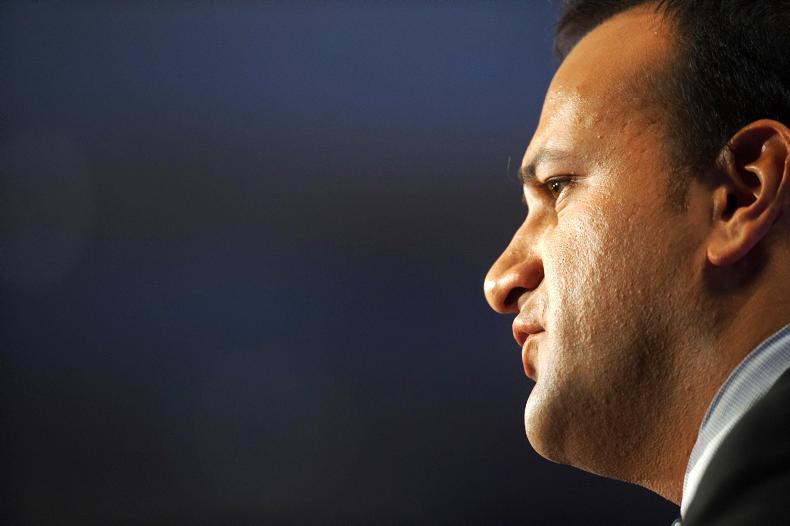
An Taoiseach Leo Varadkar has praised the “extraordinary performance” of Ireland’s agri-food sector but warned of potential threats to the industry at the IFA annual general meeting.
Highlighting the record €13.5bn of Irish food and drink exports in 2017, he noted: “That’s more than a 70% increase in export value since 2009.”
“It’s an extraordinary performance of which you should be proud and for which, on behalf of the Irish people, I thank you.
“Foodwise projects an ambitious further increase in exports to €19bn by 2025. We also plan to increase employment by 23,000 in the same period.”
Disruptive changes
However he warned of the “long-term, structural and disruptive changes” that could happen as a result of Brexit.
“The agri-food sector is uniquely exposed – 35% of our total agri-food exports, worth over €4.4bn, are to the UK. Some industries are significantly more exposed, like beef,” the Taoiseach noted.
“Even in the absence of tariffs, barriers such as sanitary and customs controls, transport logistics and shelf life, are much more significant barriers for food than for other exports.
“That is why we negotiated so long and so hard in the weeks before Christmas. At stake is the future of Ireland, our peace and prosperity.”
Watch An Taoiseach Leo Varadkar's speech introduced by IFA president Joe Healy in our video below:
Although he highlighted Brexit risks, Taoiseach Varadkar was positive about the outcome of negotiations. "I'm confident a hard Brexit is something we can avoid – it would be catastrophic for this industry," he said.
He then promised: “We are in this together and I want you to know: this Government will always have your back.”
Mercosur negotiations
Highlighting important trading arrangements between Ireland and European countries, the US, China and Japan, the Taoiseach admitted that the EU-Mercosur negotiations pose “a significant threat to the Irish and European beef sector”.
He told farmers: “We have worked closely with other member states to ensure that Ireland’s sensitivities are well understood.
“Ireland without our beef industry, quite simply, would not be Ireland.”
CAP budget
Taoiseach Varadkar addressed farmer fears about the CAP budget post-Brexit.
“I know that the future of the CAP is a major concern for many of you here today. Ireland has argued and will continue to argue for the retention of a strong, well-funded and effective CAP Budget post-2020,” he said.
“We believe that if the EU wants to do new things, and it should, we should find new money. It should not come from cuts in established, well-functioning programmes like CAP, Erasmus or Research.
On domestic schemes, he confirmed that changes to means testing under the Fair Deal nursing home scheme were on the way for farmers.
Varadkar: "We intend to make changes to the Fair Deal to make it fairer for farmers" #IFAAGM
— Farmers Journal (@farmersjournal) January 16, 2018
Climate change
Referring to greenhouse gas emissions, the Taoiseach said Ireland is already one of the world’s most efficient food producers in terms of carbon footprint per unit of output.
“Clear evidence of this comes from the decoupling of emissions from output in agriculture. Milk production increased by 13.2%, while emissions increased by 1.6%,” he said.
“But the fact remains that emissions increased and are expected to rise by between 4% and 5% by 2020, reflecting expansion in this sector,” he warned.
“We need to do much more to improve the sustainability of this industry. We cannot underestimate the importance and scale of this challenge.”
Calf exporters keen for bigger numbers


SHARING OPTIONS