Since 2019, we have been monitoring herbicide resistance in wild oats. A total of 172 resistance-suspect populations have been tested, of which 95 (55%) were confirmed as resistant.
Most cases of wild oat resistance have occurred in fields where the same herbicide, or herbicides with the same mode of action, have been used repeatedly. Around 80% of resistant populations originated from spring barley fields.
This emerging picture should not be ignored. Although these samples come from suspect fields, they may reflect wider resistance trends developing across the country.
Evidence from Canada, where wild oats are a major problem, has also shown good agreement between suspect samples and random resistance surveys.
In the 2025 harvest, worryingly, we identified two new resistance patterns in suspect populations submitted for testing that had not been previously recorded, posing a serious concern.
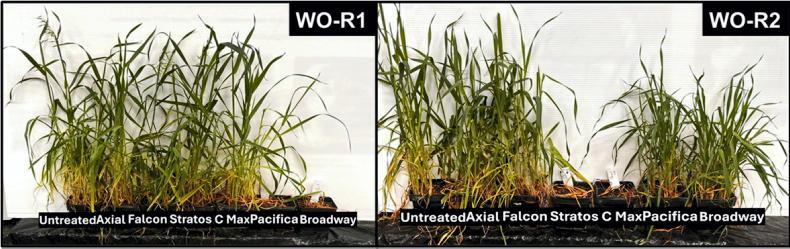
Figure 1: symptoms of resistant wild oat populations (WO-R1 and WO-R2) following application of ACCase Axial, Falcon, Stratos, Centurion (C Max) and ALS Pacifica and Broadway herbicides at recommended label rates on plants grown to the three- to four-leaf stage. Where treated plants are absent from a square, full control was achieved.
WO-R1 population, from a spring barley field in Co Wexford, showed cross-resistance to all herbicides from the ACCase group (Axial, Falcon, Stratos and Centurion), while alternative ALS herbicides (Pacifica and Broadway) remained effective.
WO-R2 population, from a winter wheat field in Co Carlow, showed multiple resistance to both ACCase (Axial and Falcon) and ALS (Pacifica and Broadway) herbicides, but graminicide herbicides Stratos and Centurion remained effective.
Key points
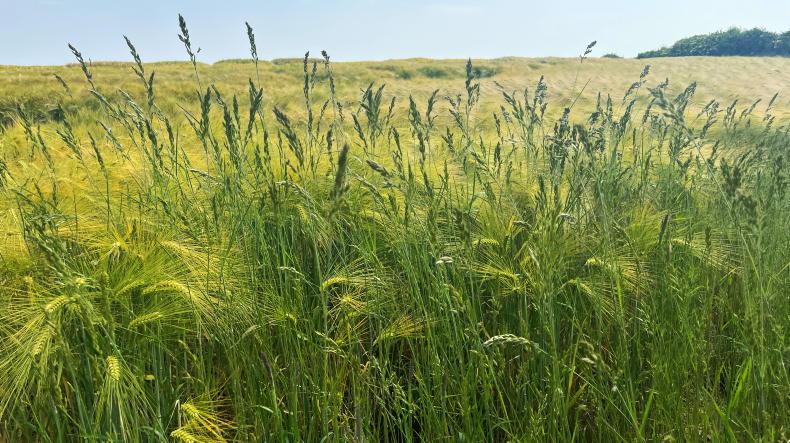
Wild oats, such as blackgrass, are noxious weeds.Reliance on a single product, without integrated strategies, will drive resistance across the entire mode of action group.Resistance now detected to ALS herbicides (Pacifica and Broadway) means effective chemical control options are narrowing.High-risk farms (continuous spring barley with repeated use of Axial) should remain especially vigilant.Cultural and non-chemical control (eg crop rotations, stale seedbeds, hand rogueing, machinery hygiene and on-farm biosecurity) should be the first line of defence. Herbicides should be used judiciously, at full rate and at the correct growth stage; in heavily infested fields, more drastic measures (eg crop destruction, whole cropping or the use of grass leys) may be required to prevent further spread.
Since 2019, we have been monitoring herbicide resistance in wild oats. A total of 172 resistance-suspect populations have been tested, of which 95 (55%) were confirmed as resistant.
Most cases of wild oat resistance have occurred in fields where the same herbicide, or herbicides with the same mode of action, have been used repeatedly. Around 80% of resistant populations originated from spring barley fields.
This emerging picture should not be ignored. Although these samples come from suspect fields, they may reflect wider resistance trends developing across the country.
Evidence from Canada, where wild oats are a major problem, has also shown good agreement between suspect samples and random resistance surveys.
In the 2025 harvest, worryingly, we identified two new resistance patterns in suspect populations submitted for testing that had not been previously recorded, posing a serious concern.

Figure 1: symptoms of resistant wild oat populations (WO-R1 and WO-R2) following application of ACCase Axial, Falcon, Stratos, Centurion (C Max) and ALS Pacifica and Broadway herbicides at recommended label rates on plants grown to the three- to four-leaf stage. Where treated plants are absent from a square, full control was achieved.
WO-R1 population, from a spring barley field in Co Wexford, showed cross-resistance to all herbicides from the ACCase group (Axial, Falcon, Stratos and Centurion), while alternative ALS herbicides (Pacifica and Broadway) remained effective.
WO-R2 population, from a winter wheat field in Co Carlow, showed multiple resistance to both ACCase (Axial and Falcon) and ALS (Pacifica and Broadway) herbicides, but graminicide herbicides Stratos and Centurion remained effective.
Key points
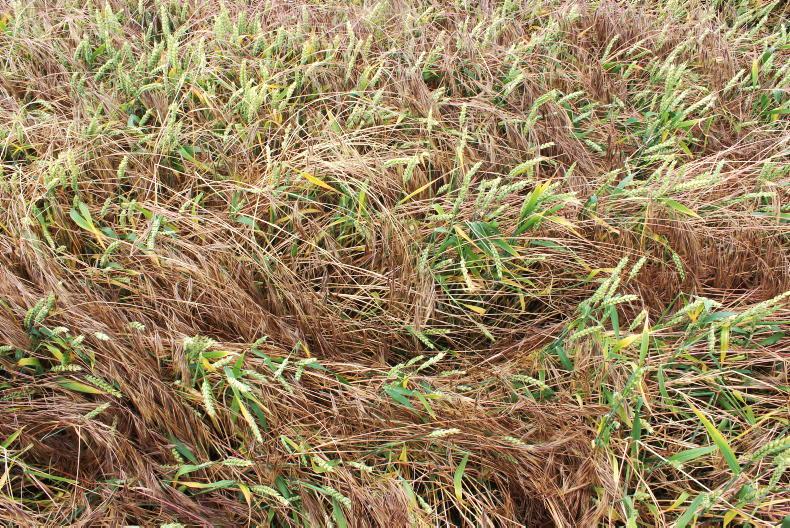
Wild oats, such as blackgrass, are noxious weeds.Reliance on a single product, without integrated strategies, will drive resistance across the entire mode of action group.Resistance now detected to ALS herbicides (Pacifica and Broadway) means effective chemical control options are narrowing.High-risk farms (continuous spring barley with repeated use of Axial) should remain especially vigilant.Cultural and non-chemical control (eg crop rotations, stale seedbeds, hand rogueing, machinery hygiene and on-farm biosecurity) should be the first line of defence. Herbicides should be used judiciously, at full rate and at the correct growth stage; in heavily infested fields, more drastic measures (eg crop destruction, whole cropping or the use of grass leys) may be required to prevent further spread.
SHARING OPTIONS