


This summer, a number of farmers in Ireland had direct contact with the SoilQuest precision agronomy system. Described as a system that connects agronomy with precision farming, this is a potentially useful management package on larger land parcels especially where ditches were knocked to make fields bigger.
The system combines information on soil type with fertility information and then generates precision application software to control where the spreader applies different rates of a product based on soil requirement across a field.
SoilQuest introduces precision technology by initially scanning your soil to produce a soil texture map across a land bank. This is an on-the-move operation where an electrical conductivity scanner is pulled across a field at regular intervals.
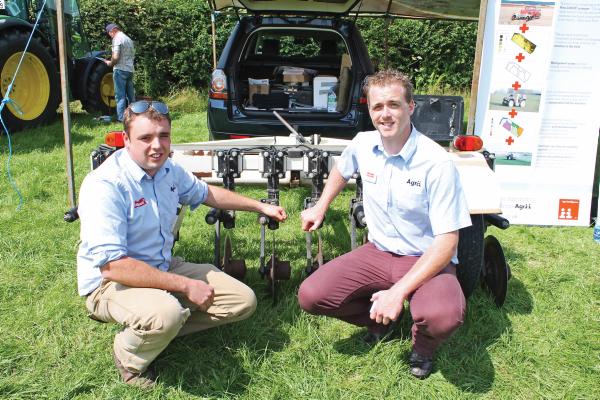
The machine used, called a Veris 3100 soil electrical conductivity scanner, sends electrical current down through a soil engaging disc and then measures the transfer of this current in the soil by collecting it in another soil engaging disc.
The ability of the current to flow through the soil is influenced by the amount of clay in the soil. And this process is conducted at two working depths – 30cm and 90cm – to help get a better 3D image of the texture of the soil.
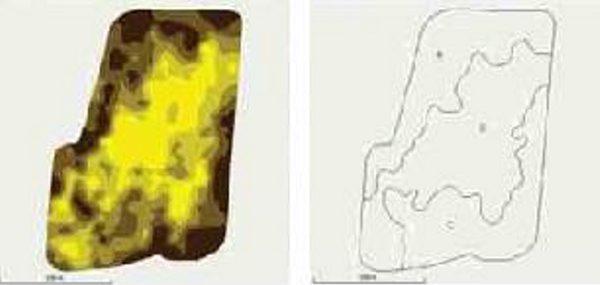
The conductivity analysis produces a soil type map (left above). This is interesting for a field and even more so for adjoining fields. The map will show the degrees of electrical conductivity within the field and this is then inferred as soil texture variation by responding to the amount of clay in the different zones. But as electrical conductivity is also influenced by soil moisture content, one must still be careful in the interpretation of these results.
Fertility analysis
Once the initial soil type map is created, each field is divided into management zones to broadly correlate with the soil type map, as soil texture has a direct implication on a soil’s ability to hold or lose nutrients.
Each management zone is then sampled for soil fertility. The soil test results from these management zones are then interpreted to produce soil analysis maps.
These are then used to generate fertilizer recommendations and precision application files are created to control variable spreaders which do the application.
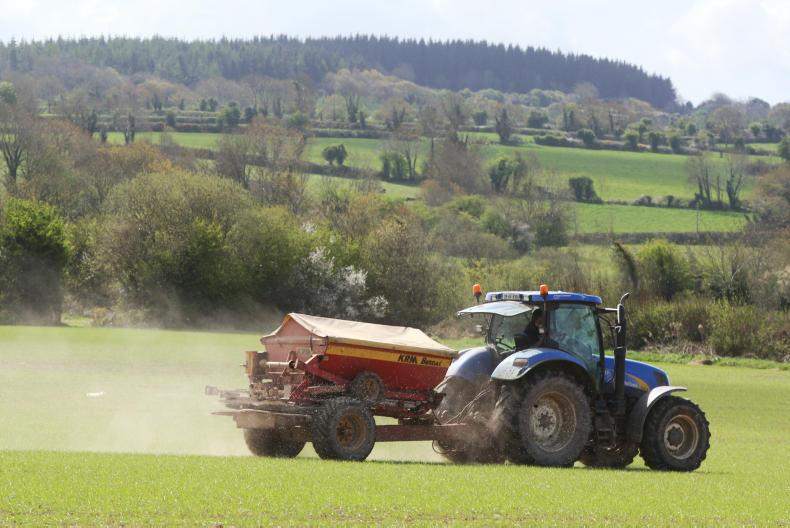
A variable spreader can then apply the appropriate amount of fertilizer to each zone as it passes along the tramlines. The objective is that each zone is more appropriately fertilized to optimise its fertility and maximise its yield potential.
Caution
A note of caution must be urged here though. The basis of this fertility map will be the soil type zones from which it was created. However, growers with an individual knowledge of the different parts of their own fields may identify variation within these soil type zones which may also be influenced by fertility.
It is certainly possible that significant soil fertility variation, either on P or K or pH, can occur on a uniform soil type and this can be hidden in this analysis alone.
So let growers’ experience also dictate where soil samples should be taken separately. The two information sources combined can then be used to more accurately adjust fertility in the medium term. This fertility improvement might also involve differential lime application to correct soil pH.
Application and cost
The ability to differentially apply fertilizer depends on the generation of application maps that control the application rate on the fertilizer spreader.
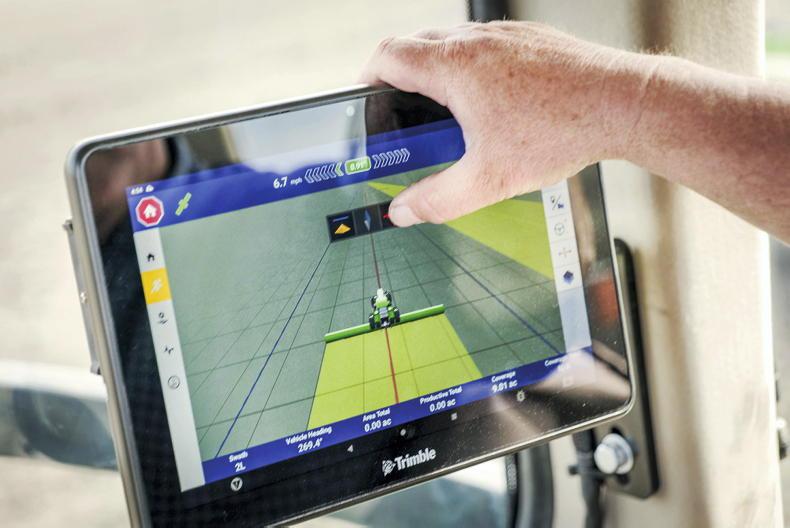
A variable rate spreader is essential, which means a spreader fitted with load cells linked into a GPS control system. This controls the rate to be applied on each specific area. So some form of basic GPS system is needed on the tractor to tell the spreader where exactly it is in the field to control the rate in each specific zone.
The cost of the analysis was £26/hectare (incl VAT) to start with (€29.90/ha) and then there were supplementary charges for the next test after a few years, plus costs to make maps etc.
This is now changing to two total costs – £13/ha to cover the first four years plus £9/ha to cover the next set of tests. This includes the conductivity testing, the initial soil testing in the soil type zones, producing the application maps and a follow-up soil test after four years.
Obviously, this testing methodology is only of use to growers who have access to GPS controlled variable fertilizer application technology. However, it has the potential to be of great value on many farms. It can also be tapped into variable rate seed drills to alter seeding rate on different soil types.




SHARING OPTIONS