



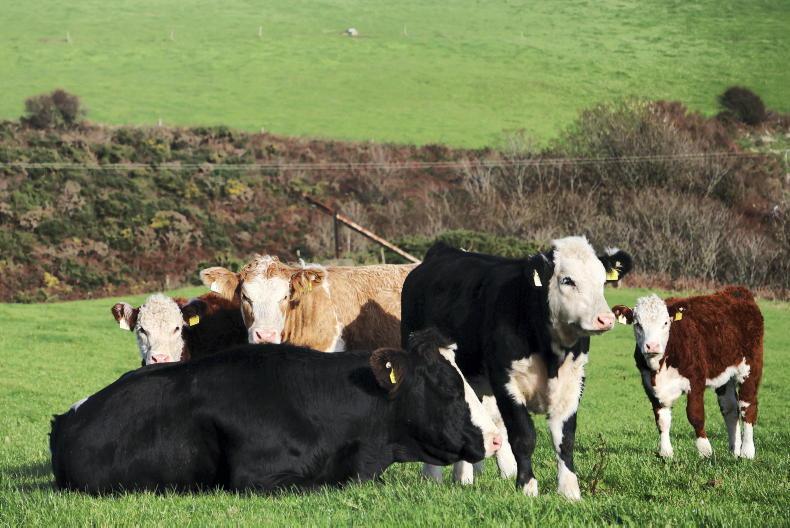
Last week’s Teagasc figures showing a 29% cut in suckler numbers by the end of the decade with continued growth in dairy cows - even if the rate of growth is slowing - has provoked an angry response from suckler farmers, as reported in this week's Irish Farmers Journal.
While seeing it in the context of the latest Teagasc marginal abatement cost curve (MACC) calculation has crystalised the reality, in truth the suckler herd has been in decline for years.
A quick glance at the decline in the number of suckler cows over the past decade makes grim reading.
In 2013, the number was almost 1.1m, but fell steadily until it was just above 1m in 2018.
The rate of decline has accelerated since then and now sits at less than 850,000 suckler cows (see Figure 1).
There is nothing in either farmgate prices or Government support to suggest anything other than this will remain the direction of travel.
Of course, the history of suckler cow development was for decades shaped by the quota cap on the dairy industry and it was reasonable to expect some realignment in the lead-up to quotas ending in 2015.
Financial package
However, what is particularly worrying is the steady decline since numbers first dipped below 1m in 2019 and the sharpest decline over recent years was between 2022 and 2023 when the herd fell by almost 5% in a year and this happened in what was considered a relatively good year for farmgate prices.
Farmgate prices have only bee one part of the equation for suckler income - the other was EU and Government support payments, which have been progressively removed and moved to land as opposed to livestock.
The Minister may correctly point to the financial package he secured for sucklers, but, ultimately, this is for a very small number of cows relative to the total herd and it is a fraction pro rata of what is being made to encourage a switch to organic production.
National park farming
Irish suckler farmers are squeezed between a beef market that doesn’t pay enough for the specialty product that it is and Government and EU policy that prioritises anything but production.
The huge investment to encourage the expansion of organic farming is a mixed blessing.
The reality for many suckler beef and sheep farmers is that there will be a huge incentive to scale back production and become organic almost by default. A side effect of this will be a further reduction in numbers in conventional beef and sheep production.
What will the impact be on the small organic farming niche that has been in existence
There is also a great unknown – what will the impact be on the small organic farming niche that has been in existence to this point, essentially dependent on a market premium for its income source?
There has been plenty of evidence in the past where as soon as there is any surplus of organic produce coming off farms, it finishes up being sold in conventional markets without an organic premium.
That risk only increases as production increases and beef and lamb in particular, already perceived by many as the luxury meats and most vulnerable in times of food price inflation as at present, become particularly exposed.
Land use competition
There is also the question of land use priorities over the next decade.
As the nitrates requirements squeeze dairy producers, they will need more land and while tillage may be the most vulnerable, suckler hectares will work as well.
We need to grow more forestry - more marginal land currently used in suckler and or sheep farming is the obvious target. The same applies to rewetting in whatever guise that is presented.
Economic impact
There has been little consideration given to the implications of a shrunken suckler beef sector beyond the farm gate, with the exception of the KPMG report commissioned by the Irish Farmers Journal in 2021.
It didn’t model a 25% reduction in emissions, as it wasn’t the set target at the time, but a 30% reduction was modelled by KPMG.
It showed that it would mean a 22% cut to the beef herd and an 18% cut to the dairy herd - a combined total of 40%. The cost of this was put at €3.9bn to the rural economy.
The latest Teagasc modelling suggests a 29% cut in sucklers, combined with an 8% increase in dairy numbers, which is half the combined number that emerged during the KPMG exercise with a cost of €3.9bn.
It is impossible to calculate the net cost of Teagasc’s model, but it could well exceed €1bn and be concentrated in areas where beef and sheep production are unlikely to be replaced by dairying.
Teagasc has taken a lot of flak for signing the death warrant for suckler farming with its latest MACC.
However, the harsh reality is that it has just built a model based on the direction of travel over the past decade that has been hidden in full view of us all.
Suckler cow numbers were 24% lower in June 2023 than they were in June 2013, reflecting the fact that support payments have been drifting away from the most productive farmers and the market has failed to compensate.
It is simply impossible for Irish and European beef producers to go out and compete in global markets alongside North and South American plus Oceania exporters to growing Asian markets.
Ironically, in Asian markets, US grain-fed beef - including growth-promoting hormones banned in Europe - commands a premium over any suckler-based Irish offering.
So much for premium product - neither the market nor Government and EU policy really want it.



SHARING OPTIONS