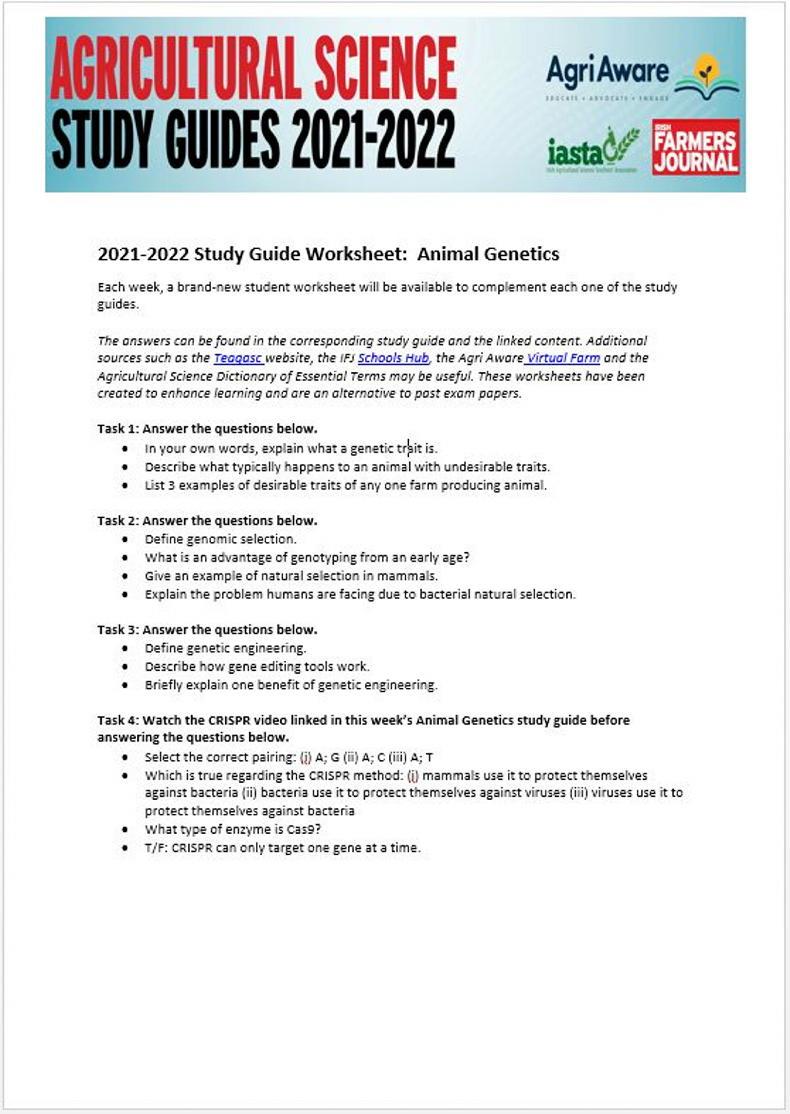
Each week, a brand-new original student worksheet will be available to complement each one of the study guides, which can be used by students in class or at home.
The original worksheets will include various tasks from comprehension exercises, dictionary work, multiple choice questions and more.
The worksheets have been designed to enhance learning of the new Leaving Certificate material and as alternatives to exam questions.
ADVERTISEMENT
The worksheets can be used as a tool to assess self-learning or, alternatively, classroom assessment.
The answers can be found in the corresponding study guide and the linked content. Additional sources such as the Irish Farmers Journal website, Teagasc website (http://www.teagasc.ie/), and the Agri Aware Virtual Farm may be useful.
Task 1: Answer the questions below.
In your own words, explain what a genetic trait is.
Describe what typically happens to an animal with undesirable traits.
List three examples of desirable traits of any one farm producing animal.
Task 2: Answer the questions below.
Define genomic selection.
What is an advantage of genotyping from an early age?
Give an example of natural selection in mammals.
Explain the problem humans are facing due to bacterial natural selection.
Task 3: Answer the questions below.
Define genetic engineering.
Describe how gene editing tools work.
Briefly explain one benefit of genetic engineering.
Task 4: Watch the CRISPR video linked in this week’s animal genetics study guide before answering the questions below.
Select the correct pairing: (i) A; G (ii) A; C (iii) A; T
Which is true regarding the CRISPR method: (i) mammals use it to protect themselves against bacteria (ii) bacteria use it to protect themselves against viruses (iii) viruses use it to protect themselves against bacteria
What type of enzyme is Cas9?
T/F: CRISPR can only target one gene at a time.
Register for free to read this story and our free stories.
This content is available to digital subscribers and loyalty code users only. Sign in to your account, use the code or subscribe to get unlimited access.
The reader loyalty code gives you full access to the site from when you enter it until the following Wednesday at 9pm. Find your unique code on the back page of Irish Country Living every week.
CODE ACCEPTED
You have full access to the site until next Wednesday at 9pm.
CODE NOT VALID
Please try again or contact support.
Each week, a brand-new original student worksheet will be available to complement each one of the study guides, which can be used by students in class or at home.
The original worksheets will include various tasks from comprehension exercises, dictionary work, multiple choice questions and more.
The worksheets have been designed to enhance learning of the new Leaving Certificate material and as alternatives to exam questions.
The worksheets can be used as a tool to assess self-learning or, alternatively, classroom assessment.
The answers can be found in the corresponding study guide and the linked content. Additional sources such as the Irish Farmers Journal website, Teagasc website (http://www.teagasc.ie/), and the Agri Aware Virtual Farm may be useful.
Task 1: Answer the questions below.
In your own words, explain what a genetic trait is.
Describe what typically happens to an animal with undesirable traits.
List three examples of desirable traits of any one farm producing animal.
Task 2: Answer the questions below.
Define genomic selection.
What is an advantage of genotyping from an early age?
Give an example of natural selection in mammals.
Explain the problem humans are facing due to bacterial natural selection.
Task 3: Answer the questions below.
Define genetic engineering.
Describe how gene editing tools work.
Briefly explain one benefit of genetic engineering.
Task 4: Watch the CRISPR video linked in this week’s animal genetics study guide before answering the questions below.
Select the correct pairing: (i) A; G (ii) A; C (iii) A; T
Which is true regarding the CRISPR method: (i) mammals use it to protect themselves against bacteria (ii) bacteria use it to protect themselves against viruses (iii) viruses use it to protect themselves against bacteria
If you would like to speak to a member of our team, please call us on 01-4199525.
Link sent to your email address
We have sent an email to your address. Please click on the link in this email to reset your password. If you can't find it in your inbox, please check your spam folder. If you can't find the email, please call us on 01-4199525.
ENTER YOUR LOYALTY CODE:
The reader loyalty code gives you full access to the site from when you enter it until the following Wednesday at 9pm. Find your unique code on the back page of Irish Country Living every week.








SHARING OPTIONS