


The early development in Irish agriculture was slow, but by the mid-1960s, output from farms was beginning to improve.
Soil fertility levels were still shockingly low and fertiliser sales were still inadequate to allow soils to reach their potential productivity. Consequently, the carrying capacity for livestock on farms was very low compared with modern times.
At this time, there was virtually unanimous agreement between all agriculturalists that increased use of fertilisers was a key factor for the nation’s endeavour to expand agricultural output.
Accurate figures for soil fertility status are hard to come by for the late 1950s, but by the late 1960s phosphorus (P) and potassium (K) levels were still low. In 1964, the average soil P and K levels were 3.2ppm and 50ppm, respectively. In modern terms, the mean P and K levels were both around Index 1. The average soil pH on permanent pasture was 5.86. In 1964, the total population of cattle was just under five million, made up of around 1.4m cows and a little over 3.5m other cattle. At this time, just over 34,000t of nitrogen (N) fertiliser was used.
Against this background, it was clear to leaders in the agricultural sector, that while significant progress had been made, Irish soils were still falling well below their production potential and more needed to be done.
Dr Tom Walsh, director of An Foras Talúntais, in conjunction with leading staff members in the Department of Agriculture, the advisory services, farming organisations and the fertiliser trade came together and decided to set up a new organisation, with fertiliser use and efficiency at its heart.
Formation of the FAI
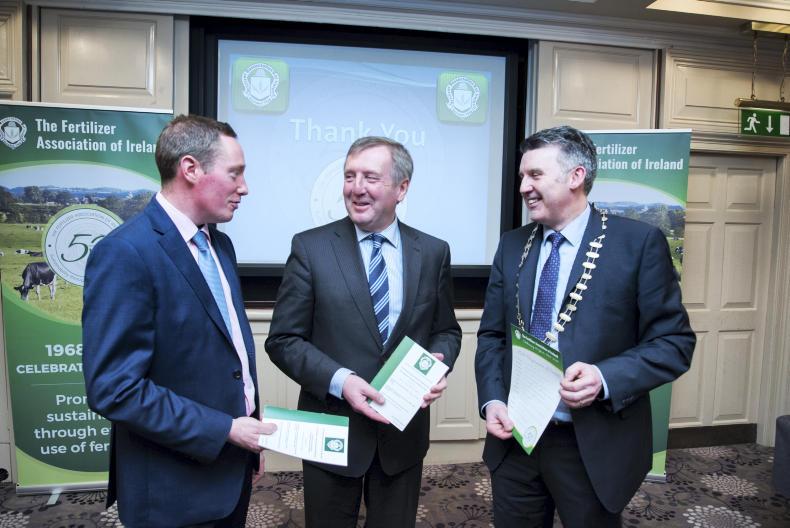
The Fertilizer Association of Ireland (FAI) was established in 1968, and its first president was Dr Tom Walsh. The objective of the FAI was straightforward: “To promote the efficient use of fertiliser in producing quality food economically.”
It was also to provide a forum for the exchange of scientific and technical information in relation to the production and use of fertilisers, including lime.
The practical aim was to promote the efficient use of fertilisers by meetings, field visits and conferences, and the publication of technical information.
In many ways, it is a unique association, by virtue of the fact that the make-up of the FAI council which under the associations constitution must be drawn from all sections of the agricultural industry, representing research, advisory, farming, administrative, wholesale and retail sections of the trade.
No one sector could hold sway, thus ensuring that debate within the FAI council was always fair and balanced, despite the often-competing interests of some sectors.
Over the years, this balance on the council has proved invaluable.
Scientists were kept grounded by the practical concerns of farmers, while the trade and the farming sectors were kept up to date by meetings that introduced and clarified the latest scientific thinking.
1968 to 1978: the early years
The FAI quickly got to work, and one of the early decisions was that all proceedings of scientific meetings would be published in full.
A flavour of some of these papers published at the time include a paper on a fertiliser use survey by well-known agronomist WE Murphy, a paper on the economics of fertiliser use by economist, Brendan Kearney, a paper by leading scientist of the day Aidan Conway on beef production present and future and papers on liming practice, and policy and fertiliser needs of the seventies by JC Brogan.
Fertiliser sales surged in the late 1960s to early 1970s, but Ireland’s entry to the European Economic Community (EEC) in 1973, which proved to be a major benefit to Irish agriculture in the long term, coincidentally coincided with a sharp drop in fertiliser sales in 1974.
This was due to a combination of rapidly escalating fertiliser costs and falling cattle prices.
It should be said that the drop-off in sales was not as dramatic as that witnessed in other European countries during this period.
By 1978, volume of sales had recovered. This suggests that Irish farmers now appreciated the value of good soil fertility and the necessity to use fertilisers to improve productivity.
1979 to 1988: wider dissemination to the farming community
In this era, the FAI’s council also felt that a mutual understanding between the various sectors on the council and ordinary members of the association could be further enhanced by having some agricultural field outings.
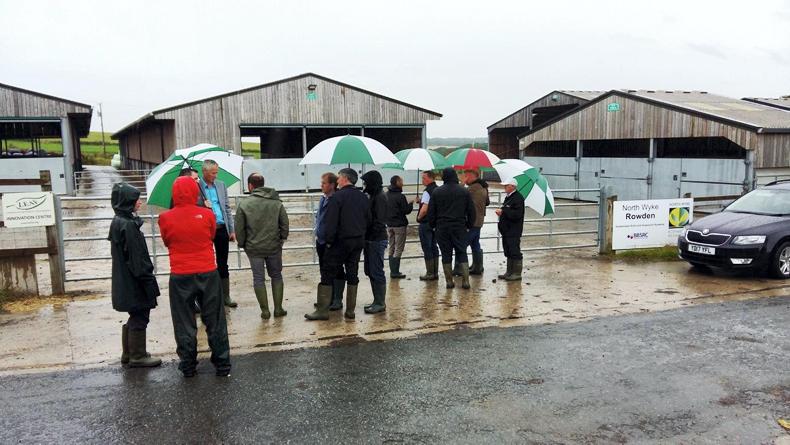
Invariably, the field trips were in the morning to various agricultural colleges and Irish research centres and to farms displaying a high degree of efficiency in dairying, tillage, beef and sheep production.
These outings were very popular for the FAI membership and wider farming community as they were organised at various locations around the country.
Around this time, the National Ploughing Championship was rapidly becoming a major event in the Irish calendar with massive numbers of farmers attending.
The FAI decided to mount a stand at this event, in order to promote efficient fertiliser use for profitable farming. This event proved to be highly successful for several years.
While the scientific meetings proceeded, it was strongly felt by the FAI council that more was needed to bring the message of efficient fertiliser use to farmers. A
decision was made to introduce a fertiliser supplement that would be published in an early spring edition of the Irish Farmers Journal. The Irish Farmers Journal embraced this idea with enthusiasm and the fertiliser and machinery industry supported this supplement with advertising. The pattern was set and each year the supplement was published.
However, the backbone of the FAI continued to be the annual scientific meetings.
The format for these meetings is that three to four formal papers are presented on the day, and these papers, fully edited and appropriately referenced are published annually in the proceedings of the FAI scientific meetings.
Some of the topics tackled during this decade include an article on fertiliser use by Liam Stafford (IFI), an article on trace elements by Garry Fleming (Teagasc, Johnstown Castle). Willie Murphy and Mal O’Keeffe (Teagasc, Johnstown Castle) wrote a few papers on fertiliser surveys. Donal McCarthy, (Teagasc, Moorepark), Prof Gerry Boyle, AFT, and well-known sheep researcher Seamus Hanrahan also published papers during that decade. Marie Sherwood (Teagasc, Johnstown Castle) and Austin Morgan (UCD) were among the first to write papers on the effects that an over-use of fertilisers could have on water quality.
1989 to 1998 – heightened environmental awareness
Over this decade the usual obligations of the FAI were carried out with enthusiasm. The Irish Farmers Journal spring fertiliser supplement was continued and expanded with great success.
The ploughing match obligations were also successfully carried out up until 1995.
However, the National Ploughing Championships invariably took place in mid- to late September, at a time when the fertiliser season was closing off and the FAI council felt that it was better to focus its attention on the springtime and further enhance the spring fertiliser supplement and associated events.
Around this time, a serious problem was emerging in agriculture and the environment.
It was becoming apparent that water quality in our rivers and lakes indicated deteriorating status. The FAI realised that, in the long-term interests of fertiliser use, a more environmentally friendly approach was needed.
Against this background, a voluntary code of practice for fertiliser use on farms was developed and published in 1991.
It was the first of its kind in Ireland and was hailed by the industry as the way forward. The FAI was widely thanked for this timely initiative.
The potential for water pollution was very serious at this stage and, in 1995, the government of the day introduced the first Rural Environmental Protection Scheme (REPS), which had strict guidelines for nutrient management.
This was a five-year voluntary programme for farmers and was followed by a further three REPS programmes and since by various environmental schemes (AEOS and GLAS) that lay down strict guidelines for fertiliser use and farm management.
Because many farms do not participate in these schemes, the FAI continued to promote its Code of Good Practice and, in 1999, it published an improved and more up-to-date version.
The FAI saw a further need to educate young farmers about nutrient management and, in 1995, it introduced a Fertiliser Management Trainee Scheme.
The best individual students selected from successful participants in the scheme in each Teagasc training centre were presented with their award by FAI council members.
1999 to 2008 – introduction of environmental legislation
REPS 2 and 3 were launched during this period and the EU took direct involvement in the protection of the environment. In 2006, the first EU Nitrates Directive – National Action Programme, (SI no. 378 of 2006) was introduced in Ireland.
The FAI took a scientific view and made a series of submissions to Brussels that were based around the Code of Good Practice.
This had some positive effects and when the eventual legislation was put into practice, the new rules and regulations, while somewhat restrictive, were manageable.
The FAI initiated an award scheme in 2000, in which the UCD agricultural science degree student who came first in the soil science examination was given a bursary.
In 2009, the “Crops Nutrient Management Course” was introduced for agronomists, advisers and technical personnel in the trade and agri-cooperatives. This course is facilitated by Teagasc at Johnstown Castle, Kildalton and Oak Park in conjunction with the FAI.
The FAI has produced 53 technical proceedings booklets over its history and over the past two years the association has made all these technical papers available on its website.
The FAI’s spring scientific meeting continues to be a great success with large attendances, and papers continue to be presented by experts both nationally and internationally.
In 2015, the FAI initiated a series of “technical bulletins” with three such bulletins produced to date and a fourth planned for 2018.
This is an ongoing project and it is hoped to produce a comprehensive series of technical bulletins covering all aspects of nutrient management and fertiliser use over time.
The FAI is now in existence for 50 years. In that time, it has fulfilled the wishes and objectives of its founding fathers. It is an association with a reputation for hard work, truth and balance. It has helped to establish a strong fertiliser industry at the heart of the agricultural sector in Ireland and has helped to ensure that the farming community are fully conversant with the sustainable use of fertilisers.
However, the association must be proactive in facing the challenges of the agricultural sector in the future, such as dwindling mined nutrient and oil resources, improving water quality, meeting greenhouse gas and ammonia emission targets and the effects of climate change.
Much work remains to be done for the FAI given that national soil test results indicate that just 11% of soils have good overall fertility in terms of pH, P and K levels.
The nutrition of our soils will need to improve if we are to achieve the Food Wise 2025 targets and to maintain a future in farming for the next generation.




SHARING OPTIONS