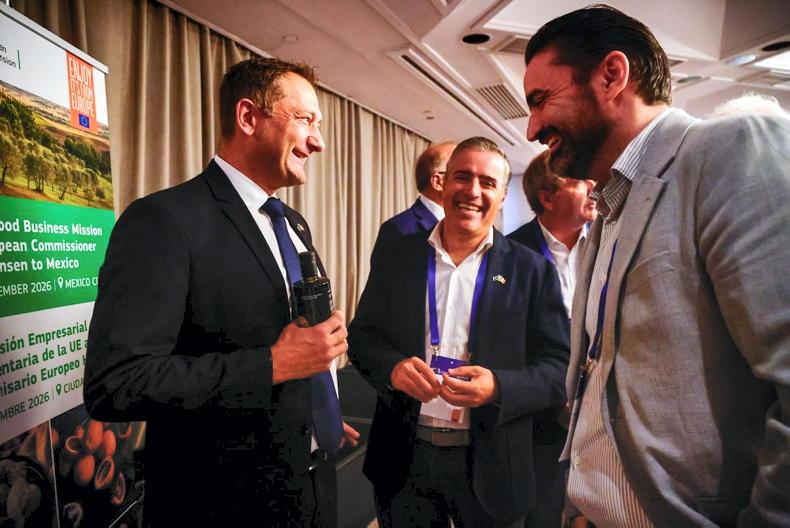
Christophe Hansen, the European Commissioner for Agriculture and Food, led an EU agri-food business mission to Mexico in the past week.
It was scheduled to include representatives from Glenstal Foods, Lakeland, Ornua and Tirlán from the dairy sector; drinks-industry representatives; and Bord Bia. There was no representative listed from the Irish meat industry.
Mexico is a major player in agri-food and a significant exporter and importer of beef and pigmeat. Much of its trade is conducted with North and South American countries.
In May this year, the EU and Mexico signed a trade agreement that updated and extended a previous agreement that had been in place since 2000.
Trade and tariffs
EU food-and-drink exports to Mexico were worth €2.5bn in 2025, of which €175m or 7% were dairy exports. Meat exports were included in the “other” category.
Bord Bia data shows that, up to September this year, €76.9m of Irish food-and-drink exports went to Mexico, with €61.2m of that made up of dairy products, with Casein accounting for €50.7m.
When the trade deal comes into effect, Mexican tariffs on pork imported from the EU, which are currently up to 45%, will be reduced to zero.
On blue cheese, the current 45% tariff will also be reduced to zero; and for other cheeses which are also subject to a 45% tariff, the tariff will be reduced to zero for a 20,000t quota.
Understandable interest
That explains the interest from Irish dairy exporters, though the tariff elimination hasn’t been sufficient to trigger participation by pigmeat exporters.
EU beef and dairy imports from Mexico are negligible at present, but this, too, may change when the recently agreed trade deal becomes operational.
It provides for a preferential 7.5% import tariff on up to 5,000t of beef, phased in over five years, and a further 5,000t of offal, again phased in over five years.
There is a 6,667t poultry quota, and a 10,000t pork hams quota, both at 7.5%, phased in over three years for the poultry and in one year for the pork.
Comment
The new trade deal will make Mexico a more accessible market for Irish dairy and pigmeat exports in particular, and the 30,000t beef quota may also create some market opportunity in time.
It is currently a tiny market in the context of overall Irish food-and-drink exports as, indeed, is the EU for imports from Mexico. The small tariffs provided for in the trade agreement suggest that we need not expect huge volumes of Mexican product flooding the EU market any time soon.
While the prospect of immediate business may be small there is, no doubt, a political dimension to the visit. Mexico – as well as Canada – is in dispute with the US over the trade agreement between the countries that was revoked by the US. Therefore, positive trade relations with the EU take on a symbolic importance even if the volume of product traded is likely to be minimal.
That said, the Commissioner did assemble a strong delegation of companies and representative organisations to join the mission. That suggests that while there may be no immediate prospect for major sales, it is a market that commercial interests see as being worth a look.