



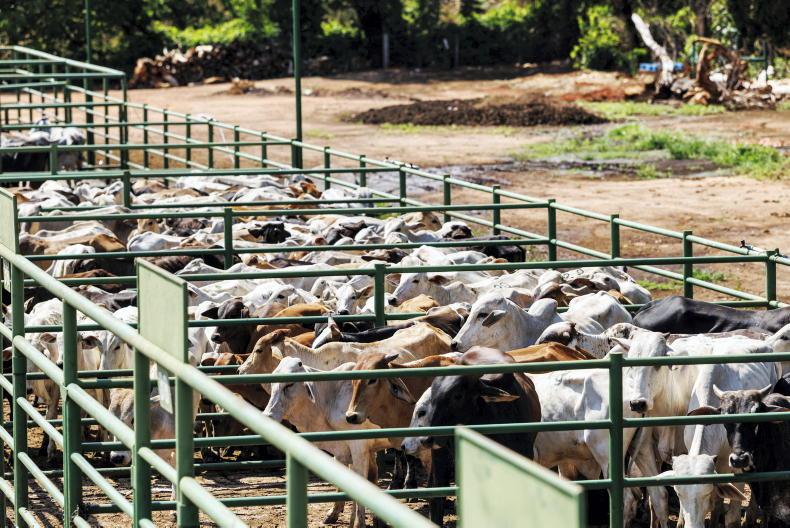
The EU decision to suspend meat imports from Brazil due to failure to comply with antibiotic protocols is now in place with effect from today, 3 September.
It happens at a time when both beef and poultry meat volumes coming into the EU were on an upward trajectory as can be seen in Figure 1 and Figure 2. In the first half of this year, the EU imported in total 158,352 tonnes of beef, of which 47,462 tonnes was supplied by Brazil.
Looking at the graph in Figure 1, we can see that overall EU beef imports have been increasing over recent years as production has decreased.
Brazil have been capturing a growing share of this market and were the biggest supplier of EU beef imports in the first half of the year, having increased the volume they supplied by almost 17,200 tonnes compared with the first half of 2025.
Not just beef
It has been a similar trend with chicken meat imports. As Figure 2 shows, imports of fresh and frozen chicken have also been on an upward trend over the period since 2021, reaching 200,690 tonnes between January and June this year.
Brazil have been progressively increasing their share of this market, supplying 74,488 tonnes of this total which incidentally was almost three times the amount supplied in the first half of 2024 and an increase of over 17,600 tonnes on the first half of 2025.
While Brazil is the number one supplier of EU beef and chicken meat imports, the EU is a relatively small export market for Brazil who exported almost 2m tonnes of beef and almost 3m tonnes of chicken meat in the first half of this year.
However, while volume may be small in the overall context of Brazil’s beef exports, the EU increases in significance when it comes to value, as they are a buyer of the more valuable meat cuts.
For beef that means that the EU is primarily a steak meat market for Brazil’s exporters while for chicken it is breast meat.
EU agri-food trade surplus in first half of 2026
Overall EU trade in agri-food products recorded a €23.9bn surplus in its agrifood trade balance for the first half of the year. This was despite a 2% or €2.2bn decline in the overall value of exports to €117.2m compared with the previous year. The reason for the surplus widening is because of an even greater fall in the value of EU agri food imports during the first half of the year. The value of EU imports fell by €3.6bn or 4% year on year to €93.4m in the first half of the year.
The main drop in export values was caused by an 11% or €1.7bn drop in sales to the US as last year’s values were exceptionally high during the first six months of the year in anticipation of US import tariffs. Exports to the UK were down 3% or €837m due to a decrease in value of pig meat, coca products, dairy and vegetable preparations while a reduced volume of cereal exports to the UK was also a contributor to the overall decline.
Cereal preparations and milling products is the largest EU agri food export, worth €12.2bn in the first six months and recorded a 1% or €174m decline on the year before. Dairy is the next largest category at €7.997bn, €18m more than in the first half of 2025. Pig meat exports recorded a sharp 12% or €773m drop in value to €5.4bn due to lower prices while cereals increased marginally by €18m to €5.164bn. Beef and veal exports are a relatively small category, adding €940m to EU exports for the first half of the year which is a drop of €192m year on year.
Brazil imports are the exception
With the exception of Brazil, EU imports from the eight largest supplying countries, all declined in the first half of the year. Poultry and beef imports from Brazil have already been analysed but the main reason for EU imports from Brazil increasing by 5% or €425m to €9.569bn was an increase in soya imports even though the oilseeds and protein crops category was down 3% overall. There was a major drop in soya imports from the US which was partially offset by the increase from Brazil.
In value terms, the biggest decline was in coffee, tea, coca and spices imports whose combined value fell by €3.6bn with the 26% decline in cocoa import values accounting for €3bn of this decline.
This meant that the countries that supplied EU cocoa imports experienced the biggest drop in values with Côte d’Ivoire leading the way, down 19% or €942m, followed by Nigeria with a 46% or €567m decline, Cameroon down 43% or €536m and Guinea down 94% or €250m.
Imports of cereals fell by €715m with lower volumes of wheat imports accounting for €415m of this decline. In the overall context of EU agri-food imports, beef and veal are a smaller category but it recorded the largest percentage increase in value during the first half of the year, up 23% or €327m to €1.776bn.
Comment
A decision by the EU to suspend meat imports from Brazil was inevitable given the EU’s standards on control of antibiotics and the outcome of the Irish Farmers Journal investigation late last year.
Politically, it is not where the EU would want to be after closing the Mercosur trade deal earlier this year and the suspension is being presented in Brazil as the introduction of a non tariff trade barrier.
Due to the short production cycle for poultry, achievement of antibiotic compliance could be delivered within weeks but, given the cattle production cycle, it is difficult to envisage how compliance could be achieved in less than two years.
That effectively closes Brazil out of the EU market for beef just when they were building momentum.
What will be interesting now is to observe if the UK becomes a significant alternative market to the EU. Despite Farming Unions and the processing industry calling for alignment with the EU ban, the UK has taken no action and their market remains open.
From Irish farmers and exporters viewpoint, a significant switch in Brazil’s beef exports to the UK from the EU could have a more negative impact than would have been the case if it had been spread across the member countries of the EU.



SHARING OPTIONS