



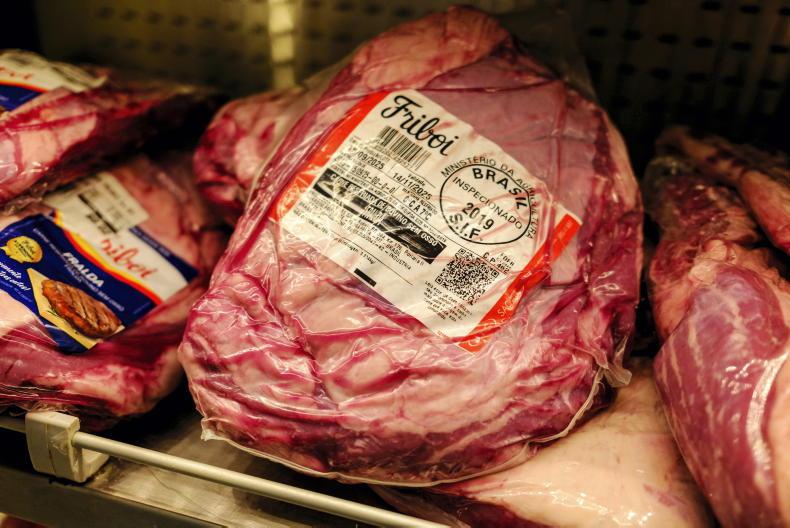
Brazil’s beef exports fell by 35% to 229,259t in September compared with September last year, as shown in Figure 1. This was primarily because the 1.1m tonne quota for exports to China was filled. Turning to Figure 1a, we can see that there was a particularly dramatic fall in beef exports to China, down from over 190,000t in September 2025 to just under 13,000t. For the first time since 2019, China was not Brazil’s largest beef export market in September; in fact the additional 55% tariff has pushed China down to sixth place.
For this particular month, the US has become the main export market, increasing dramatically compared with September 2025 and the EU was the second largest export market, as exporters sought to maximise volumes ahead of the suspension which came into effect on 3 September.
Cattle prices on upward trend
With a sharp decline in export volumes, it might have been expected that the demand from processors for cattle in Brazil would have cooled. However, the opposite has been the case and factory cattle prices, which had been on the increase for much of this year, accelerated sharply over recent weeks.
By the end of last week, media outlets were reporting that the steer price had climbed towards the equivalent of €4.60/kg at the end of last week, which is a sharp increase on the €3.69/kg reported by Bord Bia for week ending 26 September. While a weaker euro compared to the real explains 20c-30c of this increase, stronger demand has to account for the remainder.
With the export market to China effectively closed because of the additional 55% tariff at present and exports to the EU suspended, it might have been expected that there would have been a drop in demand from factories for cattle. Growth in exports to the US has been the positive story for Brazilian beef this year, but even that substantial increase isn’t sufficient to offset the effective loss of China and the European Union.
Tightening of cattle supply
Back in March this year, USDA were forecasting that there would be a 2% decline in cattle throughput this year following a period of year on year increase in slaughter. They expected that producers would start retaining cattle, cow slaughter would decrease and that heifer retention would push up prices.
Slaughter data for the second quarter of this year suggested that the USDA forecast may have been off the mark. Government statistics show that a record 10.7m cattle were processed between April and June 2026, the highest on record for the second quarter a 1.3% increase on the same period last year, and up 4% on quarter one of this year.
On the other hand, with processors competing to get as much beef exported to China as possible before the quota was filled, there may have been an element of front-loading in cattle processing during the second quarter. If this was the case, it would explain the record kill and a subsequent scarcity of supply going into the final quarter of the year.
Australian beef exports decline
Exports from Australia, the world’s second largest beef exporter also declined in September compared with last year. As Figure 2 shows, record monthly totals for beef exports were recorded in May and June this year but in the third quarter there has been a sharp decline with monthly totals for July, August and September well down compared with 2025.
Meat and Livestock Australia projections suggest that the number of cattle processed in factories will peak for the current cycle at 9.6m this year and while exports are forecast to reach a record 1.646m tonnes this year, they expect a decline over the next two years to 1.541m tonnes in 2028.
As was the case with Brazil, Australia filled their 2026 quota for China early and this also helps explain why there was a particularly sharp drop in beef exports in the third quarter after a particularly strong second quarter. The volume shipped to China in September 2026 was just 9,333t compared with 20,742t in the same month last year. The graph in Figure 2a also highlights that Australia had their China quota filled by June and the competition between exporters for share of this quota also contributed to the record volumes exported in the second quarter of 2026.
Irish interest
Of particular interest to Irish farmers and exporters in relation to Australian beef exports is their focus on the UK. This had picked up significantly in the middle of last year and continued to the end of the second quarter in 2026 but since then it has cooled significantly. September was the third month in a row that Australia exported less beef to the UK than they did in the corresponding month last year, down from 1,726t in September last year to 1,345t this year.
Meanwhile in the United States
Last year there was much noise around US trade policy and imposition of tariffs. This year, there may have been less focus on trade in the US but China has quietly been a significant disrupter for Brazil and Australia, the top two global beef exporters. Notwithstanding the announcement made by president Trump at the Irish Open on dropping Irish whiskey tariffs, the major announcement has been the removal of US import tariffs on ground beef imports.
These came into effect in September and initial reports suggest limited interest with less than 40% of the 100,000t September quota utilised. The ambition for this ground beef quota was to cool mince beef prices for US consumers ahead of November elections, but the unintended consequence has been to alienate many US farmers, most of whom traditionally vote for the president’s Republican party.



SHARING OPTIONS