



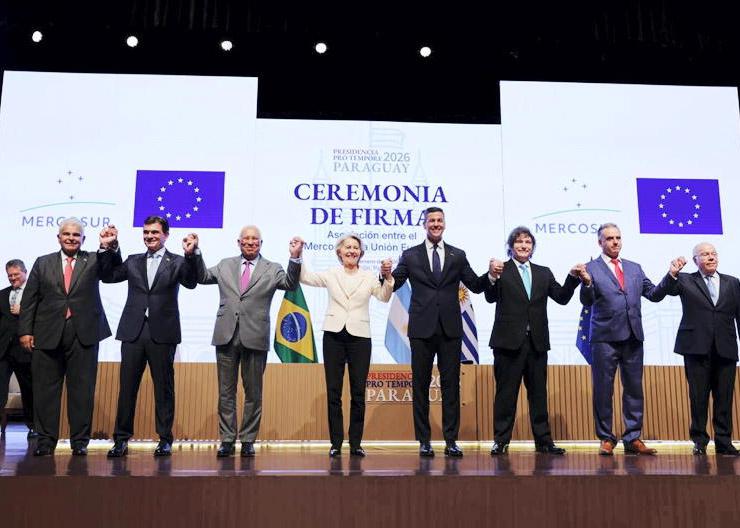
German Chancellor Friedrich Merz this week said that the Mercosur trade deal will take effect provisionally as soon as the first country in the Argentina, Brazil, Paraguay and Uruguay trade bloc ratifies the deal.
His comments come despite the vote in the European Parliament last month in which a narrow majority of MEPs voted to send the deal to the European Court of Justice for an opinion on whether the trade pact is consistent with European Treaties.
“As things stand today, attempts to delay it at the last minute, namely in the European Parliament, have been unsuccessful,” Merz told a gathering at the Frankfurt stock exchange on 2 February.
His comments echo those of European Council president António Costa recently, in which he called on the European Commission to provisionally implement the deal.
He said the Council “decided to go for the provisory application of the Mercosur agreement,” adding “I invite the Commission to use this decision of the Council and implement the provisory application of the Mercosur agreement.”
Commission president Ursula von der Leyen said: “A decision will be taken when one country of Mercosur or more countries of Mercosur have completed their [ratification] procedure and basically are ready.”
EU Agriculture Commissioner Christophe Hanson echoed those comments in Dublin this week, saying that no decision had yet been taken on going ahead with provisional implementation of the trade deal while it remains in front of the European court.
“The mandate given by the Council is very clear,” he said “the Commission has the possibility to go for provisional application.”
Hanson was quoted in a newspaper on Sunday calling the Irish position on Mercosur “incoherent” and “inconsistent”, adding that he is “quite astonished about” Ireland’s vote against the deal. He also argued in favour of the deal in light of growing concerns about the future of the US-EU trade relationship. “In these very turbulent political times, it is very important not to have all the eggs in the same basket,” he said.
Tánaiste Simon Harris said he did not have to justify Ireland’s position in a meeting with Hanson on Tuesday, noting that other European countries opposed the agreement.
It is clear from the comments from von der Leyen and proponents of the deal that the catalyst for the decision made on provisional implementation of the trade agreement will be the ratification of the deal by Mercosur member states.
Paraguay, the country which currently holds the rotating presidency of the Mercosur bloc, seems likely to be the first country to reach that milestone, with Argentina not far behind.
Paraguay’s President Santiago Peña this week said that the agreement has already been presented to the country’s parliament, with ratification expected to take a number of weeks, possibly paving the way for a request for provisional implementation to be sent to the EU Commission in early March.
“We are working to make this happen, and we want Paraguay to be the first country to implement it,” Peña told Euronews this week.
In answer to a question on whether the criticism of the deal from the agricultural sector in Europe is fair, he said “I think it stems from ignorance. That ignorance leads to prejudice, and that prejudice leads to misinformation.”
He said that the deepening integration of the EU in recent decades reduced the contact the bloc has with South America. “There is a European who thinks he knows South America based on what he knew from the 70s and 80s.
"He knows absolutely nothing because our countries have changed tremendously – they’ve developed, human capital has grown.
“Today Europe needs to rediscover South America.”




SHARING OPTIONS