



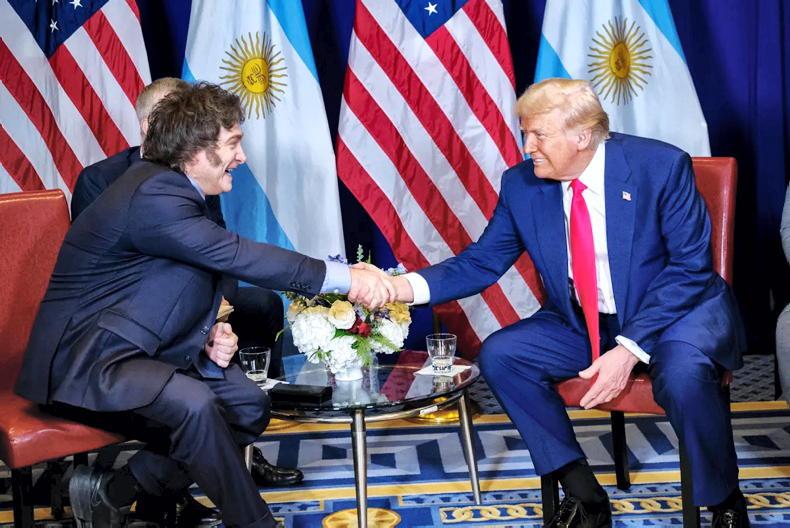
Following President Trump’s announcement of a bigger beef quota for Argentina, there has been a major backlash from US farmers.
US farmers and ranchers are traditionally considered politically aligned with the Republican party – as are many rural voters. President Trump’s brand of politics generally found favour with this constituency.
However, last week the National Cattlemen’s Beef Association (NCBA) Chief Executive Colin Woodall hit out at the President for “rewarding Argentina with this expanded access to the US market [which] harms American cattlemen and women, while also interfering with the free market.”
He was referring to the announcement by the US president that he was going to increase the quota for beef imports from Argentina from 20,000 tonnes to 80,000 tonnes.
Perfect storm in US beef
As has been the case in the EU and UK, farm gate prices have increased substantially over the past year, driven by shortage of cattle. Aligned with robust consumer demand, this has fed into significantly higher retail prices for consumers.
US beef price inflation is currently running at 16.6% for steak meat and almost 13% for mince beef in the year to September (US bureau of labor statistics). This compares with average food price inflation, which is running at just over 3%.
President Trump is particularly sensitive about inflation, and his ambition with the Argentine beef quota is to lower prices. In a rare rebuke to US farmers on social media he said “they also have to get their prices down, because the consumer is a very big factor in my thinking, also”. He referenced the decision to add an additional 50% tariff on US beef imports from Brazil as evidence of commitment to US farmers.
New plan
Also last week, secretary of agriculture Brooke Rollins published the USDA plan to fortify the American beef industry: strengthening ranchers, rebuilding capacity and lowering costs for consumers. This document with a very long title has ambitions to do it all from the farm to fork, which may be laudable but is notoriously difficult to achieve.
Herd decline
As the document highlights, 17% of ranches have been lost since 2017, which amounts to more than 100,000 farm businesses. This is at least a part contributor to the national cattle herd falling to a 75-year low of 86.7 million at the start of this year.
This is the sixth year in a row that the national herd has declined in the US, and the long-term trend has been downward over the past 50 years since it peaked in 1975 at 131.8m head as shown in Figure 1.
While cattle numbers have been in long-term decline, the consumer demand for beef has increased, estimated to be up by around 9% over the past decade. Robust demand has had the twin effect of pushing up cattle prices as shown in Figure 2, and beef imports, which, as Figure 3 shows, were higher in 2024 than in any of the previous 20 years.
Currency impact
In Figure 2 it should be noted that the price is in US dollars and not converted to a euro equivalent. As Figure 4 shows, the value of the US dollar weakened considerably this year, falling from a point where it was worth almost as much as the Euro in January (€1=$1.02),while by the middle of last month it had fallen to €1=$1.18).
This means if we converted the US cattle price into euro equivalent, the rate of increase would be nowhere near as dramatic as when it is shown in US dollars.
As an aside, the weaker dollar means that US exports are more competitive on the world markets – this is a contributory factor to the lower prices of some global dairy commodities.
It also makes beef imports to the US more expensive, which contributes to consumer beef price inflation as well as keeping US domestic cattle prices high.
US beef trade
The US is unique in global beef trade, as they are both in the top three beef exporting and importing countries. The other two major exporters, Brazil and Australia, import very little beef while China and Japan, the other major importers, export next to nothing.
The reason for this is that more forequarter beef is consumed in the US than hindquarter beef. This means that US processors export large quantities of the higher value steak meat, mainly to Asian countries.
At the same time, they import more forequarter beef that is used in burgers and other ready to eat products which are popular with US consumers.
Trade policy
US trade policy, particularly the spat with China, has had a negative effect on US agricultural exports. This has been most felt in grain where China, the biggest customer, has essentially stopped buying.
The impact on beef exports has been cushioned by less supply, but the effective absence of sales to China means that the full potential value isn’t being secured.
As for US imports, the decision to add a minimum tariff of 10% to everything has been absorbed by the market, and no doubt this contributes to the higher cost of beef for US consumers.
Brazil was on course to be the second largest supplier this year, until they had an additional 50% tariff imposed from August.
Imports of Brazilian beef have fallen but are still substantial, meaning this very expensive product is now feeding into US beef price inflation as well.
Comment: trade agreements would be of more benefit than the plan
The agriculture secretary’s plan is summarised as measures to:
The 13-page document outlines measures which will be of benefit to some farmers, but there is nothing that will offset the disruption to markets which has followed from a shifting trade policy.
For example, the additional 60,000 tonne annual beef quota for Argentina is less than the 1,600 tonnes being imported from Brazil per week, paying 50% extra in addition to the over 25% standard import tariff.
Dropping that tariff plus sealing a deal with China would do wonders for beef and US grain exports to that important market. Economists had predicted that US tariff policy would drive inflation as the year progressed.
However, that hasn’t happened yet with general inflation, but it very much has with beef. Higher cost imports due to tariffs, weakness in domestic supply alongside robust consumer demand is the are the ingredients for soaring beef price inflation in the US.
In brief




SHARING OPTIONS