



Although long-term weather data shows that annual rainfall in Ireland has increased over the last 30 years, the seasonal variation in rainfall has also increased.
According to Met Éireann, up to 20% less rain is falling during the meteorological spring and summer (March to August) particularly in the south and east.
Reduced summer rainfall, coupled with warmer temperatures, increased evapotranspiration and increased sunshine, have resulted in more frequent and severe soil moisture deficits (SMD) on drier soils.
This is greatly reducing grass growth rates during the main grazing season and adds considerable cost for farmers.
As SMD reaches around 30 to 40mm, growth starts to become restricted, with substantial reductions occurring at 50mm and effectively zero grass growth at 70mm.
Currently, parts of the south and east are now experiencing all too frequent SMDs exceeding 80mm, with the outlook for a continuation of similar conditions over the coming weeks.
Grass growth rates in the southeast have fallen below 20kg DM/day this week on many farms, with supplements now being used to meet animal requirements. Is there anything farmers can do to reduce the impacts of SMD on feed supplies?
Some very innovative farmers are meeting this relatively new challenge head on, by growing high-quality summer crops as part of their reseeding programme.
Mike and Tina are milking 90 cows in Ballyhooley, Co Cork, and are members of the local Ballyhooley Dairy Discussion group. In recent years, repeated dry summers with periods of low grass growth have become much more common.
While their farm would historically grow 14t DM/ha each year, that has reduced to 11t to 12t DM/ha due to low grass growth during July and August in recent years.
More often than not, Mike has had to feed high levels of concentrates and some silage at some point during summer. Given the significant reduction in milk prices in 2026, Mike and Tina decided to grow a summer crop of stubble turnips on a paddock that they plan to reseed this year, as a way of reducing summer feed costs.
“Nothing is more expensive than when grass isn’t growing and cows can’t graze, so I wanted to try a summer crop that could provide high-quality feed cheaply and that would allow me to get a new reseed established before winter,” Mike says.
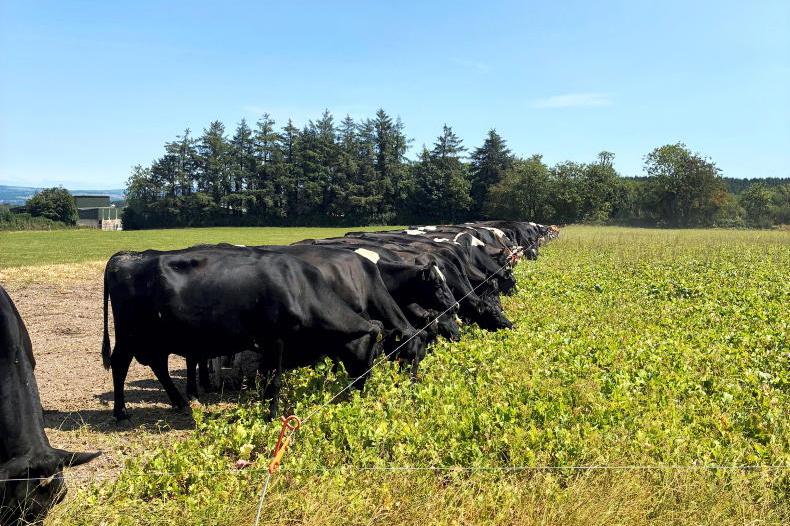
The crop of stubble turnips was sown on 5 May after ploughing, and reached a yield of 11t DM/ha by the time the cows commenced grazing it on 14 July (equivalent to a daily growth rate of 165kg DM/ha from the day of sowing).
Mike expects the 1.2ha paddock to supply the herd with 5kg of dry matter per head of high-quality feed for the next 30 days, thereby saving on silage and concentrate feed during the drought period.
Between fertiliser, seed and sowing costs, Mike estimated the total cost of growing the crop was €829/ha (or €80/t of DM before reseeding costs).
He estimates that one month’s grazing of stubble turnips rather than silage, concentrates or PKE as part of the diet, will reduce feed costs by €3,000 this summer (equivalent to €35/cow). In terms of day-to-day management, there was an initial seven-day period where Mike offered the cows 2kg of stubble turnips in the paddock after morning milking to get them used to it.
Thereafter, the herd is getting a full night break of grass (7kg DM/hd) in addition to 3kg of concentrate daily at milking. During the day, the cows have access to 3kg of silage in circular feeders in the paddock, in addition to 5kg DM of stubble turnips.
The paddock has multiple water troughs and shade where they are grazing the stubble turnips during the day.
“The cows adjusted very quickly to the crop and I’m very happy with how they have been using the feed,” Mike says.
While the crop is an excellent energy source, Mike has noticed no effect on milk yield or milk composition (with the herd milking 2kg milk solids/cow/day currently).
Mike intends to reseed the field in mid-August when the crop is gone by min-till cultivation and hopes to get at least one grazing off it again before closing for winter.
In total, during the year of reseeding, the paddock will have provided approximately 2t DM of grazed grass in addition to the 11t stubble turnip crop.





SHARING OPTIONS