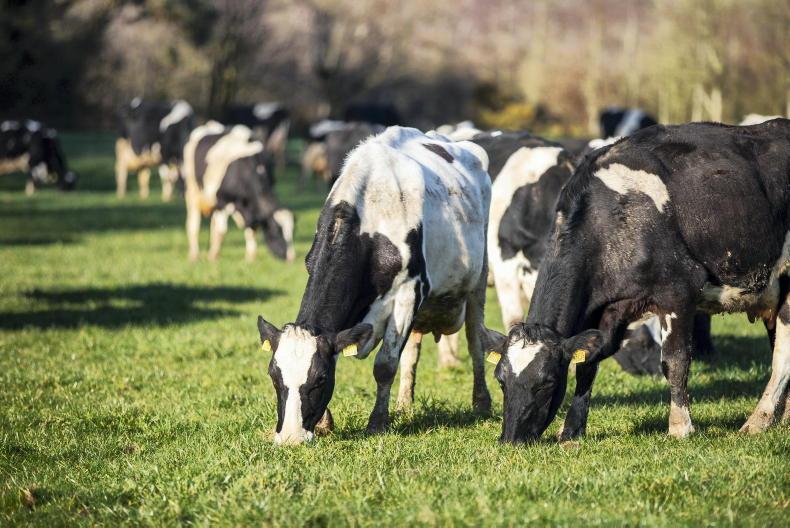
If you draw comparisons between weather and ground conditions this year and the tale of Goldilocks and her porridge, there’s very few periods where it has been ‘just right’. It has fluctuated between too dry or too wet, with brief periods in the middle offering a reprieve.
Some short fine spells in the past week have allowed some farmers to secure the bulk of second cut grass or some surplus paddocks, but other farmers in the northern half of the country had to hold off on sending in a mower as ground conditions were too poor, and will remain so until a longer period of settled weather returns.
For farms on typically drier land and at a stocking rate above three cows/ha on the milking block, it will soon be time to start building cover. PastureBase figures show that for most farmers, growth is in excess of demand.
With second cut ground coming back in to play for some, this should help lessen demand as stocking rate decreases, but for those unable to graze silage ground, other methods will have to be employed.
Fertiliser application should be brought up to date on all paddocks; clover included. The nitrogen fixing abilities of the clover will begin to wane from now on, and failing to apply N to these swards will see a hit taken on growth. A unit/acre/day should be applied, with likely only two to three rounds of application left for the year.
Any remaining slurry left in tanks should be spread with LESS, with application targeted at paddocks low in P and K, or paddocks that had several cuts of surplus bales taken from them.
The current damp and overcast conditions we are experiencing will reduce the nitrate loss to the atmosphere, while growth is still there to utilise the nitrogen effectively.
Dunphy Family – Easkey, Co Sligo
Grass growth has been steady the past number of weeks, running between 50 and 60kg of growth. We have been correcting quality, between baling and topping paddocks to have a clean start to the autumn rotation, with good quality swards now ahead of cows.
Second cut silage was completed last week, with some of this on the milking block. With this back in the rotation, we have lowered the stocking rate and will soon start working towards building covers.
We are spreading 19 units of 38 N + 7S of protected urea on an 18-19 day round. Ground conditions are good.
Stocking Rate (cows/ha) 3.2
Growth Rate (kg/day) 58
Average Farm Cover (kg/cow) 200
Yield (l/cow) 21.8
Fat % 4.8
Protein% 3.87
Milk Solids (kg/cow) 1.94
Concentrates 2
Eamon and Patrick Fagan – Glasson, Co Westmeath
Grass is OK – we had been tight for a long time and had been feeding bales up until the weekend. Grazing conditions are fine as we are on dry ground here. Cows are going in to excellent quality 1,300kg DM/ha covers, with a small amount of baling and some topping done to correct paddocks that were poorer quality. Second cut silage is complete, with 30 acres of this being red clover silage. This was spread with 1,500 gallons of slurry post first cut and has received slurry again. The third cut will be baled. The white clover reseed sown in May struggled during the drought but was grazed last week.
Stocking Rate (cows/ha) 3.2
Growth Rate (kg/day) 66
Average Farm Cover (kg/cow) 195
Yield (l/cow) 21.5
Fat % 4.61
Protein% 3.63
Milk Solids (kg/cow) 1.82
Concentrates 4
Brendan Horan – Teagasc Moorepark, Co Cork
We are spreading a unit/day of protected urea on our grass-only trial, but we have still been struggling with growth post-drought. Growth has consistently been in the 40s the past number of weeks due to a lack of moisture. Swards have grown an average of 7.2t/DM ha up to the beginning of July, so we would expect them to hit between 13-14t DM/ha of an annual tonnage. Quality has been a real issue this year and we have seen protein percentages down by 0.15% on average. We have all our ground back in the rotation. We will be purchasing some dry cow feed to fill winter feed requirements.
Stocking Rate (cows/ha) 2.57
Growth Rate (kg/day) 44
Average Farm Cover (kg/cow) 202
Yield (l/cow) 17.1
Fat % 5.75
Protein% 3.65
Milk Solids (kg/cow) 1.65
Concentrates 1