



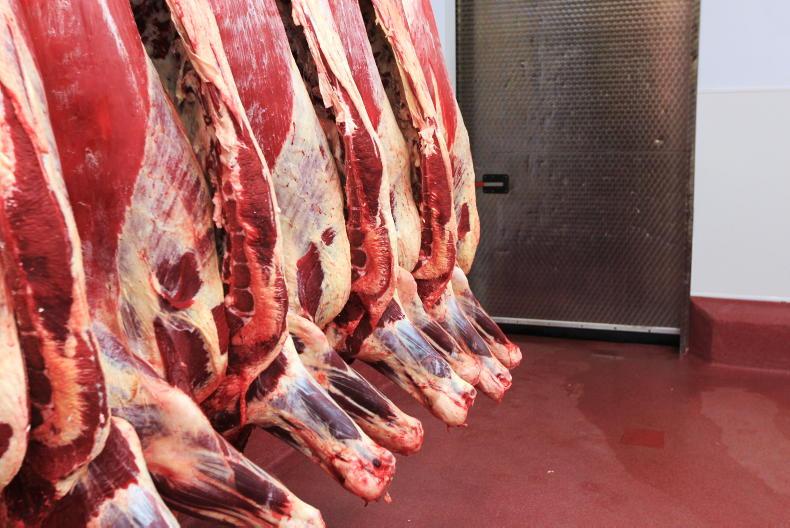
Factories continue to try to apply pressure to the trade. The kill increasing has meant the ball is back at their foot, but they aren’t getting it all their own way and are meeting resistance in pulling quotes further.
Factories seem adamant that they will get base prices back to €4.50/kg in the next three weeks, but this flies in the face of the direction our main beef markets are heading in.
The beef price differential between Ireland and Britain remains over €400/head on a 380kg carcase.
Base quotes this week remain pretty stable, with €4.60/kg to €4.65/kg being quoted for bullocks and €4.70/kg to €4.75/kg being quoted for heifers.
Regular sellers and those with numbers have a stronger hand to do deals on weights and other bonuses.
Foyle Meats, Donegal, is still working off €4.75/kg for heifers killing out between 300kg and 400kg, while bullocks are back to €4.70/kg for 300kg to 400kg carcases. It has indicated a 5c/kg pull for next week’s kill.
Bull trade
The bull trade remains pretty stable, with €4.90/kg being paid for U grading under-24-month bulls this week.
R grading bulls are being quoted at €4.80/kg to €4.85/kg, with a little more going to regular suppliers and those with numbers.
O and P grading bulls are trading at 5c to 10c/kg less than this, with fat cover being a big determinant on price for some of the poorer-quality bulls.
Under-16-month bulls are in short supply and generally working off a base price of €4.60/kg to €4.65/kg. The bull kill remains very low, with 1,102 young bulls killed last week.
Cow price
Factory appetite for cows remains strong. A big gap has opened up between poorer-quality cows in marts and well-fleshed suckler cows.
Well-fleshed P+3 cows continue to trade at €3.80/kg to €3.90/kg, depending on weight and quality, with a little more going in some factories.
O grading cows are working off €4.10/kg to €4.20/kg, while good R grading cows are coming in at €4.30/kg to €4.40/kg.
U grading cows are being quoted at €4.40/kg to €4.50/kg in some factories this week.
Last week’s kill came in at 36,719 head - an increase of 1,351 head on the previous week. Much of this increase came from bullocks, with 17,717 bullocks killed last week, the highest kill so far in 2023.
The cow kill stood at 7,635 - an increase of over 500 cows on the previous week.
Speaking to agents on the ground, the thinking is that numbers won’t increase much further, as a lot of finishing cattle have been housed at this stage and will take a few weeks before they hit the market.
The latest information from the Bord Bia price tracker shows that the prime Irish composite price is lagging 34c/kg behind the prime export benchmark price for the week ending 23 September.
R4L bullocks continue to trade over £4.92/kg (€6.04/kg incl VAT) this week in Britain on the back of a reduced supply of finished cattle.
The only section of the trade that showed some weakness this week across the water was the cow trade, which was a little easier on the back of higher numbers coming forward for slaughter.
While numbers of slaughter-fit cattle have been in decline across the UK in recent months, the AHDB is reporting a possible increase towards the end of 2023.
NI comment
Factories are trying hard to keep a lid on beef prices in NI, but a strong live trade is underpinning the trade with higher returns available for finished stock.
Quotes are steady around 454p/kg (€5.50/kg inc VAT) for U-3 animals, but most deals remain on 470p to 476p/kg (€5.69 to €5.77/kg).
Young bulls are making 466p/kg (€5.65/kg), while cull cows start around 360p/kg (€4.36/kg) for animals at R3 conformation.



SHARING OPTIONS