



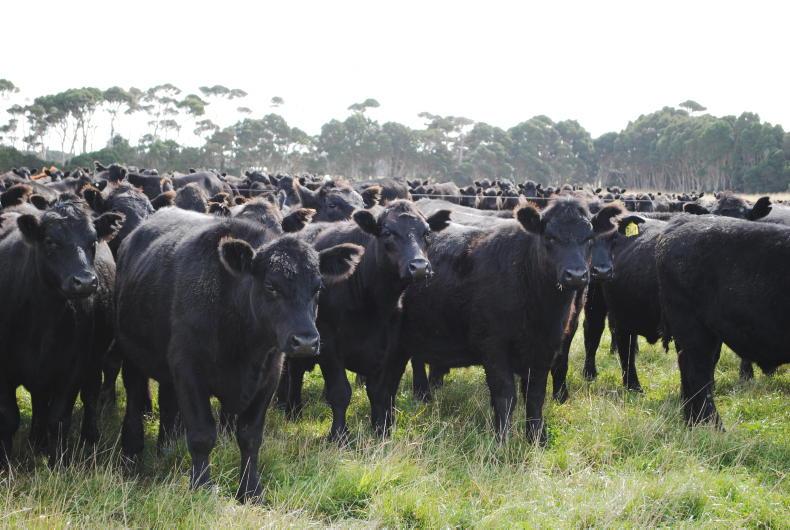
Australia’s beef production is forecast to pass 3m tonnes carcase weight equivalent (cwe) this year as the number of cattle slaughtered in factories is predicted to increase from 9.3m last year to 9.6m this year.
This is the September update on cattle industry projections from Meat & Livestock Australia (MLA), with the original being published in March.
The slightly higher output is explained by “improved seasonal conditions and long-term productivity gains are supporting historically high cattle turn-off while slowing the herd contraction that was previously forecast”. The cattle herd is forecast at 30.6m head for this year.
The MLA outlook suggests that this is the peak for the current cattle cycle, with numbers forecast to taper off over the next two years.
Next year, the national herd is expected to drop to 30.1m, falling further to 29.7m in 2028.
The number of cattle slaughtered is expected to drop to 9.2m next year and the following year to 8.9m. This will have an impact on beef production, though it is predicted to be less than the lower throughput would suggest, because of higher carcase weights.
These have been trending upwards over several year and are forecast at 313kg this year, rising to 315kg next year and 319kg in 2028.
Trade
Australian beef exports have been on an upward trajectory this decade and the MLA outlook is that this will continue this year, before falling back slightly in 2027 and 2028.
The forecast is that 1.646m tonnes product weight will be shipped this year – a record – dropping back next year to 1.580m tonnes and 1.541m tonnes the following year.
MLA also comments on the major factors having an impact on beef trade. These concentrate around developments in the US and Asia, their main beef export markets.
Neither the UK – with whom Australia has had a trade deal since 2023 – nor the EU – with whom a deal was concluded earlier this year – merit a mention.
In the context of overall Australian beef exports, both will be relatively low destinations for the foreseeable future, though volumes to the UK have grown significantly over the past year.
Quotas
For the first time since China became a major beef importer, it introduced import quotas in 2026. Both Australia and Brazil were given quotas well below the volumes they supplied in 2025.
With companies aggressively pursuing business in China before the quota was filled, Australia had its quota of 205,000 tonnes filled by June and Brazil filled its by August.
Any Australian beef exports to China since June will carry a 55% tariff, which means it will be looking elsewhere. It has a similar problem with South Korea, where it has reached the trigger point for the safeguard coming into effect.
The potential problems with these Asian markets for the latter part of 2026 have been greatly offset by continued growth in demand from the US, where beef import tariffs have been reduced by the Trump administration.
This is an attempt to control beef price inflation ahead of the November elections and it means that the US will likely import record volumes of beef this year.
After Brazil, Australia is the world’s next-largest beef exporter. Beef production in Australia is very much dictated by climate and periods of prolonged drought led to fast herd reductions and cattle culls followed by a period of rebuilding.
Much of this decade has been a rebuilding period following prolonged drought between 2017 and 2019. The big challenge now for Australia is coping with the quotas imposed by China and South Korea, two of its main export markets.
From an Irish perspective, it is what Australia exports to the UK that has the greatest potential to affect our beef markets. It increased its beef exports to the UK over the past year, as Irish volumes reduced, but this has levelled off in the past few months.
Australia is also going to get increased access to the EU market when the trade deal comes into effect, but, again, this is quota0controlled and while it will grow market share, this will be partially offset by ongoing reduction in EU beef production.



SHARING OPTIONS