


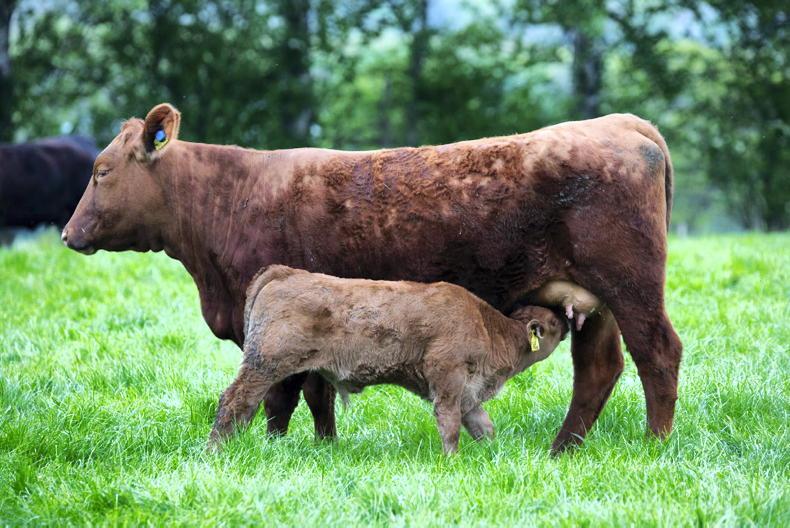
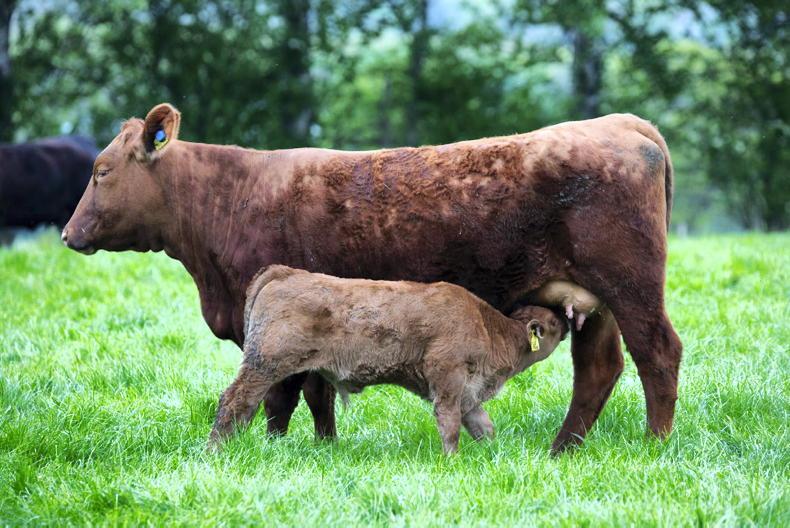
It’s a quieter time of the year on a lot of suckler and beef farms, with the bulk of the summer work now done and breeding finished up or coming to a close on a lot of farms.
Autumn calving herds will be prepping (like Niall O’Meara and Trevor Boland below) for their busy calving time, but if the weather plays ball, which it should, then autumn calving is generally a simple affair.
Many farms have eased back on N in the last while, and were probably right to do so. Where silage stocks were sufficient, surplus bales were not needed, and once quality was in the sward then N wasn’t required.
The damper, warm conditions seem to have really suited clover fields as well, and in comparison to last year, clover percentages in fields seem to be much higher, which is likely contributing to growth ticking along with additional N.
What is important to be mindful of though is the off take of P and K from paddocks where surplus grass was baled or pitted.
We often apply slurry of chemical P and K to designated silage ground, but it can sometimes escape us to replace off takes from paddocks that were skipped for grazing.
Every tonne of dry matter removed in bales takes away about 3.2 units of phosphorus (P) and 20 units of potassium (K), while one bale is generally 180kg DM, depending of course on dry matter percentage.
A compound like 18-6-12 or a round of slurry will help replace these nutrients pulled off paddocks.
Shaun Diver – Tullamore Farm, Co Offaly
Second-cut was harvested last week, which will be targeted mostly at dry cows. It should be of good quality, but went in a bit green as it was a smash and grab job. Ideally, we would have liked to have left it for a day to wilt.
Wholecrop silage (barley, oats and peas) should be ready for harvesting in the coming week or so. We will try mowing with the Big M this year, putting three swards into one to minimise grain loss.
The last of the lambs are being weaned today which consist of the ewe hoggets’ lambs. Our faecal egg count is showing 630 eggs per gram, so we will go in with the first dose of the year on the lambs in the coming days.
System Suckler to beef
Soil Type Variable
Farm cover (kg/DM/ha) 690
Growth (kg/DM/ha/day) 52
Demand (kg/DM/ha/day) 44
Niall O’Meara – Killimor, Co Galway
I’m prepping for calving now which will start in a month’s time, with cows getting their pre calving mineral the last two weeks as well as having received an iodine drench. These cows are being strip grazed on some heavier paddocks to keep them full but without putting on fat covers ahead of calving.
We baled 11 acres of second-cut at five bales to the acre, with four surplus paddocks that were just gone ahead of cattle baled out at three bales to the acre.
Five more acres of after grass that I didn’t get to graze with the strong growth have been earmarked for the mower, 0-7-30 is being spread on any ground where silage is harvested, while I will start back with N in the next week or so.
System Suckler to weanling
Soil Type Variable
Farm cover (kg/DM/ha) 780
Growth (kg/DM/ha/day) 54
Demand (kg/DM/ha/day) 35
Trevor Boland – Dromard, Co Sligo
Grass is tipping away nicely at the minute. I have a good bit of grazing ground closed up for silage. It hasn’t been topped up with fertiliser and will be cut fairly light in the next two weeks, along with second-cut ground, as I will be looking for this ground to come back again for autumn calvers.
The first calf landed today, with cows calving outdoors. I will look to offload some stock and keep good quality grass in front of the freshly calved cows for the three months prior to housing.
Yearling heifers are still on grass only, but I will introduce 3kg meal per day to these to push fat covers and get as many killed off grass as possible. Any leaner heifers by mid-October will be sold live as stores.
System Suckler to weanling
Soil Type Variable
Farm cover (kg/DM/ha) 753
Growth (kg/DM/ha/day) 65
Demand (kg/DM/ha/day) 46



SHARING OPTIONS