



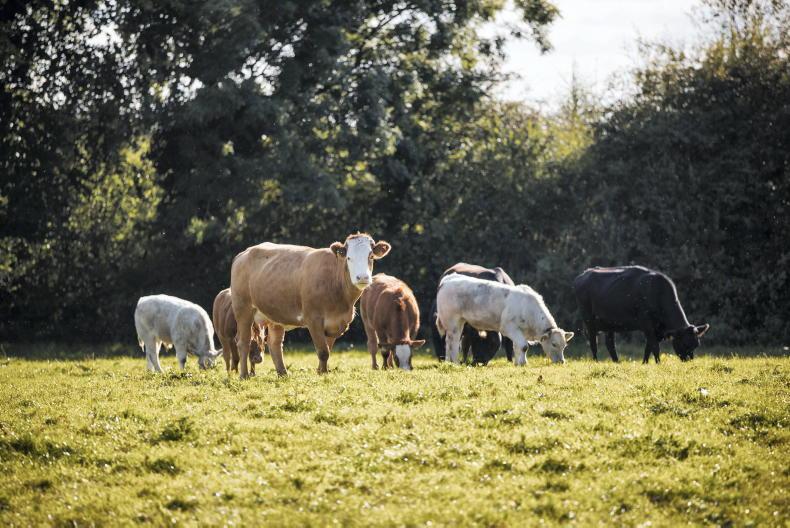
John and Stephanie O’Hanlon along with their children, Ríain , Caloán and Ellie farm 39Ha in the townland of Tipper just outside Ballymahon in Co Longford. John joined the Organic Farming Scheme in 2023 and after two years in conversion he is now running a fully converted organic beef farm.
The farm system involves operating a 30-cow, spring-calving suckler herd selling progeny at 15-16 months of age over the summer months.
The cows are a mixture of Simmental, Limousin and Hereford cross and are bred to an Aberdeen Angus bull.
Land quality would be described as mixed with a mixture of low-lying ground and better quality ground.
The farm consists of just over 31Ha of grazing ground. In 2024 John reseeded a 2Ha field with red clover to try and make some high protein silage for feeding to weanlings. There are three cuts of red clover silage taken each year with 8Ha cut for conventional silage on an annual basis.
In 2015, John decided to plant some forestry on a low-lying part of the farm that was always difficult to graze due to its wet nature.
There is also a 1.53Ha riparian margin to comply with the ACRES scheme and he also planted another 2Ha of species-rich grassland in 2025. The farm is stocked in line with organic stocking rates, with the current stocking rate at 1.52 LU/Ha and 115kg/N/Ha.
System tweak
Having ventured down the organic route in 2023, a TB outbreak on the farm in autumn 2024 meant that John had to look at his system again as to how it worked for him.
Not being able to sell store cattle during the time he was locked up made John look at the option of going all the way to finish. This would mean he wouldn’t be impacted by not being able to sell cattle in the live market and instead slaughter them as they become fit.
Cow numbers are currently being reduced to 20 with the aim of finishing all animals before they reach 30 months. John said: “The idea of going all the way to slaughter would also mean that I could avail of the organic premium for beef at the slaughter stage. It also eliminates the limbo that we were in the face of another TB outbreak.”
Breeding performance
One of the farm’s strengths in the last few years has been the breeding performance on the farm. The herd’s calving interval is well below the national average at 373 days and that was with the farm using 100% AI in the past.
Sixty-three percent of the herd calved down in the first six weeks of the calving season in 2025 with the herd recording a mortality figure of 7.1%.
Grazing Management
Cattle are generally run in two groups, one group of 30 suckler cows and calves and another group of 30 yearlings. Cattle are rotationally grazed with some of the larger fields split in two to help in grass management. They typically spend three days in each paddock with eight paddocks available to each group leaving a 24-day rotation on the farm.
In spring, weanlings are turned out first around the 1st week of April with cows and calves turned out around the middle of April, weather dependent. Housing of stock normally takes place from the middle of October with weanlings housed by the middle of November. Soil fertility is an issue on the farm with 92% of soils Index 1 and 2 for phosphorus and 85% of soils Index 1 and 2 for Potassium. John puts this down to a low levels of fertiliser being applied before joining the organic scheme and no fertiliser for the last 3 years.
He is focusing his farmyard manure and slurry to the fields that most need it.
Table 1 outlines the farm’s financial performance in 2023 and 2024.
As John was in conversion in 2024 all cattle were sold on the conventional market while some of the 2025 sales were sold as full organic status cattle.
In 2024, there were 12 one–two-year-old cattle sold weighing 436kg selling for €1,268, 11 one–two-year-old female cattle sold weighing 411kg selling for €1,167 and four cows weighing 560 sold for €1,190.
Sales were down in 2024 with John not being able to sell stock when he usually would. He is hoping that with the organic system fully bedded in that sales will recover in 2025 and beyond.
Weanling performance is one area where John is aiming to make improvements on his farm. Weanlings gained 0.32kg/day during the 2023/2024 housing period with the feeding of red clover silage increasing gains in 2024/2025 to 0.42kg/day.
Organic ration is very expensive at €800-€900/tonne so John is concentrating on making top-quality silage to increase the weight gain in his stock.
John places a big focus on silage quality, with the 2024 first-cut silage coming in at 73.5 DMD and 13.9% protein. His second-cut silage analysed at 75.8 DMD at 15.4% protein while his red clover silage came in at 72.5 DMD at 19.6 % protein.




SHARING OPTIONS