



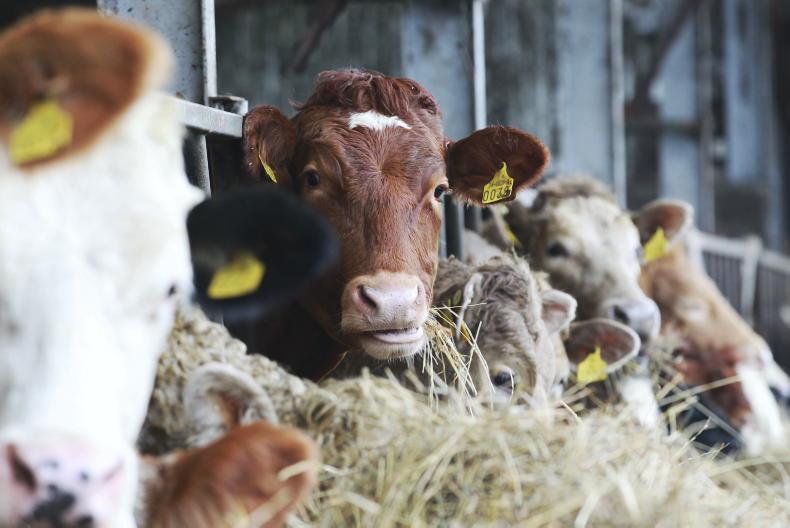
To ensure good herd efficiency and maintain a decent bottom line in suckler cow production, it is crucial that only the best cows are put forward for breeding in the coming weeks in autumn-calving herds. Consider four key areas for selection criteria.
Cow temperament
As an indicator of potential cow temperament at calving and post-calving, observe behaviour while restrained in a crush and evaluate the cow’s aggressiveness toward the handler.
A common scale is one to five, with one being calm and five being dangerous and unmanageable.
Cows that score four and above should be highlighted for culling, with daughters not retained for breeding.
Adopting this method can significantly improve herd temperament for easier cow management and farm safety. Cows that are very cross at calving should always be culled.
Examining each individual cow’s calving interval will highlight any cows or cow families with fertility issues.
Cows with a calving interval over 410 days should be considered for culling, with an aim for cows to achieve 385 days and below.
However, it’s important to determine if long calving intervals are related to other management issues, such as bull fertility problems or twin births in the previous year, etc.
Calving issues
It’s important to record why a cow needed intervention or resulted in a difficult calving.
If it was due to calf malpresentation or multiple births, then this needs to be taken into consideration. However, cows that repeatedly need assistance at calving should be culled.
In addition, calvings that result in prolapses should be considered for culling, as this can significantly affect cow fertility and be a repeat issue in subsequent years.
Cow efficiency
The gross margin of a suckler unit depends on the volume of calf output in a herd.
Therefore, weighing cows and calves at weaning and calculating a cow’s efficiency in relation to the kilogrammes of calf produced as a proportion of cow body weight is a useful measure of milking ability.
Suckler herds should aim for cows to produce closer to 50% of their body weight in lowland systems, with a more conservative 42% in upland areas.
Underperforming cows should be considered for culling, but assessment should also be made of other issues, such as calf ill-thrift due to pneumonia.
Often, by the time there are data to calculate this weaning efficiency figure, cows are already several months back in-calf.
However, these figures can still be useful once the herd starts to calve down again – if a high-performing cow loses a calf, there will be an opportunity to foster a calf from an under-performing dam.



SHARING OPTIONS