



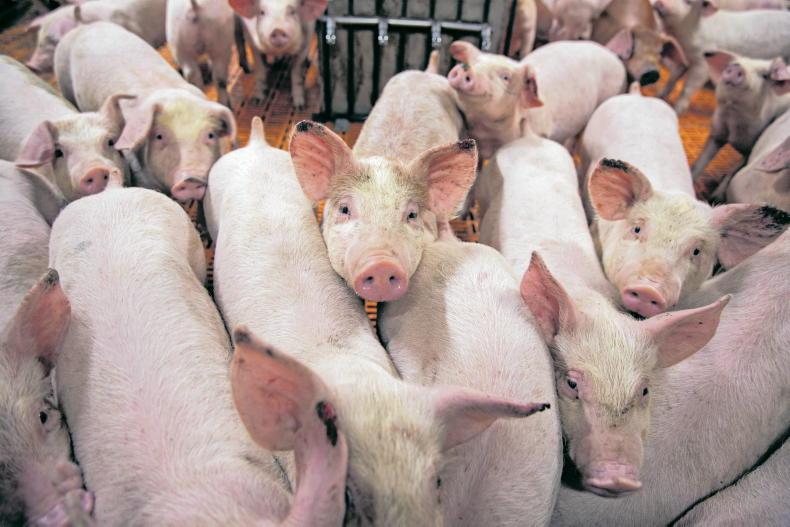
Most areas of the agri-food sector utilise the work permit system to attract highly skilled and qualified workers who are non-European Economic Area (EEA) nationals. This is to address labour shortages in specific industries. To obtain an employment permit in Ireland, the process generally involves the employer applying for the permit on behalf of the non-EEA worker, who must also meet certain eligibility criteria. This is done through the Department of Enterprise, Trade and Employment. In the first half of this year, 1,037 work permits were issued to the agriculture, forestry and fishing sector.
Over the last few years, pig farmers have been hiring experienced individuals to work in the pig sector, either as section managers for large farms or as pig farm assistants. This has been a real release valve for the industry, as previously, it was challenging to get anybody to work in the sector.
The majority of these workers are coming from the Philippines, where there is a well-developed pig sector. They have a good level of English, and a lot of them have a formal qualification in agriculture and have worked in modern pig units.
However in the last number of months, concerns have been raised among farmers with reports of international workers on permits being poached by other farmers in the pig sector. Sources in the industry told Irish Country Living, "It is not in the long-term interest of the industry to be poaching workers. It might be a quick fix for somebody who is short-staffed, but long-term. I think it's very damaging."
Permit structures
Non-EEA nationals in Ireland with an employment permit can switch employers after working for the initial employer for at least nine months. To do this a 'Change of Employer' application needs to be submitted, which results in the existing permit being updated to reflect the new employer's details.
At the moment, it costs an Irish farmer employer €7,000 to €8,000 per applicant to hire someone on a work permit with a minimum starting salary of €34,000.
It's understood that when employers are going to that expense, they're doing it on the basis that it's a two-year contract, and they're sharing that cost over those two years.
What the pig sector is currently experiencing is poaching of workers from one farmer to another, without any conversation or communication from the new employer. This is resulting in a financial loss to the farmer who has paid for the initial application and flights of the worker along with a sudden labour shortage of being down a worker overnight in some cases.
At the moment, it costs an Irish farmer employer €7,000 to €8,000 per applicant to hire someone on a work permit with a minimum starting salary of €34,000
Personal experience
Damien O’Donnell, office manager at Colm Ryan’s Farm, Co Clare told Irish Country Living, “In December 2023 we initiated the process to recruit three workers (on permits). In September 2024, they landed on-site, after their interviews, visas and sourcing accommodation, which took 10 months. They got on well; we trained them on our fattening unit and in our breeding unit. They were well educated, and all had degrees in agricultural science, so we were very happy with them.
The farm later got a letter of resignation and the worker moved to another business. "We didn't authorise him to transfer to any other farm. It turned out he went to another unit. We rang them and they admitted to hiring him. We said we invested €7,500 in this worker. They said he wasn't happy; he is entitled to move. I said he was happy, but obviously, he was poached. He was with us for ten months.
“The other two workers who came in with him are still with us; they are very happy. He was on our fattening unit, and we had only two staff on that, so we are down to 50% of our workforce again. It has a huge impact as we have to start the work permit process again and wait another 10 months, along with losing €7,500.
“There are only 100-odd pig farmers in Ireland, and they need to be united. We were very let down to think another pig farmer would poach and take one of our workers.”
Another farmer who wants to remain anonymous told Irish Country Living:
“I brought in four Filipino nationals initially, which was relatively successful. We later brought in another three on work permits.
"One of my workers who had been with me for six months gave notice and left. About a week later, another one of my workers in the initial batch handed in her notice. Those individuals are now working for the same company, whilst I have no proof, I believe that the first person got their feet under the table, and the others quickly followed suit.
“It takes about five or six months to get the workers into the country. You have made a decision that you’ve exhausted all other avenues and can’t get suitable qualified staff to fill those positions and work with a company to get the work permits organised.
"My problem here is not with the individuals but with those who are taking advantage of the efforts and financial contributions of other farmers.
"No one should be forced to stay (on any farm), but I think there should be an understanding among farmers that if you have a worker that’s experienced within the pig industry and he is looking for a job and ready to start, you can take it for granted that someone else has gone through the expense of bringing that individual into the country.
“It put on massive pressure in regards to labour shortages. We are very reliant on staff as 40% of my workers are made up of non-EU nationals. We have got new people in since then, but you have to start the same process all over again, and the financial loss was €14,000.”
Irish Country Living has reached out to the Department of Enterprise, Trade and Employment for comment.



SHARING OPTIONS