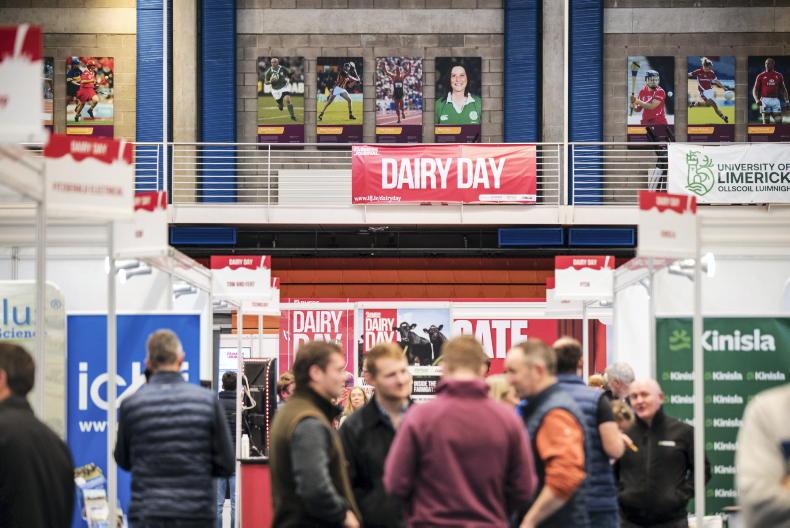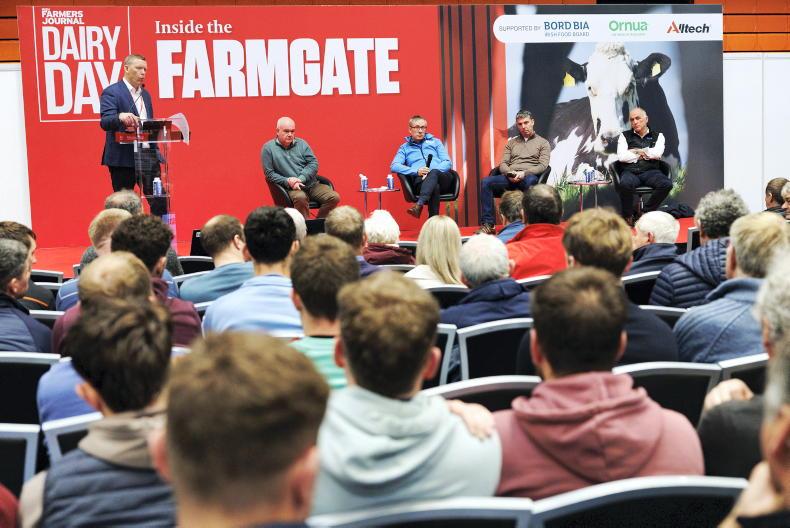
With a range of excellent panel discussions covering all aspects of dairy farming and the wider dairy industry at the University of Limerick last Saturday, it’s difficult to pick out just a couple of key highlights from Dairy Day 2026. This week we’ve chosen to summarise three of the panels, who discussed the topics of the future Irish dairy herd from a genetic standpoint, the next generation of young dairy farmers as well as a SWOT analysis of the overall Irish dairy industry.
Next generation of dairy herds
The next generation dairy breeding panel provided a lively discussion on what the future breeding programme in Ireland should look like.
Patrick Kelly, Michael Doran and Sean O’Donnell outlined their own approaches. All three herds are in the top 20% on EBI and are achieving high levels of performance within spring-calving pasture-based systems. Both Michael and Patrick began by using New Zealand genetics in the early 2000s to improve their herds, but are now exclusively using high-EBI Irish Holstein-Friesian bulls.
In contrast, Sean began milking a Holstein Friesian herd in 2009, but quickly converted to using New Zealand bulls and crossbreeding. That change, inspired by farmers in his local discussion group, improved herd fertility and maximised milk composition and solids from a smaller, more efficient dairy cow. He now selects bulls on the New Zealand Breeding Worth Index and will not use Irish bulls, as their milk composition figures are too low for him to continue to increase milk fat and protein composition to deliver a higher milk price in future.
Dr Andrew Cromie, general manager of Sexing Technologies (ST) Europe, provided a summary of how international breeding programmes are using new breeding tools to increase the rate of genetic gain in their populations. He highlighted a recent article by Dr Donagh Berry in the Irish Farmers Journal which showed that international breeding programmes in the US, Canada and the Nordic countries are now making faster genetic gain than in Ireland.
Andrew suggested that, for Irish farmers to benefit from advanced breeding programmes, they would need to share ownership of genotypes with companies like ST in the future.
All panellists agreed that there is significant scope for further genetic improvement on most Irish dairy farms by eliminating the use of stock bulls and low-EBI AI bulls and breeding future replacements from high-EBI heifers and the best cows within herds. Michael Doran, chairman of the ICBF, reminded the audience of the strengths of having a national breeding programme which is owned by Irish farmers and which has delivered consistent improvements in animal performance over two decades.
Patrick Kelly, who is a board member with Progressive Genetics, cautioned farmers against the use of international bulls with high genetic potentials which have not been proven in a pasture-based environment. He also pointed out that, from an AI industry viewpoint, significant investment in advanced breeding programmes is risky as it may not deliver suitable genetics for use on Irish farms.
Next generation of dairy farmers
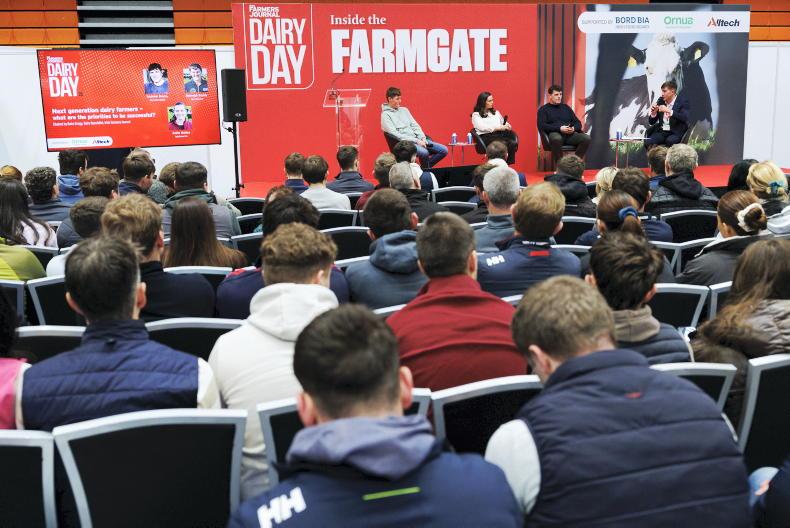
Hearing young people’s success stories is always something that draws a crowd and the next generation panel at Dairy Day was no different.
Andrew Doyle, Aoife Dullea and Darragh Scully all shared their own unique journeys into the industry and provided plenty of food for thought to the masses of both young and more experienced people sitting in the audience.
Andrew and Darragh both come from non-dairy backgrounds and are now operating in share-milking arrangements, while Aoife had never really intended having a career as a dairy farmer, but after a tragic family circumstance, she decided to return to her home farm and support her parents.
While each of the three panellists have had different pathways into the industry, there were some consistent messages in what it takes to get where they have today.
Education
Whether it was a university degree or diploma in dairy farm management from Teagasc, all three stressed the importance of getting some form of education.
These accreditations allowed Andrew, Aoife and Darragh access to good people and farmers, both at home and abroad.
“I got very lucky with the people I worked for to be honest. They steered me in the right direction,” Darragh said when reflecting on his early career.
Andrew credited much of his learnings to time spent on large-scale dairy farms across both Ireland and New Zealand, while Aoife also pointed to her time in New Zealand working with good people on a large-scale farm as part of her ag science degree in Waterford Institute of Technology as a key stepping stone.
Obstacles
Obstacles are a part of everyone’s journey, but all three of the panellists have found ways of navigating and overcoming them.
In Darragh and Andrew’s case, most would expect finance to be a big stumbling block having not come from dairy farms and not having a big land base to borrow against. However, both have managed to get started.
They have done it through a mix of saving, some borrowing and support from the people in their arrangements. Capital wasn’t a limiting factor, provided you found the right arrangement and people to work with.
Conflict
Entering into arrangements – whether it’s with family or with an outside party – will inevitably bring its own challenges.
For Aoife, she says working with family is a big positive as they can talk openly and discuss their plans for the future. They can also cover for each other very easily if there are events or occasions to attend. This is particularly important as Aoife is also working off-farm full time. Having the support network around her helps to keep all sides going.
“Like any business, there will be clashes and differences of opinion but ultimately, we want the same outcome for the farm. For us, it’s not necessarily to grow huge numbers and be the biggest but to have a sustainable farm that will be there in 20 or 30 years’ time,” she said.
“My parents are also laid back. They’ll give their ideas and opinions, but they allow us to make our own mistakes which is helpful.”
In Darragh’s case, he feels that having aligned values with Shane and Sinead Horgan, the farmers he is in the share farming arrangement with, allows them to run the business without conflict.
“Part of the reason I went in with Shane and Sinead is that we like the same type of system,” he explained.
“Crossbred cows, grass, a small bit of machinery as well as having our time off. If there’s something coming up, we’ll discuss it and normally one of us will have a slightly stronger opinion (depending on the topic) and we usually just go with that.”
Lessons
When asked what were some of their key takeaways or things they might have done differently looking back, all three shared some excellent nuggets of advice.
“If I was to go back, I’d save harder or try and buy my own youngstock sooner. Even if that meant taking a loan, it would have helped to build up a relationship with the bank,” Andrew said.
In Aoife’s case, because she is still quite new to it all, she’s taking her time and doing plenty of research along the way. Chatting to people with other perspectives before rushing into any big decisions has been something she’s found very beneficial.
Darragh says he wouldn’t change a thing.
“No, I wouldn’t change anything, sure it’s all part of getting me to where I am today. It’s funny the little things you’d pick up along the way, even away from farming, that can benefit you,” he said.
Opportunities
While land ownership and further growth were opportunities all three were targeting in the future, they each felt they had scope to improve and continue to grow within their current arrangements for now.
They also shared that, while it was important to weigh up opportunities carefully, being decisive and taking risk is important to get started.
Mike McCully’s SWOT analysis
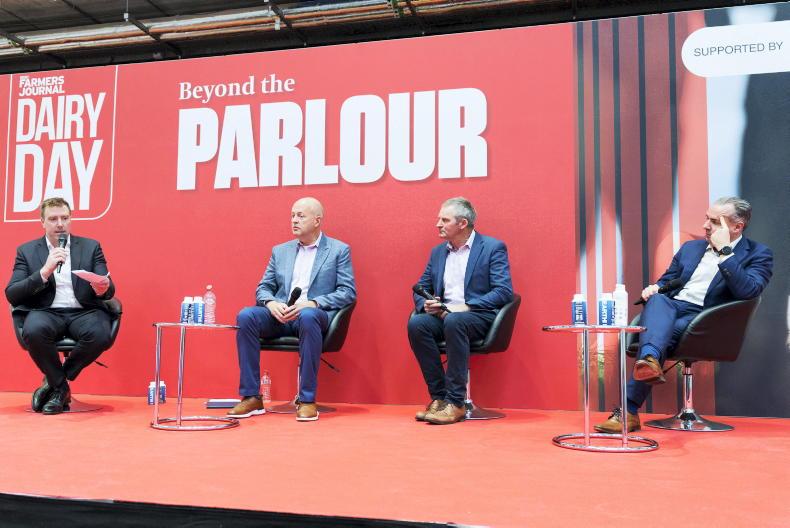
What are the strengths, weaknesses, opportunities and strengths of the Irish dairy-processing sector today? These were the questions asked of US-based dairy business consultant Mike McCully at Dairy Day.
In addressing the topic, Mike referred to a flattening of milk growth in Ireland since 2021 after more than a decade of growth. He also referenced a flash survey of Irish Farmers Journal readers conducted online last week.
In that survey, 42% of respondents said the farmer-owned co-op model was a strength, 32% said the grass-fed credentials was a strength and 28% said sufficient processing capacity was a strength.
When it came to weaknesses, the strongest sentiment was that there are too many co-ops in Ireland that are too small. This was the view of 46% of respondents.
Others referenced a high-cost base for doing business in Ireland, while others referenced inadequate management and governance of co-ops.
There was much discussion between the panelists, Edward Carr, president of ICOS and chair of Arratipp, and Jason Hawkins, CEO of Carbery, and the audience over mergers, research and development and adding value.
Edward and Jason both agreed that there is a cost to duplication of resources at co-op level in terms of multiple milk collection and processing teams, management teams, boards, etc, but they didn’t quite agree that it could be as high as 2c/l to 3c/l in cost savings.
Edward made the point that all processing capacity in Ireland is required at peak, so savings won’t come from closing down a plant.
Jason said that scale alone won’t help Ireland to compete with the Americans because they will always be bigger than us, but by focusing on efficiencies at processing level and then really going after value-add, “we might be able to realise that 2c/l to 3c/l gain”.
A federated approach to milk processing was an option discussed from the floor.
Similar to the Carbery model, this may allow co-ops to keep their own identity, but avoid duplication and competition in milk collection, processing and marketing.
The options discussed at Dairy Day will be teased out over the coming months.
To listen back to all of the sessions at Dairy Day, tune into the Inside Dairy podcast on Spotify, Apple or the Irish Farmers Journal website and app where each session is available in full.