



At last week’s Dairy Industry Newsletter (DIN) conference in London, the respected dairy analysts from GIRA and IFCN were all confident of an uplift in milk prices, soon.
Historical data was presented showing that every major milk price crash in the recent past was followed by a quick recovery in prices.
This analysis however, is predicated on a sharp reduction in milk supplies globally, which – in reality – has yet to be seen. While the rate of gain in milk output has declined, it is still gaining. Philip Goetz from IFCN said that in Germany (Europe’s largest milk producer), dairy cow numbers continue to increase and that milk flows are still up over 5% week on week 2026 versus 2025.
He said that their analysis shows that the cost of production on German farms is at the highest level ever recorded but that costs in 2027 could be higher again as up to 50% of costs are directly related to feed and energy costs.
Like in Ireland and in the US, high beef prices are cushioning the impact of low milk prices on dairy farms with beef prices in the Bavaria region of Germany up 65% between 2023 and 2025.
Christophe Lafougere from GIRA was bullish on the long-term increase in demand for dairy, particularly in countries in South East Asia.
He said that increased demand for protein is a long term trend and that an increasing proportion of milk production will go towards milk protein isolate, potentially leading to a shortage in skim milk powder.
My takeaway from DIN is that dairy markets will recover, but only after we start to see declines in globally traded dairy supplies.
Forecasters are predicting 2026 to have one of the strongest El Nino weather patterns in the second half of the year. While it doesn’t have a huge impact on Europe, it does tend to lead to more stormy conditions and a wetter winter.
It has much greater impacts in the southern hemisphere, leading to droughts and severe impacts on grass growth. It doesn’t indicate a higher likelihood of droughts in Ireland this summer, but that could still happen. A dry summer in Ireland is not inevitable, but it’s not unlikely either given the amount of rain that has fallen over the last six months.
Risk management on farms is no longer just about finance or animal health, it’s also about feed. If we do get a drought this summer, it will be the first one in probably 20 years to happen when milk price and margins are low.
The usual routine of just buying in extra feed to plug the gap has been pretty much cost-neutral up to now, but will that change in 2026? In my view, culling poor performing or empty cows early should be the first reaction to a bad drought, if one happens in 2026. This is because in low or no profit years, not spending money is more important than making extra milk.
Regardless of grass growth this summer, producing enough winter feed is a key priority. With high fertiliser prices, I expect that many beef and drystock farmers will spread less fertiliser this year and so there might be less silage available on the open market. In a dry summer, the cost of buying silage usually goes up.
There are few practical steps farmers can take right now to mitigate against the impact of a dry summer. Pushing grass out in front of cows is a non-runner because it reduces quality.
The best action is to keep grass in the vegetative stage by grazing down tight at each rotation (3.5cm to 4cm post grazing height) and continuing to apply nitrogen, potash, sulphur and phosphorus fertiliser, if possible.
At a discussion group meeting in Cork earlier this week, the average level of meal being fed was 2kg per cow whereas this time last year it was 3kg per cow, with similar levels of grass availability. It’s obvious that farmers are reducing costs in light of lower milk prices, which is good.
Farmers can’t control diesel prices or feed prices, but they can decide how much of each to use, within reason. It can be argued that tractor related tasks such as topping or pre-mowing can always be avoided, but it is especially important to consider it in low milk price years.
In many ways, the lower-than-normal growth rates for the time of year are a blessing because it means that grass is not growing out of hand and pre-grazing yields are within the target range in most cases. The majority of farmers I speak to are looking forward to a quiet summer with no capital expenditure planned. After a decade or more of building and developing, farmers are using the low milk price as a reason to press pause on spending in 2026. Other than maintenance work on roadways, they are planning to spend very little money outside of the core essentials to run the farm.
With most dairy farmers now a week or more into the breeding season, the number of AI serves continues to be back compared to last year.
For the full month of April 2026, the number of AI serves recorded by AI technicians was back 21% on the same number in 2025.
For the last two weeks, the number of AI serves is tracking to be back 4.2% when compared to the same period in 2025.
Whether or not this trend continues for the duration of the 2026 breeding season remains to be seen, but at the moment it looks like there will be less AI used this season compared to last.
That usually results in a reduction in the availability of dairy replacements in subsequent years.
It should be the priority in all years, but especially in low milk price years, to maximise in-calf rates to retain as much value as possible in stock.
There are lots of options for surplus in-calf stock but increasingly fewer options for empty cows.
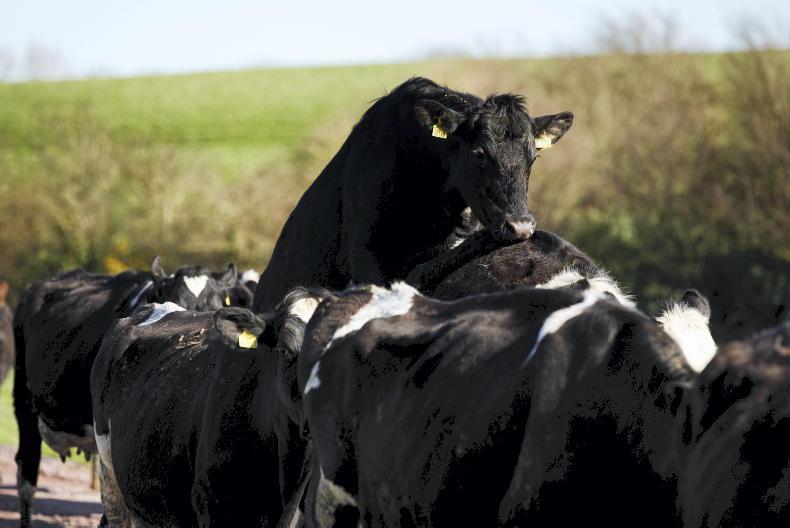
The highest risk cows for being empty are generally the last 15% of cows to have calved. In many cases these cows are not yet cycling.
If left unchecked, they may not come bulling in time to have a chance of going back in-calf within the first six weeks of the breeding season.
The next highest risk animals are those that have not shown a heat yet. Some of these will have been calved a long time but have some sort of a fertility problem preventing normal cycling behaviour.
Best policy is to firstly identify these cows from submission rates or pre-breeding heat detection and get them scanned by a vet.
In some cases the vet will prescribe more time, a washout or will put the cow on a hormone programme to get her back cycling again.
The other animal type to look out for is cows with too regular heats, such as cows bulling every 10 days. This is often an indicator of cystic ovaries which can be treated with hormones also.
The targets are to submit 90% of cows for AI within the first 21 days of the breeding season and for 60% to go in-calf at each insemination event.
The target is to have less than 10% empty after 12 weeks of breeding meaning there is another 10% of the herd available for voluntary culling due to mastitis, lameness or performance issues.
To hear more about the DIN conference, the latest news in dairy markets and an update from Limerick dairy farmer Colin Doherty on his 2026 so far, check out the latest episode of the Inside Dairy podcast at www.farmersjournal.ie or wherever you get your podcasts.



SHARING OPTIONS