It is fair to say most of the suckler and tillage farmers I have been talking to over the last year considering converting to milk see around 100 cows as the basic entry level requirement if they are going to go milking. This is especially true if a lot of money has to be borrowed for buying cows, parlour, slurry storage, cubicles and for reseeding etc.
In general, new entrants to dairy should plan cow numbers with a stocking rate of one cow per acre for all the acres around where your milking parlour will be. So if you have 70 to 80 acres around your parlour, then you could and should be aiming to milk 70 to 80 cows in the short term. Of course, you can milk more than this stocking rate, but you will be moving towards a higher input system of milk production. This higher input system can also work but requires higher up-front investment, higher risk, and a higher overall management level.
A cow to the acre, or 2.5 cows per hectare, will allow you graze a spring-calving milking cow, and make enough winter silage while supplementing the milking cow with meal (between 300kg and 500kg of meal per cow). Depending on how much grass you grow, you will need additional area for grazing replacements and don’t underestimate what they will eat.
Be realistic in your figures for the first five years. You won’t hit top targets for milk yields, so aim for middle of the road at around 4,800kg at 3.30% protein and 3.8% fat for a spring calving set up in first couple of years.
Milk price won’t stay at 40 c/litre, so in your plan aim for 28 to 30 c/litre. Interest rates and bank margins are on the increase, so factor in higher repayments. Build in a contingency fund of 20% on the total outlay. It will be spent.
Buy quality stock (close to €200 EBI) so you can get better fertility and better milk solids. Weanlings are already higher in price relative to previous years, as some suckler farmers planning to start milking in 2015 are looking to convert some drystock to weanling dairy replacements. I’ve heard prices of €800 and €900 each for weanling heifers earlier this month and as the year progresses I expect prices for quality stock to continue an upward trend. There may well be quality milking stock for sale later this month, but for many planning to start milking next year it may all come a year too early, unless you plan to suckle Holstein Friesians for a year. Heifer calves are making €450 each and over it for quality, early born AI bred heifer calves.
Estimating costs
If creating a budget for conversion, use the list below as a reminder of some of the potential costs involved and see what costs apply to your farm. You may have some investment in place already so you obviously won’t need everything on this list. Some things can maybe be left for a few years until you get up and going and start bringing in some money.
Remember begin with the end in mind – where you want to end up in ten years time. You might not get what you want in the first five years but you will get there over time instead of going broke in the mean time.
Nobody can say where milk price will go. If you are borrowing, interest rates can only go up so don’t overstretch yourself in the early years when you are learning the trade and exposed to high fixed costs.
Begin site works in spring and aim to do the bulk of the building in spring and summer. Wet building conditions can increase costs substantially and increase the time to complete the job. Working with contractors on a building project is a full time job and takes time so don’t plan for anything else.
Summary list
Planning permissionElectricity connection (3 phase)Engineer/Planner – drawings, mapping, site assessment, development chargesSite excavation – stone filling/levellingMilking (incalf) cowsReplacement heifersReseeding (seed, fertiliser, lime, contracting)Fencing (wire and posts)Water supply & piping & troughsWinter housing & slurry storage Farm roadwaysMilking parlour & collecting/handling yard – includes Bulk tank, Milk pump, plate cooler, water heating, lighting, Silage slabFeed binMachineryLabourWorking capital – money for feed etc before money coming inFarm office – farm computer, phone, internet connectionsContingency – 20% of all aboveVATWater tank/reservoirDiesel tankNew entrant Padraig Keane
on weather and calving
Our eyes and ears have been glued to the weather forecast these past few weeks. It’s the main topic of conversation, as we do our best to get calved cows out to grass. Storm after storm reminds us that we have no control over this external force of nature. All we can do is work with the weather, dodging the rain clouds by on-off grazing.
Since the end of January, we have 27 heifers calved. So far, the count is 15 bull calves and 12 heifers. At one stage, I was getting a little worried, with 14 bulls and eight heifers. Thankfully, it is beginning to balance up. We can’t complain. Calving has gone well to date. All calves were born alive and well.
However, we did lose one calf. I watched the cow calve a big black bull calf. After spraying his naval with iodine, I went to the parlour to get a bottle for colostrum. When I got back to the calving shed, the cow was lying on the calf’s head. I got her up as soon as I could but it was too late. I was sickened. Every calf since has been taken away from its mother immediately. Lesson learned.
As mentioned above, the milking cows are out on grass during the day (weather permitting). They are also getting 4kg of an 18% dairy nut (UFL of 0.96 with PDIN and PDIE of 119 and 112, respectively) and baled silage. The 18 heifers left to calve are on ad-lib pit silage (65 DMD) and 1kg of dry cow ration. We are feeding the heifer calves three litres of whole milk twice a day. This will continue until we run out of colostrum and transition milk and then we will switch to milk replacer. The 14 bull calves were sold this week for €100. They were bought by a local couple and will be reared on an automatic calf feeder.
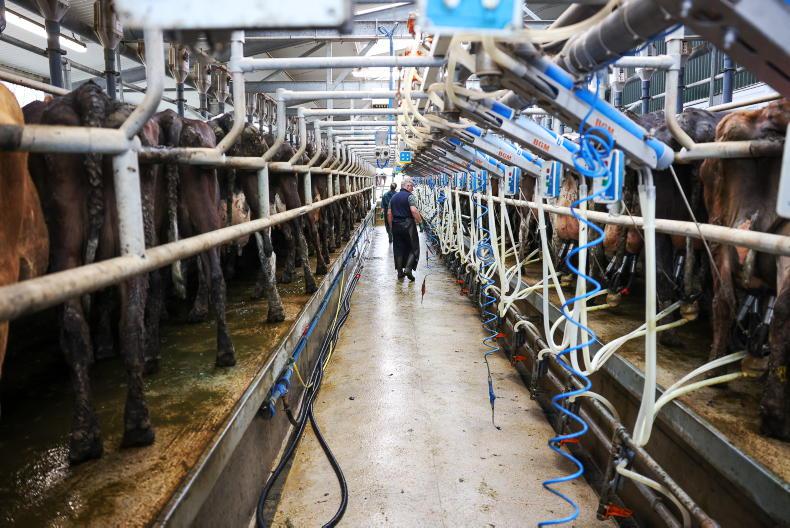
We are milking the 27 with a six-unit temporary milking machine. Oliver and Gary Peake installed the parlour and 650 gallon bulk tank in a single bay of an existing slatted shed. During milking, the cows stand side-by-side on a slightly elevated platform, at the back of the slatted pen, with their backsides facing towards the feed passage. The clusters are attached from inside the slatted pen.
The temporary machine was necessary for a number of reasons. Firstly, we could not begin work on our new milking parlour until we received grant approval. The Dairy Equipment Scheme offers a 40% grant for milking and cooling equipment. We applied for the grant the day after I received the new entrant quota at the end of August. However, we only received approval last week.
Secondly, to obtain finance from the bank, I am required to have planning permission for all new buildings. Planning permission approval takes a minimum of three months from the date of submission. Time was not on our side, but we were determined to milk in 2014.
The word ‘temporary’ probably doesn’t do it justice. It is a compact setup, with all the basic necessities. It’s a little unorthodox, but it gets the job done. The heifers don’t know any different and thankfully they have settled in well. We’ll see what it’s really like when the somatic cell count (SCC) and total bacteria count (TBC) test results come back from the co-op.
The milk lorry came for the first time last Thursday. We were collecting milk since Monday and sent 1,093litres in total. Three co-op catchment areas overlap in our locality. After long deliberation, I went with Glanbia. I believe that they will provide the best opportunities for our business in the future. Their decision to drop the 2c/l development levy as well as their generally competitive milk price and excellent co-op feedback, in terms of SCC, protein and fat levels, were some of the main deciding factors.
Making the front cover of the Irish Farmers Journal a fortnight ago was an honour. I appreciate all of the positive comments. However, I don’t think people should be congratulating me. I have achieved nothing yet. The people you should really be congratulating are the established farmers who have been through it all. At the end of the day, I have learned everything I know from these guys. They are my mentors and the people I look up to. I have a long way to go before I am even in the same league.
It is fair to say most of the suckler and tillage farmers I have been talking to over the last year considering converting to milk see around 100 cows as the basic entry level requirement if they are going to go milking. This is especially true if a lot of money has to be borrowed for buying cows, parlour, slurry storage, cubicles and for reseeding etc.
In general, new entrants to dairy should plan cow numbers with a stocking rate of one cow per acre for all the acres around where your milking parlour will be. So if you have 70 to 80 acres around your parlour, then you could and should be aiming to milk 70 to 80 cows in the short term. Of course, you can milk more than this stocking rate, but you will be moving towards a higher input system of milk production. This higher input system can also work but requires higher up-front investment, higher risk, and a higher overall management level.
A cow to the acre, or 2.5 cows per hectare, will allow you graze a spring-calving milking cow, and make enough winter silage while supplementing the milking cow with meal (between 300kg and 500kg of meal per cow). Depending on how much grass you grow, you will need additional area for grazing replacements and don’t underestimate what they will eat.
Be realistic in your figures for the first five years. You won’t hit top targets for milk yields, so aim for middle of the road at around 4,800kg at 3.30% protein and 3.8% fat for a spring calving set up in first couple of years.
Milk price won’t stay at 40 c/litre, so in your plan aim for 28 to 30 c/litre. Interest rates and bank margins are on the increase, so factor in higher repayments. Build in a contingency fund of 20% on the total outlay. It will be spent.
Buy quality stock (close to €200 EBI) so you can get better fertility and better milk solids. Weanlings are already higher in price relative to previous years, as some suckler farmers planning to start milking in 2015 are looking to convert some drystock to weanling dairy replacements. I’ve heard prices of €800 and €900 each for weanling heifers earlier this month and as the year progresses I expect prices for quality stock to continue an upward trend. There may well be quality milking stock for sale later this month, but for many planning to start milking next year it may all come a year too early, unless you plan to suckle Holstein Friesians for a year. Heifer calves are making €450 each and over it for quality, early born AI bred heifer calves.
Estimating costs
If creating a budget for conversion, use the list below as a reminder of some of the potential costs involved and see what costs apply to your farm. You may have some investment in place already so you obviously won’t need everything on this list. Some things can maybe be left for a few years until you get up and going and start bringing in some money.
Remember begin with the end in mind – where you want to end up in ten years time. You might not get what you want in the first five years but you will get there over time instead of going broke in the mean time.
Nobody can say where milk price will go. If you are borrowing, interest rates can only go up so don’t overstretch yourself in the early years when you are learning the trade and exposed to high fixed costs.
Begin site works in spring and aim to do the bulk of the building in spring and summer. Wet building conditions can increase costs substantially and increase the time to complete the job. Working with contractors on a building project is a full time job and takes time so don’t plan for anything else.
Summary list
Planning permissionElectricity connection (3 phase)Engineer/Planner – drawings, mapping, site assessment, development chargesSite excavation – stone filling/levellingMilking (incalf) cowsReplacement heifersReseeding (seed, fertiliser, lime, contracting)Fencing (wire and posts)Water supply & piping & troughsWinter housing & slurry storage Farm roadwaysMilking parlour & collecting/handling yard – includes Bulk tank, Milk pump, plate cooler, water heating, lighting, Silage slabFeed binMachineryLabourWorking capital – money for feed etc before money coming inFarm office – farm computer, phone, internet connectionsContingency – 20% of all aboveVATWater tank/reservoirDiesel tankNew entrant Padraig Keane
on weather and calving
Our eyes and ears have been glued to the weather forecast these past few weeks. It’s the main topic of conversation, as we do our best to get calved cows out to grass. Storm after storm reminds us that we have no control over this external force of nature. All we can do is work with the weather, dodging the rain clouds by on-off grazing.
Since the end of January, we have 27 heifers calved. So far, the count is 15 bull calves and 12 heifers. At one stage, I was getting a little worried, with 14 bulls and eight heifers. Thankfully, it is beginning to balance up. We can’t complain. Calving has gone well to date. All calves were born alive and well.
However, we did lose one calf. I watched the cow calve a big black bull calf. After spraying his naval with iodine, I went to the parlour to get a bottle for colostrum. When I got back to the calving shed, the cow was lying on the calf’s head. I got her up as soon as I could but it was too late. I was sickened. Every calf since has been taken away from its mother immediately. Lesson learned.
As mentioned above, the milking cows are out on grass during the day (weather permitting). They are also getting 4kg of an 18% dairy nut (UFL of 0.96 with PDIN and PDIE of 119 and 112, respectively) and baled silage. The 18 heifers left to calve are on ad-lib pit silage (65 DMD) and 1kg of dry cow ration. We are feeding the heifer calves three litres of whole milk twice a day. This will continue until we run out of colostrum and transition milk and then we will switch to milk replacer. The 14 bull calves were sold this week for €100. They were bought by a local couple and will be reared on an automatic calf feeder.
We are milking the 27 with a six-unit temporary milking machine. Oliver and Gary Peake installed the parlour and 650 gallon bulk tank in a single bay of an existing slatted shed. During milking, the cows stand side-by-side on a slightly elevated platform, at the back of the slatted pen, with their backsides facing towards the feed passage. The clusters are attached from inside the slatted pen.
The temporary machine was necessary for a number of reasons. Firstly, we could not begin work on our new milking parlour until we received grant approval. The Dairy Equipment Scheme offers a 40% grant for milking and cooling equipment. We applied for the grant the day after I received the new entrant quota at the end of August. However, we only received approval last week.
Secondly, to obtain finance from the bank, I am required to have planning permission for all new buildings. Planning permission approval takes a minimum of three months from the date of submission. Time was not on our side, but we were determined to milk in 2014.
The word ‘temporary’ probably doesn’t do it justice. It is a compact setup, with all the basic necessities. It’s a little unorthodox, but it gets the job done. The heifers don’t know any different and thankfully they have settled in well. We’ll see what it’s really like when the somatic cell count (SCC) and total bacteria count (TBC) test results come back from the co-op.
The milk lorry came for the first time last Thursday. We were collecting milk since Monday and sent 1,093litres in total. Three co-op catchment areas overlap in our locality. After long deliberation, I went with Glanbia. I believe that they will provide the best opportunities for our business in the future. Their decision to drop the 2c/l development levy as well as their generally competitive milk price and excellent co-op feedback, in terms of SCC, protein and fat levels, were some of the main deciding factors.
Making the front cover of the Irish Farmers Journal a fortnight ago was an honour. I appreciate all of the positive comments. However, I don’t think people should be congratulating me. I have achieved nothing yet. The people you should really be congratulating are the established farmers who have been through it all. At the end of the day, I have learned everything I know from these guys. They are my mentors and the people I look up to. I have a long way to go before I am even in the same league.






SHARING OPTIONS