



Last weekend saw plenty of showers and torrential rain in some parts, especially in the midlands. A lot of midland farms received over 40mm (2in) of rain during the weekend.
Many farmers who were starting to feel the effects of drought got rain in the nick of time, but some farms that didn’t get the rain are still struggling.
Rainfall has been very hit and miss over the past week. For example, Met Eireann records show that on Friday 18 July, Roches Point in Cork got 1.6mm rainfall, while Cork Airport received 8.6mm on the same day.
These two weather stations are just over 20km apart as the crow flies. This is just a small example of why there can be such a variation in grass growth in areas that are very close together during this warm spell.
This week sees second-cut silage being the main task on farms. The mainly dry weather provides an excellent opportunity to make quality silage, which always pays dividends during the winter.
If your growth rates are strong, do a farm walk and try to identify any strong paddock which could be cut with the main crop of second-cut silage.
Growth rates remain strong this week, ranging between 24kg DM/ha on a Carlow farm that only got 6mm of rain in two weeks, to 131kg DM/ha on a farm in Kerry – huge variations.
Heavily stocked farms will not be taking many paddocks out for silage and some are not taking second-cut silage as they find it a struggle to build autumn grass covers once silage is cut.
Lower-stocked farms can afford to cut paddocks out for silage, but try to complete this earlier rather than later so you give paddocks an opportunity to recover before growth rates drop off. Be careful not to cut out too much in August.
Our farmer in south Tipperary had a lot of heavy showers last weekend. His growth rate is at 64kg DM/ha and demand is 60kg DM/ha. His average farm cover this week is 741kg DM/ha and cover per cow is 198kg. He is stocked at 3.73LU/ha at the moment. Cows are milking 19.13kg at 4.09% fat and 3.51% protein (1.45kg MS).
Southwest Cork reports that the muggy, warm weather is helping grass to really take off. He has a lot of reseeding done and, now that paddocks are coming back into the rotation, it’s becoming difficult to keep grass under control, even with drystock coming on. He has 400 bales made already and the way things are going, he will be making a few hundred more.
Super growth rates again for our farmer in mid-Kerry. He has taken out more paddocks for silage to bring the average farm cover down from a high of 1,215kg DM/ha. Growth rate is huge at 131.5kg DM/ha and cover per cow is 331kg. The pre-grazing cover is 1,580kg DM/ha and demand is 62kg DM/ha. He is stocked at 3.66LU/ha and cows produced 1.55kg milk solids.
Our mid-Clare farmer received 8mm of rain and has a growth rate of 56kg DM/ha. His pre-grazing yield is 1,200kg DM/ha. He has an average farm cover of 660kg DM/ha and cover per cow is 207kg.
Steven Fitzgerald, Farm Manager, Curtins Farm
We are mowing 26ac of strong paddocks (four out of 18) today (Wednesday) and plan on round baling it tomorrow. These paddocks have covers of 1,800kg DM/ha and should yield two bales per acre.
We find it good to clean off these covers by using them for silage and they green up very quickly after cutting.
We sprayed off one paddock earmarked for reseeding and that is being cut today. It will get a mix of 8kg of a hybrid, 8kg Tyrella and 1kg of clover.
Growth rates have been excellent again this week at 78kg DM/ha. This is a combination of warm temperatures, plenty of nitrogen and three hours of rainfall last Saturday.
Cows are milking 18.2 litres at 4.54% fat, 3.62% protein, 4.64% lactose and 171,000 SCC. We have four cows with high cell counts and these will be treated at the weekend.
So far this year, we have grown 10t DM of grass, which is well ahead of last year at 7.9t. The crops of silage have been heavier this year and, on this farm, we haven’t been affected by drought.
DONAL PATTON, FARM MANAGER, BALLYHAISE RESEARCH FARM
We cut five paddocks this week with covers of 2,400kg DM/ha. We will skip another two paddocks this week that have got strong.
Growth rates are still very strong at 95kg DM/ha/day and demand is 60kg DM/ha. Cows are stocked high at 3.94LU/ha this week but this should reduce as the cut paddocks come back into the rotation.
We had good rainfall with a record-breaking 45mm falling in one hour on Saturday night.
The 120 cows are milking 19.3kg at 4.4% fat, 3.55% protein (1.53kg MS). The pre-grazing covers are good at 1,400kg DM/ha. Average farm cover is 695kg DM/ha and cover per cow is 180kg.
We scanned the cows this morning after 10 weeks of breeding. We recorded 50% conception after first service. Of those in-calf cows, the six week in-calf rate is 75%. I usually find that this percentage could increase at calving time because they have shorter gestation periods.
We have also been working on improving road infrastructure to help graze areas that are presently not accessible. One such paddock is on the bank of a river – half of the land is dry and the other half is very wet. In the past, it was impossible to manage this paddock, but the new roadway will split it up nicely.
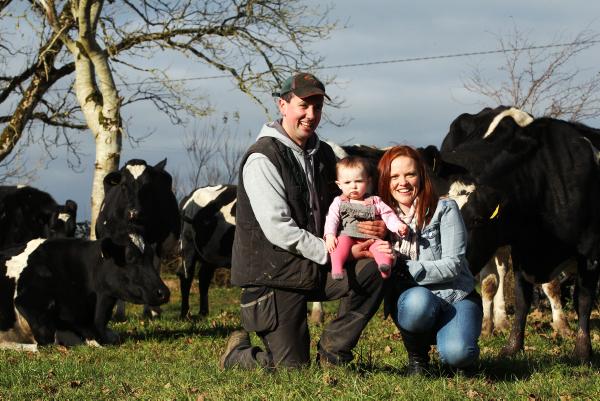
Brian Reidy, wife Caroline and daughter Tori, Tubbercurry, Co Sligo
We are busy today, cutting 47ac for second-cut silage. The average farm cover is 730kg DM/ha and pre-grazing yields are 1,350kg to 1,400kg DM/ha. Cows are entering excellent quality after-grass.
We are spreading 30 units of CAN after cows and growth rates are at 86kg DM/ha/day.
We have had thunder showers over the week that have really helped growths and the last four weeks have seen strong growths of over 80kg DM/ha.
The 127 cows are milking 18.1 litres at 4.31% fat, 3.51% protein and 194,000 SCC. We are feeding 1kg concentrates just to keep up with minerals.
Milk yield is a little lower than you would expect because 65% of the herd are heifers.
We switched to all spring-calving from liquid milk this year. All heifers are contract-reared and 35 cows are leased. We are at week 12 of breeding, which consisted of six weeks of AI followed by six weeks with two Angus bulls. We will continue breeding for another two weeks.
Denis Finnegan, Coachford, Co Cork
Drought has been a major issue for much of July. We hadn’t had any rain since the beginning of July until Saturday evening, when we got up to 2in of rain.
I did my farm walk this morning (Wednesday) and recorded an average growth rate of 54kg DM/ha for the week. I expect this to be much higher since we got the rain, probably up on 100kg DM/ha/day. During the dry spell, cover per livestock unit dropped to 128kg.
Because it dropped so low, I decided to start zero-grazing a field two miles away that was going to be used for second-cut silage. I hated doing this because cows had to stand for long periods on a concrete holding yard while grazing this grass.
Milk solids dropped from 1.67kg to 1.5kg because grass was too strong for grazing. In a quota-free world, I would definitely feed 5kg to 6kg concentrates – it would make financial sense and would be easier on the cows. Since the rain and zero grazing, cover per cow has built back up to 183kg. I plan on lifting this by 100kg per week to build up for the autumn. Second-cut silage will be cut in 10 days. Cows are milking 19 litres at 4.16% fat and 3.54% protein. Last week, my farm turned into a car park for 25 nations because the World Fishing Championships were held on the river Lee. It was a great atmosphere.





SHARING OPTIONS